
The flood of discoveries about grape varieties that has emerged in the last 16 years (see In the beginning was the grape) strongly suggests that the great majority of them are descended from a handful of particularly ancient 'founder varieties'. Their identities are still being established but the following have so far emerged, some of them very surprising. I suggest one or two particularly good examples of them wherever possible.
FRANCE
Pinot is perhaps the best known of the founder varieties. It comes in many different coloured mutations of which Pinot Noir, Pinot Gris/Grigio and Pinot Blanc are the best known. As Pinot Noir it makes hauntingly nuanced, generally light- to medium-bodied fruity reds, most famously in Burgundy but increasingly around the world. As Pinot Grigio it is all too often devoid of any attribute other than popularity. Pinot Blanc is widely grown in Alsace, in south-west Germany as Weissburgunder and in Italy as Pinot Bianco.
Domaine de la Romanée-Conti, La Tâche, Burgundy, France
Armand Rousseau, Le Chambertin, Burgundy, France
Gouais Blanc, ancient eastern French variety almost forgotten until identified as 'the Casanova of grapes' for the sheer number of its progeny. It has been banned several times in France and survives there today only in one non-commercial vineyard in the Haute-Savoie. The finest and most numerous examples are grown, as Gwäss, over the border in Switzerland although it is also known south of the alps where several Piemonte growers cultivate it, some of them calling it Liseirit. It is also grown by Chambers in Rutherglen, Australia. It's light in weight and can have attractive citrus flavours.
Josef-Marie Chanton, Gwäss, Wallis, Switzerland (this is one of the nine wines that Julia, José and I will be showing at the Decanter Masterclass in London on Sunday 18 Nov – find out more here)
Savagnin is best known under that name in Jura, eastern France, where its wines have an attractive nuttiness and a particular affinity for producing the local speciality, vin jaune, that tastes a bit like an alpine sherry. A particularly popular synonym for the variety is Traminer, and the famous Gewürztraminer grape (often without the umlaut) is the aromatic, pink-skinned mutation of it. As Traminer it is particularly popular in Austria, Alto Adige in northern Italy (birthplace of the name, not the variety), eastern Europe and Australia. It turned out recently that cuttings sent to Australia from northern Spain and then disseminated to growers by the quarantine authorities as the fashionable north-west Iberian variety Albariño/Alvarinho are in fact Savagnin.
Dom André et Mireille Tissot, Savagnin, Arbois, Jura
Umathum, Traminer, Burgenland, Austria
Cabernet Franc, more aromatic, graceful and usually lighter-bodied than Cabernet Sauvignon. In Bordeaux it is the third most planted red wine grape after its progenies Merlot and Cabernet Sauvignon, with which it is customarily blended. It is the principal grape of Chinon and Bourgueil in the Loire Valley, where its wines, usually 100% Cabernet Franc, can be quite leafy and herbaceous, although in recent years the vines have tended to ripen more fully. It is widely planted throughout the wine world, often as an ingredient in 'Bordeaux blends', but is valued on its own account in the American states of Virginia, New York and Washington.
Ch Cheval Blanc, St-Émilion, France (Cabernet Franc is blended with Merlot in this great wine and generally plays the dominant role)
Barboursville Reserve Cabernet Franc, Virginia
Mondeuse Noire. My co-author José Vouillamoz has shown that this ancient Savoie variety is either a grandparent or half sibling of Syrah/Shiraz, which explains why one of its important synonyms is Grosse Syrah. It makes Savoie's sturdiest, deepest-coloured reds. In California it was long confused with the north Italian Refosco dal Peduncolo Rosso and vine DNA pioneer Professor Carole Meredith may be the only grower of genuine Mondeuse Noire in the state. She reports its wine is deeper and spicier than her Lagier-Meredith Syrah.
Prieuré St-Christophe, Mondeuse Prestige, Vin de Savoie, France
Dom du Graboz, Le Vin de Bacouni, Switzerland
ITALY
Garganega is the main grape of Soave and was first mentioned in the thirteenth century. DNA profiling shows its close relationship to other important Veneto varieties such as Corvina and Rondinella, thereby confirming its local origins. Much more surprisingly, DNA profiling has shown that it is identical to the Sicilian variety Grecanico Dorato and an almost extinct variety as far away as Catalonia. It also turns out to have parent–offspring relationships with at least eight other Italian varieties including the most-planted white wine grapes in Sicily and Tuscany respectively. This is clearly a key grape, whose wines, if yields are restricted, can recall both lemons and almonds.
Pieropan, La Rocca, Soave Classico, Italy
Anselmi, Capitel Croce, IGT Italy
Nebbiolo is the most distinctive northern Italian red wine grape, most famously producing long-lived, scented but not heavy Barolo and Barbaresco on the Langhe hills of Piemonte but resolutely refusing, so far, to perform with much distinction anywhere else. The first mention of it in Piemonte dates from 1266. The succeeding centuries have allowed the development of several distinct clones such as Nebbiolo Lampia, but Nebbiolo Rosé, long thought to be a clone, has been shown by DNA profiling to be a distinct variety. Because Nebbiolo originated so long ago, it is not known whether it did so in Piemonte, land of white truffles, or in Valtellina to the immediate north because it has so far been shown to have parent–offspring relationships with four varieties in each region. Its parents are almost certainly extinct.
Aldo Conterno, Granbussia, Barolo, Italy
Giuseppe Rinaldi, Brunate-Le Coste Barolo, Italy
Teroldego from Trentino in the far north of Italy is also extremely well connected. Surprisingly, DNA analysis has shown that Dureza from the Ardèche, a parent of Syrah, is a full sibling of Teroldego, and that both are grandchildren of Pinot. Teroldego is therefore an uncle of Syrah, as well as a grandparent of Refosco dal Pedunculo Rosso. Winemaker Elisabetta Foradori, who almost single handedly brought Teroldego to international attention, must be delighted by this news. The variety had been in danger of being abandoned on account of the high acidity of its wines. It needs low yields and very careful handling to produce fine wine, but the Australian example below managed to win a trophy in the 2010 Australian Alternative Varieties Wine Show.
Foradori, Granato Teroldego Rotaliano, Italy
Michelini Teroldego, King Valley, Australia
Luglienga is an ancient, pale-skinned table grape that is grown all over Europe but its wine is rare and not particularly interesting. The variety is more notable for its progeny, which include Prié and, more recently, the modern crossing Regner that was one of many bred deliberately by German plant breeders in the early twentieth century to achieve high sugar levels. I have never knowingly encountered a wine made from this variety.
ITALY OR GREECE
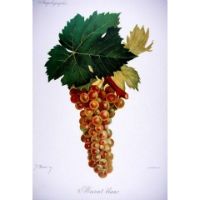
Muscat Blanc à Petits Grains, the small-berried, pale-skinned Muscat pictured above, is the noblest of several Muscat grape varieties (which are the only ones whose wines actually taste like grapes). There is a host of different Muscat, Moscato and Moscatel varieties – in fact we identify 15 different ones in our book. This founder Muscat is grown all over the world, notably in northern Italy, where it is responsible for the likes of Asti and other Moscatos, but it is so old and so widespread that we cite no fewer than 64 current synonyms, most of them beginning with M but a host of them throughout eastern Europe, such as Romania's Tămâioasa Alba, beginning with T. Muscat Blanc is especially good at making strong, sweet wines in southern France and Greece. It is still not known whether it originated in Italy or Greece.
Sergio Degeorgis, Sori del Re, Moscato d'Asti, Italy
Klein Constantia, Vin de Constance, South Africa
SPAIN
Cayetana Blanca is pretty basic white wine grape also known as Pardina and Jaén Blanco in Spain and Mourisco Branco in Portugal's Alentejo on the Spanish border. It is closely related to a number of Portuguese varieties, and to the dark-skinned Juan García that is responsible for some fine reds in north west Spain. No notable wines made from this variety have come my way. Luis could not think of any either.
ALPS (Switzerland and neighbouring regions)
Rèze. Although only a few hectares of this very ancient alpine variety, first mentioned in Switzerland's Valais region in 1313, are grown commercially today, at one time it was much more widely cultivated. Before being replaced by Fendant/Chasselas and Sylvaner after the late-19th-century scourge of phylloxera, Rèze was widely planted in the Valais and was particularly associated with a sherry-like local speciality, Vin du Glacier. DNA profiling suggests that it was once grown in the Savoie and Jura regions of France too – and my co-author José Vouillamoz had established that it has a parent–offspring relationship with at least five Swiss or Italian varieties and it may also be related to Piemonte's Freisa. The few varietal examples that exist are delicate with green-apple aromas.
Josef-Marie Chanton, Resi, Wallis, Switzerland
CROATIA
Tribidrag is also known as Crljenak Kaštelanski and Pribidrag in Croatia, Primitivo in Puglia and, most famously, as Zinfandel in California. As related in In the beginning was the grape, this ancient variety migrated across the Adriatic to Puglia and thence to California – probably via nurserymen in Vienna and New England. Since its origins have been definitively identified as Croatian, it has been enthusiastically planted there, with the total number of known vines having mushroomed from scarcely 20 to more than 200,000. The Zinfandel connection also halted a widespread decline in the area planted with Primitivo in Italy, particularly in its stronghold, the western Salento peninsula in Puglia. But most of the world's plantings are to be found in California, where it is the second most popular variety after Cabernet Sauvignon. Some of these vines are 100 years old in some of the world's oldest vineyards. Wines vary from syrupy pale pink 'White' Zinfandel to spicy, long-lived relics of the state's early Italian immigrants.
Ridge Vineyards, Lytton Springs, Sonoma, California
Morella, La Sorella Primitivo, Salento, Italy
The founder vine varieties
• 7 min read
This is a longer version of an article also published in the Financial Times.


选择方案
会员
$135
/year
适合葡萄酒爱好者
- 存取 296,465 条葡萄酒点评 & 16,124 篇文章
- 存取《牛津葡萄酒指南》及《世界葡萄酒地图集》
- Access askJancis, our AI wine assistant


核心会员
$249
/year
适合收藏家
Everything in “Member”, plus:
- Early access to the latest wine reviews, 48 hours in advance
- Early access to the latest articles, 48 hours in advance
专业版
$299
/year
供个人葡萄酒专业人士使用
- 存取 296,465 条葡萄酒点评 & 16,124 篇文章
- 存取《牛津葡萄酒指南》及《世界葡萄酒地图集》
- Access askJancis, our AI wine assistant
- 提前 48 小时获取最新葡萄酒点评与文章
- 可将最多 25 条葡萄酒点评与评分 用于市场宣传(商业用途)
商务版
$399
/year
供葡萄酒行业企业使用
Everything in “Professional”, plus:
- 可将最多 250 条葡萄酒点评与评分 用于市场宣传(商业用途)
- Access to submit wines for review
- Offer memberships to your employees and manage them from a single place
- API access available for an additional fee
More Free for all

Free for all
路边餐馆的乐趣,作者:查理·吉奥根 (Charlie Geoghegan)。照片由杰森·洛 (Jason Lowe) 拍摄。...

Free for all
首个跨大西洋合资企业作品一号 (Opus One) 涉及20世纪葡萄酒界的标志性人物。本文的一个版本发表于《金融时报》(Financial...

Free for all
突发新闻!老藤登记处 (The Old Vine Registry) 正在打破记录、突破障碍并开辟新天地。现在,老藤登记处标识正式推出。...

Free for all
从世界各地挑选 27 款霞多丽 (Chardonnay) "标志性"酒款,呈献给 18 位认证品鉴师……本文的一个版本发表于金融时报 。另见...
More from JancisRobinson.com

Tasting articles
历史悠久的葡萄园、高海拔、火山土壤和有机种植的结合使这个鲜为人知的 AVA 脱颖而出。上图为 拉塞特酒庄 (Lasseter Winery)...

Tasting articles
来自热浪年份的诱人清新且易饮的葡萄酒。索蒂马诺 (Sottimano) 从科塔 (Cottà) 特级园(如上图所示...
Tasting articles
来自 2022 年份及更早年份的葡萄酒证明了巴巴莱斯科的陈年潜力。 巴巴莱斯科 2022 年份的晚期发布打破了两个误解—...
Wines of the week
一款由前化学家以精确态度和葡萄藤语者灵魂酿造的绿酒 (Vinho Verde) 白葡萄酒。售价 23 美元起,22 英镑起。上图为拉莫斯...

Tasting articles
25种在炎热中保持清爽的方式。 上周欧洲经历了有记录以来最严重的6月热浪;本周,美国东海岸各城市将打破高温记录。在这种炎热中喝什么?水...
Tasting articles
一场垂直品鉴将詹西斯 (Jancis) 带回这款标志性加州红葡萄酒开创性的起点。在伦敦帕尔摩尔街 67 号 (67 Pall Mall...

Don't quote me
遮蔽葡萄藤并提供酒桶的森林风土与葡萄园及其葡萄酒相互关联。上图为托尼·比什 (Tony Bish) 在 法国中部的特龙赛 (Tronçais...
Don't quote me
这个月逐渐演变成一个充满取消和药物治疗的月份。 一些年长的读者可能还记得已故的罗宾·克尼克 (Robin Kernick),他是科尼与巴罗...