Who will make the first wine in China that seriously challenges the world’s finest? As the Chinese make serious incursions into Bordeaux, two top French wine companies are doing their damnedest to make China's first great red.
Many a Chinese wine producer has that aim, and I have so far tasted a handful of wines (mostly, perhaps coincidentally, made in Ningxia province by women) that have come close. I have just made my ninth trip to China and found yet more evidence of the progress being made in Chinese wineries, on which I will report next month. After all, even by 2012 China was the world’s fifth biggest producer of wine by volume.
It is the fact that, according to some measures, China is the world’s single biggest market for red wine that presumably inspired two of France’s most high-profile wine companies to invest directly in China themselves with the aim of making a wine to knock the world’s and then Chinese consumers’ socks off.
Bernard Arnault’s LVMH group may be best known for its brands of fashion (Louis Vuitton, Dior, Givenchy, Céline, Kenzo, DKNY, Marc Jacobs and many more) and champagne (Moët & Chandon, Veuve Clicquot, Krug, etc ) but it is also quite a force in still wine (Cloudy Bay, Cape Mentelle, Terrazas de los Andes, Numanthia, Newton and now Clos des Lambrays in Burgundy). See Cloudy Bay and cousins.
Under the Chandon name, LVMH make sparkling wine in California, Australia, Argentina, Brazil and now India, so it was no great surprise when they announced they were opening a major (and, for China, unusually, starkly modern) winery in Ningxia dedicated to sparkling wine production. Chandon Ningxia is already making some really rather good quality fizz. Now all LVMH has to do is to persuade the Chinese that wine does not have to be red and still. Or, as Jean-Guillaume Prats, who is in charge of LVMH’s non-champagne wine portfolio, puts it, ‘we are working to create rituals of consumption. This will be the key driving force’.
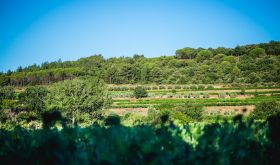
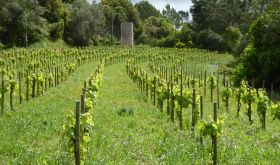
But he and LVMH want to do more than this. They gave Australian wine scientist Tony Jordan four years to scout out the most suitable part of China for tip-top red wine production and have accordingly for the last three years been setting down roots in Yunnan in the far south of the country. Their chosen vineyards are in four tiny mountain villages in the upper Mekong Valley, where Christian missionaries had already established small-scale viticulture in a dramatic setting overlooked by the Himalayas and just 35 km from the Tibetan border. See China’s new wine frontier.
The air and scenery are breathtaking here but logistics are a nightmare. It is four (and was 11) hours’ difficult drive from the nearest town of any size, Shangri La, and any seriously competent electrician, for instance. But it has the great advantage over most Chinese wine regions that winters are so mild that vines do not have to be laboriously buried every autumn, and the climate is dry enough in summer to make fungal diseases a rarity. But the world's weather never ceases to amaze us. The picture above of cars turned over on the treacherous road to the vineyards from Shangri-La was sent to me by Jean-Guillaume Prats, who reports that this is the first snow he has seen in 12 trips to the region: 'The army is stopping the traffic. They want us to go in a convoy and are wondering why two Frenchmen (Bordelais) are on their own ...'
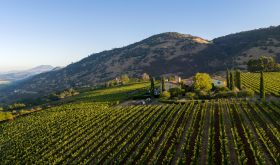
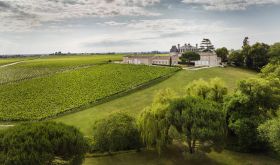
The chosen location of the other particularly ambitious French wine project is at least easier to reach. The owners of Château Lafite had unparalleled success selling their own red bordeaux in the burgeoning Chinese market during its most dramatic period of growth. To return the compliment, as it were, they announced a joint venture with the big Chinese trading company CITIC back in 2008 whereby they would establish a wine estate for the production of a great red in Shandong on China’s east coast where much of the Chinese wine trade is based (useful for imports through the port of Qingdao) but where summers are notoriously wet and often inconveniently stormy.
The Lafite team chose to clear land that had previously been a peanut farm, an operation not without difficulties (and, like the LVMH operation, based on a 50-year lease). It took until 2011 before they were able to start planting and it was only in 2015 that they managed to harvest a serious crop and make it in their own winery for the first time. They are currently working out whether the wine is good enough to represent their first proper commercial release of this as-yet-unnamed wine. The 2013 prototype, made on a small scale elsewhere, was described by Christophe Salin of Domaines Barons de Rothschild at a Masters of Wine symposium in 2014 as ‘not bad, unlike all the other wine grown locally which is bad’.
By contrast, the 2013 vintage of LVMH’s project has just been launched. Ao Yun, a name they are led to believe means 'proud cloud', is available in a grand total of 24,000 bottles carefully and currently being aimed, at a cool €200 a bottle, at wine collectors in the US, UK, Switzerland and France. Next up Hong Kong, Singapore and Japan. And only then, basking in international glory, it is hoped, will the wine be offered in China.
I have long been a critic of wines I deem overpriced, and €200 euros for a bottle of wine without any track record certainly seems pretty steep (albeit an appropriate adjective in view of the landscape responsible for it). But then, as Prats puts its happily, ‘it is very rare in the wine world when you are able to produce a wine with absolutely no competition’.
Many wines claim uniqueness; Ao Yun’s claim is incontestable. The wine is also rather delicious. Boringly, I apparently invoked the same simile when tasting it from bottle for the first time in London last December as I had done when tasting early samples in March 2014 in Yunnan. The wine has the deep colour, savour, freshness and vitality of wines obviously grown at high altitude and reminded me a little of Ribera del Duero (minus the obvious oak that plagues too many of them). It has a certain spiciness and the aroma of the Cabernet Franc that apparently makes up 15% or so of the blend with the inevitable Cabernet Sauvignon makes its presence felt on the persistent finish, but the nose is decidedly sumptuous. The alcohol level is ‘only’ 13.8% and the tannins are admirably soft. The project manager Maxence Dulou’s stint at Cheval Blanc may be in evidence here.
China and France have so far had a rather fractious relationship as far as wine is concerned. In the 1980s when joint ventures were all the rage all over the wine world, most high-profile Chinese wine projects harnessed French expertise, only to dispense with the French connection when the transfer of knowledge and experience was deemed complete.
It will be interesting to see how the Chinese take to these French attempts at a Chinese first growth, and whether there will be sustainable demand for them outside China.