
Before I dive in, I’d like to congratulate Jancis for taking #2 in Drinks Retailing’s list of the 100 most influential people in the UK drinks trade for the second year running. Miles Beale, CEO of the Wine & Spirit Trade Association, took #1. Jancis has said she’s quite happy to have Miles top the list. In her words, ‘He has to lobby government and hardly ever gets to taste wine!’ Congrats to Miles, Jancis and everyone who made the list!
Brutal weather batters vineyards worldwide
The past two weeks have been brutal in terms of weather for France, Greece, South Africa and the US.
Bordeaux lost 30% of their nascent crop across more than 1,500 ha (over 3,700 acres) when hail struck the region on 2 and 3 May. The Libournais (aka the right bank of Bordeaux) and the Entre-Deux-Mers were the hardest hit. While the hailstorms spared the most prestigious right-bank appellations of St-Émilion and Pomerol the surrounding communes of Rauzan, St-Genès-de-Castillon and Tayac were not so lucky.
Also on 2 and 3 May, Jurançon in Southwest France and Quincy and Reuilly in the Centre-Loire experienced hail. In Jurançon, the small stretch between Gan and Jurançon reported 50–70% losses. In Quincy and Reuilly, losses are reported to be around 15–20%.
On 10 May, Gers, north-east of Jurançon, was hit by hail. Lionel Candelon, president of the Gers Chamber of Agriculture, told Vitisphere, ‘There’s nothing left in the fairly narrow, fifty-kilometre corridor from Lupiac to Jegun, then much wider as far as Biran’. Growers in this area report 100% losses.
On 11 and 12 May Champagne saw mild frost damage when temperatures dropped to -1.5 °C (29.3 °F). It remains to be seen if there is any lasting impact. The frost at the end of March was much more severe.
Meanwhile, in Greece temperatures dropped below 0 °C (32 °F) on 4 May, devastating vineyards in Nemea and Mantinia in the Peloponnese. Konstantinos Mitravelas, winemaker for Mitravelas Estate, told Yiannis Karakasis MW of Greek Wine Explained that around 800–900 ha (roughly 2,000–2,200 acres) have been damaged in Nemea. President of the Nemea Winemakers Association, Nikos Vlachos, was quoted saying, ‘In many places, the damage is 100 per cent, in others, 50 per cent. It is clear that this is a major loss, but its full extent across the zone will be clearer next week.’ Mantinia suffered even worse damage than Nemea with Aris Tselepos of Tselepos Wines quoted saying, ‘Mantinia has been hit everywhere. No area has been left untouched. The first images are discouraging, but a realistic assessment can only be made in three weeks …’.
South Africa, whose trade body Wines of South Africa (WOSA) published their end of harvest report on 13 May, saw severe storms hit the Western Cape on 9 May. The Robertson region was particularly affected with many producers reporting severe flooding on 11 May. While the 2026 harvest is safely in tank, the region lost valuable infrastructure. Wineries flooded, new vineyard plantings washed away and, in at least one case, existing stocks of wines were submerged. If you’d like to help, producers in Robertson are asking the public to buy Robertson wines.
Finally, while not as dramatic as the events in France, Greece and South Africa, the US’s Washington State has declared a statewide drought that will likely require winegrowers to reduce irrigation going into the growing season.
Latest global wine statistics from the OIV
On 12 May the OIV (Organisation Internationale de la Vigne et du Vin) released its overview of the state of the world wine sector in 2025.
Total global vineyard area contracted by 0.8% to 7 million hectares (17 million acres) due to uprooting in both hemispheres. France, Spain, Turkey, Chile, Argentina and the US account for the largest decreases. India and Brazil are the only countries to have notably expanded their vineyard area.
Total wine production increased by 0.6% to an estimated 227 million hectolitres. This is still a decrease of 9.4% on the five-year average. Severe weather is the top contributor to sliding production, followed by decreased vineyard area.
Total wine consumption decreased by 2.7%. China, France and the US account for the largest share of this decrease. Portugal, Brazil, Japan, Romania, Austria and the Czech Republic saw increased wine consumption.
Total wine exports decreased by 4.7% in volume and 6.7% in value, with declines in every major wine market save for Portugal and New Zealand. This is largely due to tariff-related uncertainty surrounding the US market. The average price of wine exported declined by 2.1%. Nonetheless, the OIV reports that nearly one bottle in two is consumed outside its country of origin.
Chianti rosé and other proposals
I missed this piece of news last November. Chianti DOCG is updating regulations. Among the proposed updates is a new rosé category (previously rosé from Chianti was labelled as Toscana IGT) which requires 50% Sangiovese. Also in the pipeline is a reduction in the required percentage of Sangiovese in red Chianti DOCG from 70% to 60%; a new sub-area called Terre di Vinci in the commune of Florence; a new minimum planting density of 4,100 vines per hectare and a reduction on required acidity levels. These changes still need to be approved by the Ministry of Agriculture. This is just one of several changes to Italian wine law; check out Italian Wine Central for more.
Scholarship opportunities for wine students
On 6 May applications for the Barca-Velha Golden Vines MW Scholarships opened. Applicants must already be enrolled in the MW programme or meet all entry requirements. The two candidates who are selected for this scholarship will receive £35,000 in funding. Details for this opportunity (and the following ones) will be linked in the transcript of this newscast.
On 27 April the Becky Wasserman BIMPOC Wine Symposium scholarships opened. These scholarships will take four individuals to Burgundy for a week in late April of 2027. Applications close on 22 June.
Upcoming US wine events
The annual Rhone Rangers event – celebrating Rhône varieties grown in the United States – will be held on 13 June in McMinnville, Oregon. You can find a 10% discount code for the grand tasting in the forum on our website.
Santa Barbara’s newest wine conference, the Mindset Regeneration and Resilience Symposium, will be held at Cambria Winery and Vineyard from 8 to 10 June. The symposium will focus on farming for soil health, water retention and biodiversity, building ecosystem and economic resilience and empowering winegrowers to step forward as industry leaders in regenerative viticulture.
Wine News going on break
That’s all for this episode of the wine news. This newscast will be taking a break for the summer while I focus my efforts on US wine coverage. As much as I love writing up and delivering the wine news, it is an enormous amount of work that is only sustained by membership support. If you’d like to see this newscast resume in the fall it would be immensely helpful to me if you would do two things. The first is to become a member of JancisRobinson.com. The second is to post in our members-only forum (and yes, I do need it to be in the members forum – not on social media or podcast platforms) that you’d like the Wine News in 5 to continue. If we have enough members who’d like to see this newscast continue, we will keep it. Otherwise, it is very likely that I will need spend my time elsewhere. Thank you guys so much for listening and watching for the last two and a half years! I hope to be back in the fall!
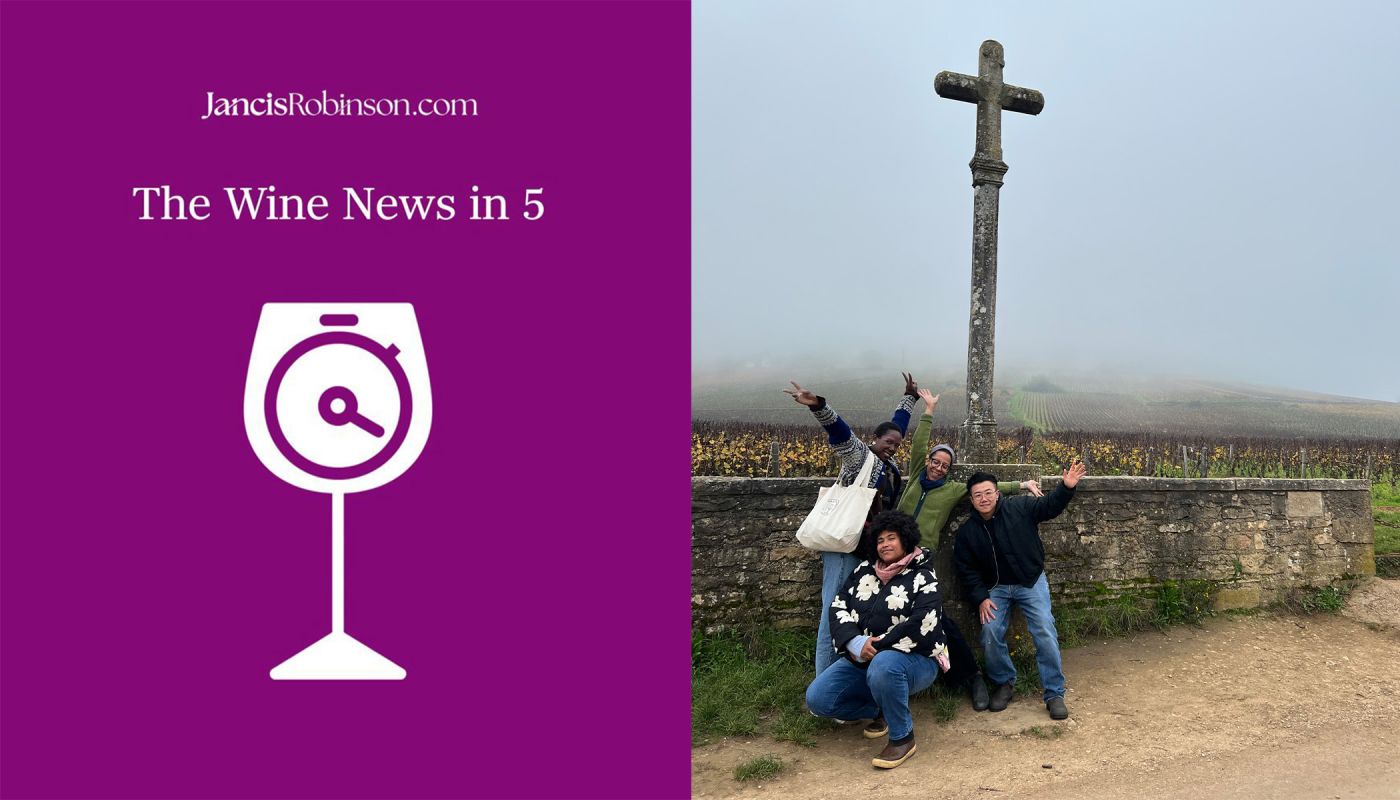
Photo at top of Loris Jones Randolph, Brittany Graham, Crys Chen and Justin Trabue, recipients of the Becky Wasserman BIMPOC 2026 scholarship, courtesy Becky Wasserman & Co.
This is a transcript of our regular five-minute news broadcast, which you can watch below. You can also listen to it on The Wine News in 5 Podcast. If you enjoy this content and would like to see more like it, please become a member of our site and subscribe to our weekly newsletter.