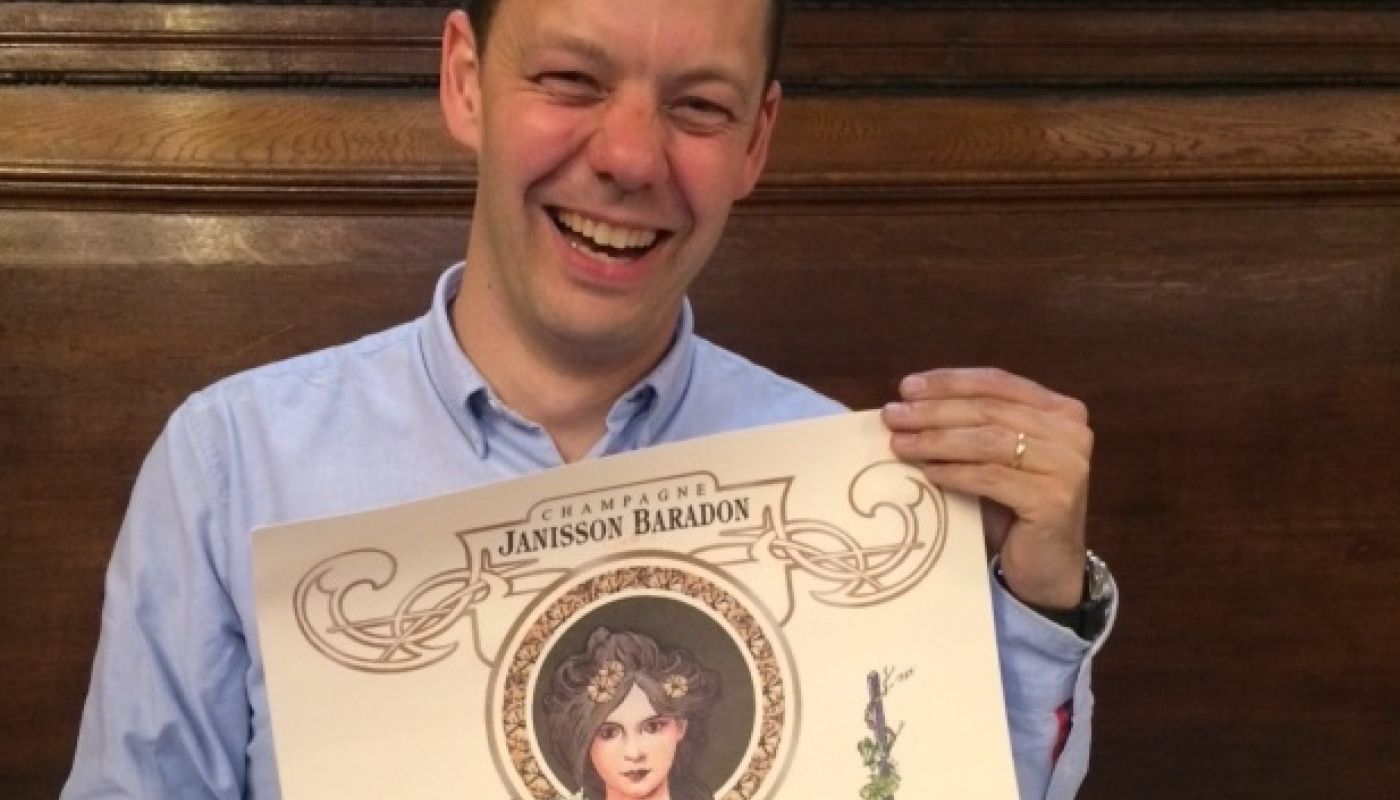
Cyril Janisson of Janisson-Baradon (pictured with an old poster) was not going to bother to come to London to present his champagnes at a tasting in Vintners’ Hall at the end of last month. ‘I decided to come only yesterday’, he confessed, pouring me a taste of Conges 2006 made from Pinot Meunier grown in the vineyard behind his house in Épernay. ‘But when I saw who was here I decided I should come.’ He nodded admiringly at the other 14 producers, all busy introducing the clients of Berry Bros & Rudd to a quite different sort of champagne.
Although long a fixture in French homes, champagne from small-scale vine growers rather than from world-famous brand owners is a relatively new phenomenon on export markets. The wines have many advantages. Their traceability and ability to express a particular vintage, village or even vineyard rather than being blended into a consistent house style very much chimes with the current zeitgeist. Most of these growers produce an intriguing range of wines that are very different from each other – quite unlike the typical big champagne house that may well make only big volumes of a non-vintage blend, a vintage-dated champagne and a rosé. Such diversity is catnip for wine enthusiasts, even if potentially more demanding for those charged with selling the wines.
But growers are much readier than most of the big houses to supply full details of their wines. Back labels of growers’ champagnes are often liberally printed with the principal vintage(s) in a non-dated blend, exact provenance of the grapes, whether any oak was used in its ageing, the date it was disgorged (when the sediment of the second, fizz-inducing fermentation in bottle is expelled) and the residual sugar or so-called dosage (getting lower all the time).
So growers’ champagnes, being identified with all this tech spec and, what’s more, with a real live individual attached, have much more of a story to tell. Another advantage has been that, with minimal marketing budgets, they have tended to be markedly less expensive than the well-known champagne brands. It seems to me, however, that growers’ champagnes have been getting more expensive recently – in the UK anyway. Exchange-rate movements surely mean that the wines should have been getting cheaper? Perhaps British merchants are finding them easier to sell and are therefore now seeking a higher margin on them than when they were introducing them to a bemused public much more used to the big names. (Terry Theise points out, in this thread on our forum, that growers themselves have increased their prices steeply recently.)
Vine Trail and then The Sampler were some of the first merchants to bring an array of growers’ champagnes into the UK but the fact that both of the rival St James’s traditional merchants Justerini & Brooks and Berry Bros & Rudd have got in on the act suggests that they are no longer considered niche products.
Berrys’ buyer Simon Field MW even went as far in his written introduction to the company’s offer of ‘artisan champagne’ to draw a parallel with the transformation of Burgundy from being dominated by négociants to the pre-eminence of individual domaines. ‘Champagne is now in the same position as Burgundy was 20 years ago, at the dawn of a brave new world of diversity. Exciting times indeed.’
The most intense among Berrys’ ‘small growers’ (not necessarily physically diminutive) is Eric Rodez, whose wines are imported into the UK by Wine Source and are also sold by Gauntley Wine of Nottingham, The Sampler and Bottle Apostle. Bald with bright blue spectacles, he says he was taught ‘the rigour of blending’ when he worked with Henri Krug, and learnt the importance of expressing the soil from arch-terroirist Marcel Deiss of Alsace. He assured me that ‘today we’re in a world of fools. For the last 25 years I’ve been free whereas my contemporaries are locked into the old ways. I seek minerality, and I’m free to ask questions all the time.’ He deliberately adds very little sulphur, like the natural wine brigade, ages most wines in oak, and is fastidious about using only grape concentrate rather than beet sugar for the final dosage of his substantial wines.
Champagne is not a wine region with an impeccable reputation for sustainability. Indeed an American wine writer friend of mine, used to the healthy vineyards of the Napa Valley, visited Champagne for the first time this spring and declared himself ‘shocked’ by the state of vineyards there. When I first visited them in the late 1970s, they were strewn with rubbish. This, none too soon, has become rarer but, for example, biodynamic viticulture, now popular in many wine regions of the world, is essayed by only a handful of Champagne growers, notably Fleury Père et Fils and Louis Roederer, one of the few big houses able to supply most of their grape needs from their own vineyards.
I asked Cyril Janisson whether he thought vineyard health was improving. ‘I hope so’, he said. ‘I think the younger generation are doing better things. The vines certainly look greener and better than they did 10 or 20 years ago. In Champagne we have the money to make improvements so we need to invest.’
Next to him was Jean-Baptiste Geoffroy, who told me proudly about his own recent investment in the family business René Geoffroy. He used to be based in the village of Cumières but in 2008 was able to buy the premises in Aÿ of the old Collet co-op. He showed me pictures of the handsome house and courtyard on his iPad and I asked whether he had had to cripple himself with debt. ‘It was the price of a small flat in London', he laughed. ‘Besides, I have five daughters, so I needed the room anyway.’
Noticing various well-thumbed guides to London lying around the tasting tables, and noting Simon Field’s comment afterwards about how ‘bemused’ his Champenois guests had been by the dinner he organised for them at Hixter Bankside in an old tin-box factory by Tate Modern, I couldn’t help registering how very different this group of champagne producers was from the corporate crowd that turns up at the grand annual generic tasting of champagne in London.
There is real charm to many of the wines and their makers, but be warned that the letters RM for récoltant-manipulant on a champagne label are no shortcut to quality. There are 16,000 growers in Champagne and only a small proportion are also gifted winemakers. Perhaps the safest shortcut to quality would be to attend the increasingly important series of tastings described recently in Champagne’s young ones strut their stuff now held by various producer groups in Champagne every April and taste for yourself.
CURRENT FAVOURITE GROWERS’ CHAMPAGNES
Except where stated otherwise, most of those top wines listed below are imported into the UK by Vine Trail of Bristol.
Agrapart, L’Avizoise Blanc de Blancs Extra Brut Grand Cru 2008
Raphael et Vincent Bérèche, Blanc de Blancs Extra Brut Premier Cru 2008
Bonnaire, Blanc de Blancs Grand Cru 2005 (£145.98 per six bottles in bond, Berry Bros & Rudd)
Chartogne-Taillet, Orizeaux Extra Brut 2009
La Closerie, Les Béguines Extra Brut NV
Ulysse Collin, Les Roises Blanc de Blancs Extra Brut NV
René Geoffroy, Extra Brut 2004
Jacquesson, Cuvée 738 Extra Brut NV (£366.72 per six bottles in bond, Berry Bros & Rudd)
Janisson Baradon, Grande Réserve
Laherte Frères, Les 7 Extra Brut NV
Guy Larmandier, Cuvée Signe François Vieilles Vignes Blanc de Blancs Grand Cru 2007
Larmandier-Bernier, Longitude Blanc de Blancs Extra Brut Premier Cru (£33.75 Lea & Sandeman)
R&L Legras, Présidence Vieilles Vignes Blanc de Blancs Grand Cru 2007
Marguet Père et Fils, Éléments 10 Extra Brut Grand Cru NV
Marguet Père et Fils, Sapience Extra Brut 2007
Eric Rodez, Blanc de Noirs
Eric Rodez, Cuvée des Grands Vintages (based on 2007)
De Sousa, Blanc de Blancs Grand Cru NV (£163.98 per six bottles in bond, Berry Bros & Rudd)
See also my tasting notes on 91 artisan champagnes.