The late Becky Wasserman was the fairy godmother of modern Burgundy. She nurtured a whole generation or more of young vignerons there and sold their wines to an American market that was, eventually, extremely receptive.
In 2003 she told me about a young man in his twenties who had recently arrived in Vosne-Romanée to reclaim his family’s wine estate. The result was an article that the FT subeditors entitled, with a nod to a TV programme current at the time, The French prince of Belair.
Louis-Michel Liger-Belair is not actually a prince but a count and, unlike many once-titled post-revolutionary Frenchmen, is supremely conscious of it. I caught up with him in late April when he was in London introducing prospective buyers to his 2023s, to survey his journey from novice winemaker with only a handful of vines to someone with a good claim to being Burgundy’s éminence grise.
The impression I had, even more powerfully than when I first met him and on my subsequent annual visits to taste the latest vintage in his increasingly grand first-floor office up a spiral staircase in a turret, was of someone haunted by penury and the obligations of being the seventh Comte Liger-Belair.
The major event in his noble family’s history is their fall from owning 60 ha (148 acres) of Burgundy’s finest vineyards, including one so glorious, La Romanée, that its name had been appended to that of the village, Vosne, the way Gevrey became known as Gevrey-Chambertin because of the status of Le Chambertin vineyard. Not only that, they owned a wine merchant so successful that in the 19th century they shipped serious quantities of wine to Russia, the US and Hong Kong.
But by 1933, during Prohibition in the US and the Great Depression, his family was forced to sell off almost everything, and their home in Burgundy, the Château de Vosne-Romanée bought in 1815 by the first Comte, one of Napoleon’s generals, fell to rack if not ruin.
Louis-Michel’s father Henry also became an army general, which meant a peripatetic upbringing for Louis-Michel. But already at eight years old he knew he wanted to live in Vosne, where the family spent their holidays. ‘I always knew the château was for me because I was the only boy, with three sisters. Just as my son Henry knows he’ll be the eighth Comte.’
Associating wine with near-destitution, Louis-Michel’s late father was decidedly unenthusiastic about his son’s desire to make it and insisted he qualify as an agronomic engineer before embarking on anything so risky.
Liger-Belair arrived to make wine in Vosne in 2000 as a 26-year-old having studied oenology in Dijon but with only the fraction of the family’s original vineyard holdings that had been rescued by his grandfather and a great-uncle from the ignominy of the 1933 public auction. The vines had been let out to sharecroppers, with the produce of La Romanée, for instance, under contract to be sold by négociant Bouchard Père et Fils.
But over time he has gradually re-acquired the rights to grow, make and sell wine from many of the original holdings, including La Romanée, the 2-acre (0.8-ha) grand cru just above the most famous, eponymous grand cru belonging to Domaine de la Romanée-Conti (DRC).
The wines of the Domaine du Comte Liger-Belair exhibit precision and increasing finesse and are now some of Burgundy’s most keenly sought. To keep the wolf from the door initially, he qualified as a land valuer, which has given him unparalleled access to the machinations of vineyard sales on the Côte d’Or, especially his northern sector, the Côte de Nuits. This has doubtless helped his estate expand at an unusually steady rate.
These sales are frequently the result of family disputes since the Napoleonic Code dictates that properties have to be inherited equally by all living family members, and unanimity can be a rare commodity. Over the years, hearing on the bush telegraph about various deals in Burgundy, I have been amazed by how often Liger-Belair seems to have played a part.
He admitted to being involved in LVMH’s purchase of the grand-cru estate Clos des Lambrays. The entrée of a global conglomerate was by no means widely welcomed by all Burgundians but Liger-Belair’s comment to me was, ‘Well at least they’re French.’ But he is also relaxed about the recent influx of vineyard buyers from Asia and the US. ‘What happens in Burgundy today is what happened in Bordeaux 25 years ago. Anyway, it’s just the same as a century ago when rich American wives were sought by poor French noblemen.’
One particular recent personal coup was his late 2021 deal whereby he has the right until 2050 to grow, make and sell some of the wines of the valuable Domaine Lamarche, which has added considerably to his premier cru and grand cru holdings.
I asked him whether he had been inspired by the idea of restitution, or the appeal of Vosne, or the life of a vigneron. For the first time in our encounter he paused, laughed ruefully and motioned towards a couch that might do for Freudian analysis. ‘Yes’, he admitted, ‘there was some notion of restitution. My father Henry was born in 1928 in one of the wealthiest families in Burgundy wine. The family company totally collapsed in 1933 and we became one of the poorest families. I wanted to restore our name back at the top of the wine firmament where it once was.’
To that end, he bought the original family wine merchant company back from négociant Boisset and is now using it for regional burgundies made by participants in a charitable scheme dreamt up by his son, currently in Hong Kong, whereby young incomers to Burgundy are mentored. ‘The idea is to keep and nurture the talent of people who are not the children of local wine families. They can build their own brand and with any luck after six years or so, find someone to back them.’
Liger-Belair Senior is very keen on young people. ‘They are our future.’ He had just hosted a lunch for various Londoners making their way in wine or hospitality. ‘We need to ask them why they don’t drink wine so we can understand the future market better. I did something similar in New York and Paris, too. We have to move from collectors in their seventies and eighties to younger drinkers. It’s a big shift. And it’s like chess. You need to see two moves ahead.’
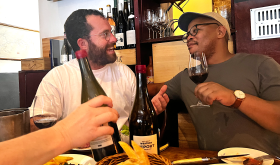
One move he has made to make burgundy more accessible is to open a wine bar in the sleepy village of Vosne, home to a bevy of world-famous wine producers. He has persuaded the locals, including such childhood friends as Jean-Nicolas Méo, Jean-Yves Bizot and Pascal Mugneret, to sell their wines with the most modest of mark-ups at La Cuverie de Vosne.
No discussion of burgundy can avoid the question of price. Thanks to limited supply and what was until recently unlimited demand, burgundy prices soared. La Romanée is priced at thousands of pounds a bottle on the secondary market, rivalling the wines of DRC. Liger-Belair increased his prices very substantially between 2018 and 2020 although, to be fair, his UK importer, burgundy specialist Giles Burke-Gaffney of Justerini & Brooks, points out that, unlike some others, Liger-Belair decides on pricing in conjunction with his customers rather than simply imposing blanket increases.
I would have thought such prices would be hard to justify but Liger-Belair had a go: ‘Prices are so high now not because of me but because of the market. We need to have our share of the business because, apart from anything else, we need to think of the inheritance taxes on our children. For a merchant it takes two minutes to sell a wine. We need three years to make it.’
One addition to the estate in 2012 had been some Chardonnay vines in the Clos des Grandes Vignes Premier Cru in Nuits-St-Georges. I asked him whether, in view of the widely touted current move away from red to white wine, he wasn’t tempted to add more white-wine vineyards. He shook his head forcefully, cognisant of the fact that all of Burgundy’s best whites are grown south of his Côte de Nuits in the Côte de Beaune. ‘I don’t want to have vineyards that far away. I like to be able to see my vineyards from my terrace. I refused the offer of renting some Chambertin [a 10-minute drive north] because my roots are Vosne. I learnt this in 2006 when I had my first Nuits, the Premier Cru Aux Cras. All my clients wanted the Vosne wines first. Besides, making red wine is a sprint: 45 days being in the winery on a daily basis. White winemaking is a marathon: three months’ work and you couldn’t even be away for the weekend.’ He and his Parisian wife Constance treasure their weekend getaway in Évian.
He paused and observed, ‘Naming even five Burgundy estates that are really tip-top in both colours would be difficult. And anyway, I’m from Vosne-Romanée!’ Red is certainly his signature colour, down to all his trousers, which vary, Sloane Ranger style, from pale pink to what he calls bordeaux red. ‘Useful for spills.’
He is now so well known throughout the Côte d’Or that he deliberately shops anonymously in Dijon market north of it rather than in Beaune market in its heartland. And his conversion to biodynamic viticulture in 2008 was inspired not by its many existing practitioners in the Côte de Beaune but by Noël Pinguet, then at Domaine Huet in the Loire. ‘He’s a mathematician’, pointed out the engineer of Vosne approvingly.
When still studying winemaking he worked at Far Niente in Napa Valley and has subsequently advised Rose & Arrow in Oregon and François Massoc’s Aristos label in Chile but gave up both consultancies in 2018. ‘I realised I did it for my ego. In the end I realised that the estate had been going up pretty quickly but then the upward curve slowed down and I realised I should concentrate on the estate. That was a good choice because we have raised the curve since then.’ That curve is presumably measured in euros.
Liger-Belair's climats
With their debut Domaine du Comte Liger-Belair vintage in brackets. See Back to basics below for an explanation of climat and monopole.
Village wines
Vosne-Romanée, La Colombière (2000)
Vosne-Romanée, Clos du Château, Monopole (2000)
Nuits-St-Georges, Les Lavières (2006)
Vosne-Romanée (2006)
Nuits-St-Georges (young vines from Clos des Grandes Vignes) (2017)
Vosne-Romanée, Aux Réas (2022)
Premiers crus
Vosne-Romanée, Chaumes (2000)
Vosne-Romanée, Aux Reignots (2002)
Nuits-St-Georges, Aux Cras (2006)
Vosne-Romanée, Aux Brûlées (2006)
Vosne-Romanée, Les Petits Monts (2006)
Vosne-Romanée, Les Suchots (2006)
Nuits-St-Georges Blanc, Clos des Grandes Vignes, Monopole (2012)
Nuits-St-Georges, Clos des Grandes Vignes, Monopole (2012)
Vosne-Romanée, La Croix Rameaux (2022)
Vosne-Romanée, Aux Malconsorts (2022)
Grands crus
La Romanée (2002), Monopole (2006)
Échezeaux (2006)
Clos Vougeot (2015)
Grands Échezeaux (2022)
Back to basics
| What’s a Burgundy grand cru? |
|
Burgundy is classified quite differently from Bordeaux. In Bordeaux it’s the château, or producer, that is ranked whereas in Burgundy it’s individual vineyards, or climats, which may have many different owners who own just a few rows of vines each. A vineyard with a sole owner is known as a monopole and Comte Liger-Belair’s La Romanée is the smallest monopole of all, and France’s smallest appellation.
It is also classified as a grand cru, Burgundy’s highest rank. There are currently only 32 in the Côte d'Or – seven for white wines and one red (Corton) on the Côte de Beaune and the rest for Côte Nuits reds – although there are always rumours about promotions in the wings. (For a full list, see the Burgundy entry in The Oxford Companion to Wine.)
Next down the ranking, and not usually quite so eye-wateringly expensive, are the premiers crus. There are far more of these, each generally associated with a particular village. So, for instance, Vosne-Romanée, Les Suchots PC or 1er cru is the premier cru Suchots in the village of Vosne. They vary enormously in reputation and some such as Les Amoureuses in Chambolle-Musigny and Clos St-Jacques in Gevrey-Chambertin are regarded as honorary grands crus.
Below premiers crus in ranking are so-called village wines, wines sold simply with a village name, sometimes with the name of a specific vineyard known as a lieu-dit that is not rated as highly as a premier cru (which is always spelled out on the label).
Then the most basic level of burgundy is a regional wine, ie one labelled not with a village name but with an appellation such as Bourgogne (French for Burgundy) or Bourgogne Côte d’Or, a newish appellation designed to indicate wines that were definitely grown on the Côte d’Or, as opposed to being from the Côte Chalonnaise or from the Mâconnais further south – although some Côte d’Or vignerons prefer to stick to the simple ‘Bourgogne’ they have always used. (See this World Atlas of Wine overview map of Burgundy.)
The grands crus tend to be particularly well-situated sites that could be relied on to ripen Burgundy’s Pinot Noir or Chardonnay reliably every vintage. In some particularly hot recent vintages, some of the grand cru wines have been so ripe that some enthusiasts found they lacked the elegance they treasure in fine burgundy. |