The news that there is currently extensive fighting in Lebanon’s Bekaa Valley has effectively doubled the number of places in the Middle East that I have longed to visit but realistically can now see no hope of ever getting to.
The place that even topped Lebanon was the old city of Aleppo in Syria. I’d been told it was a city of charm, its narrow streets full of the aromas of cooking, once the home of ‘Uncle’ Albert, a familiar figure in our Manchester home when I was growing up. But Aleppo was effectively ‘rearranged’ between 2012 and 2016 when over 33,000 buildings were either damaged or destroyed, something I find hard to even contemplate.
Despite all that Lebanon has been through, it is much easier to stay in contact with this country than its neighbour Syria (despite the charms of Domaine Bargylus wines). The Lebanese diaspora is much larger. Their food and wine are more entrenched in the West, as is their love of hospitality. The Lebanese exude a sense of fun and good times which makes their politics incredibly difficult to understand but they find a tremendous outlet in whatever they have to offer. Very rarely is there a Lebanese restaurant devoid of customers having a good time, particularly since Lebanese food has become synonymous with that of the eastern Mediterranean and in a style that is now ubiquitous.
I have over the past month managed to stay in contact with Lebanon as chairman, perhaps for the last time, of the André Simon Awards for the best food and drink book of the previous year. This year’s drinks book award, as voted unanimously, went to Wines of Lebanon: The journey continues, written by Michael Karam and with photographs by Norbert Schiller.
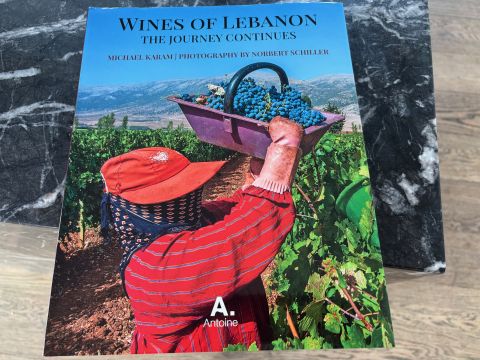
The only criticism that can be levelled at this book is that its format is too large, too unwieldy for anyone travelling through what have been this country’s extensive wine regions (now presumably under threat). But for as long as the fighting continues, this is something that will not bother too many of us.
The photographs are superb, as are the words, but it is the sense of history, of perseverance, of the determination to grow the grapes and to transform them into wine that is the hallmark of this book. War; hardship; persecution, religious or otherwise; occupation and intolerance. This country appears to have witnessed them all, often at the same time. And yet what makes me want to visit Lebanon so much is to try and find the answer to this question: how and why do the Lebanese manage to smile through all of this?
London has always provided plenty of establishments in which to enjoy Lebanese food. When I first arrived in the city, the Edgware Road close to Marble Arch was the epicentre of Lebanese cuisine, with Maroush, Al Dar and Jouri among the eternally popular restaurants. But as the price of oil has risen and incomes along with it, the focus has shifted somewhat to Shepherd Market and Knightsbridge. The latter has become of interest to anyone interested in supercar racing and spotting, a ‘sport’ that reaches its peak in high summer when wealthy Middle Easterners ship their supercars to London and race them around SW1.
Harrods has long held a particular attraction for visitors from the Middle East, perhaps one of the reasons that persuaded the Qatar Investment Authority to pay £1.5 billion to secure it in May 2010. This association certainly explains the popularity of Em Sherif restaurant on its second floor.
Not that the restaurant is free of physical disadvantages. The ceiling throughout the restaurant is extremely low, which is presumably one reason why so much of it is mirrored. There is no lavatory close by and the ones that are in operation on the second floor are quite a walk away from the restaurant, past what seemed to me to be myriad identical menswear concessions, all offering clothes in any colour as long as it was pale brown. In the evening, when this massive department store is closed, access to the restaurant is via door 10 on Hans Road.
Em Sherif, ‘the mother of Sherif’ in Arabic, was founded in Beirut in 2011 by chef Mireille Hayek (whose son is called Sherif) and has now spread to 12 locations across the Middle East and will open a second London outpost on Albemarle Street shortly. She writes a menu that is cleverly aimed at her customers. Here at Harrods – and this was a disappointment for me – there is no offal at all. No chicken livers with pomegranate molasses, a personal favourite. It was the Lebanese interest in ‘nose-to-tail eating’ that fascinated Fergus Henderson and Trevor Gulliver when the prospect of opening a branch of St John restaurant in Beirut first became a possibility 20 years ago: one of those great ‘might have been’ restaurants.
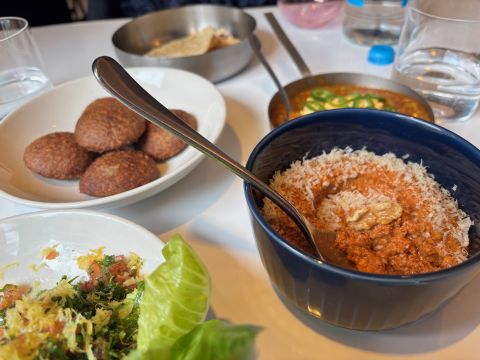
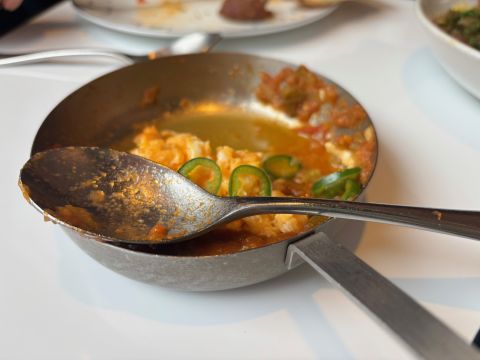
There is no room for such dishes here as the long menu aims for cleaner, some would say more sophisticated, dishes. We chose four savoury dishes: a tabbouleh (shown above in the left foreground) that was just a bit too tart and salty; shakshouka with scrambled eggs (pictured below); a dish of muhammara, the red-pepper-and-walnut dip that seemed to make the (superior) grilled pitta bread disappear; and half a dozen kibbeh, small, perfectly grilled parcels of lamb and bulgur wheat with a crisp outside and a succulent inside. We enjoyed these with water and a glass of pomegranate juice (it was a Saturday lunch closely followed by a wine dinner early that evening).
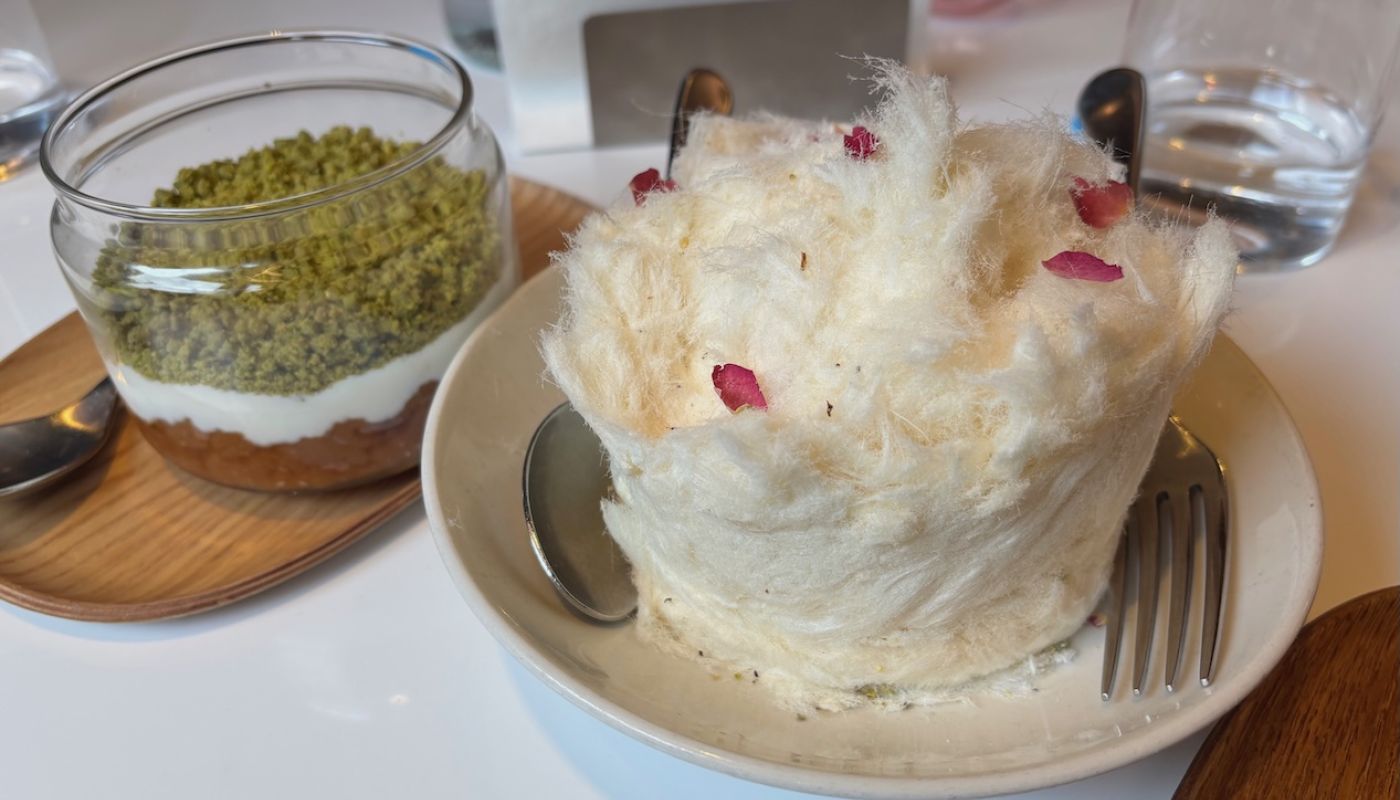
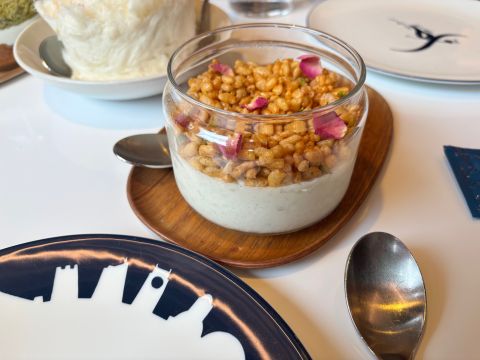
The dessert menu attracted us and, particularly, our friend whose mother was brought up in southern Lebanon. In an attempt to distract her from her concern about the current state of that part of the world, we ordered the signature rice pudding (pictured below); an aysh al saraya, a no-bake bread pudding topped with pistachios and clotted cream; and rose-perfumed cotton candy ice cream (both pictured at the top of this article) that was everyone’s favourite.
With charming service, no alcohol nor coffee, the bill came to £162.47 for three. As I watched a table of two Middle Eastern women popping olives into their mouths, I had the feeling that outside the window was not the grey streets of Knightsbridge but the sunny Corniche with the blue Mediterranean in the distance.
One final piece of information at the very end of Em Sherif’s menu really piqued my interest. It read ‘Our ice cream is supplied by Festok London’ whose website revealed their one and only shop is at 65 Weymouth Street, just round the corner from Marylebone High Street.
Lebanese ice cream is very different from the western version thanks to the presence of booza, mastic gum, which allows the ice cream to be pounded and stretched in a freezer drum rather than churned. The Festok shop is small, but well placed for large takeaway orders, with ‘Lebanese artisanal ice cream and cakes’ printed on its canopy.
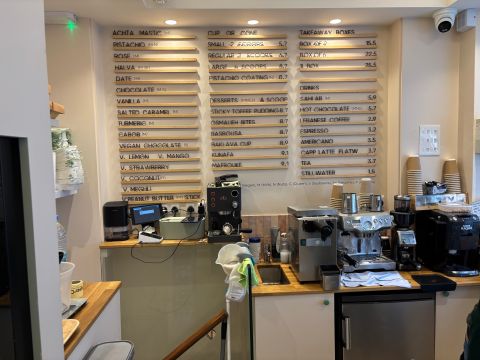
Just as the sun finally broke through the grey clouds, I called in on Festok. It is extremely clean and well managed and from a board full of choices I chose halva (a tad sweet) and achta, made with clotted cream, rosewater and mastic, that was delicious. £5.70 the lot.
So for anyone who misses Lebanon or, like me, yearns to visit, here is Lebanon in London: on the plate and by the scoop.
Wines of Lebanon: The journey continues by Michael Karam, photographs by Norbert Schiller. 348 pp, Antoine; US$80.
Em Sherif second floor, Harrods, 87–135 Brompton Road, Knightsbridge, London SW1X 7XL
Festok 65 Weymouth Street, London W1G 8NU; tel: +44 (0)78 7979 7679. Open 12.30–20.30 daily.