22 September 2012 This is a longer version of an article also published in the Financial Times.
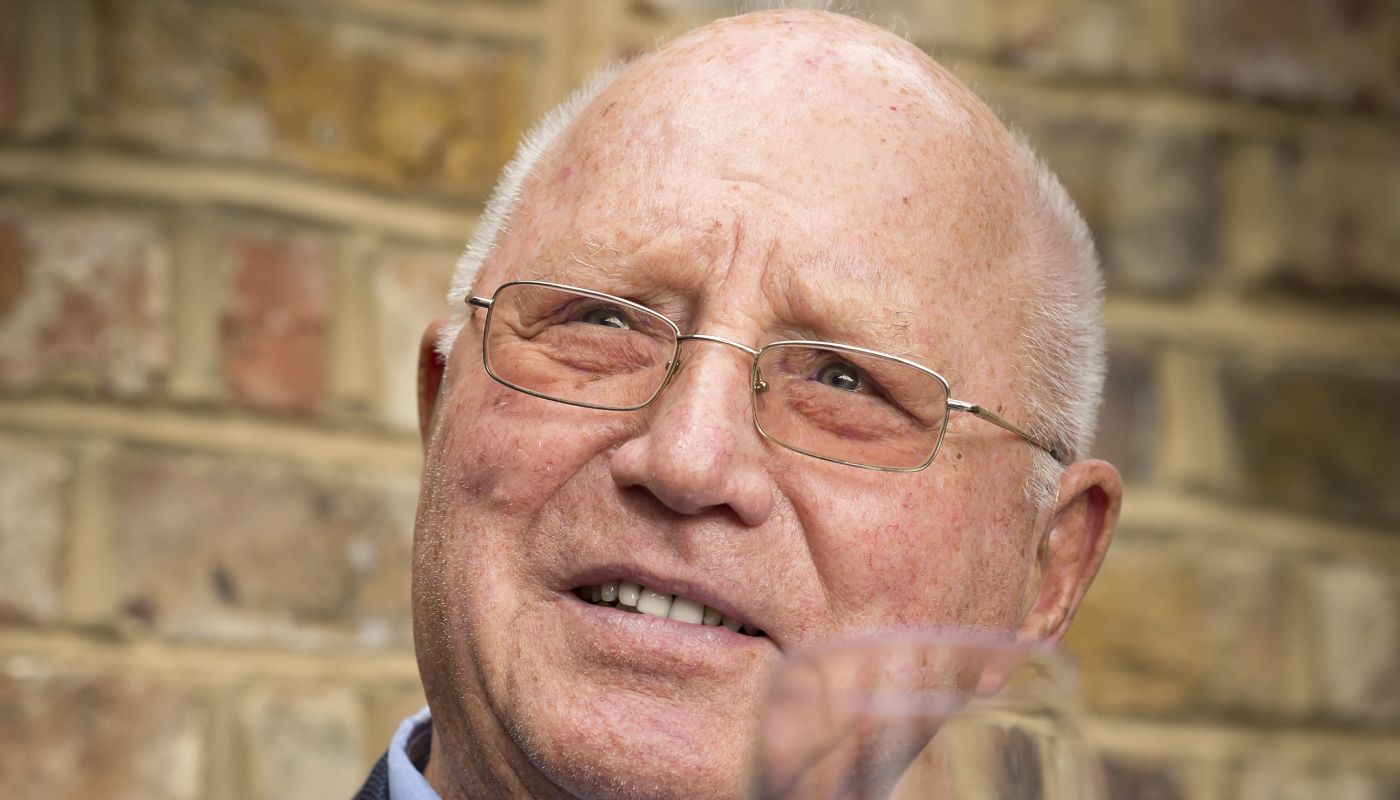
Joseph Berkmann pioneered so many things we now take for granted – popular wine journalism, consumer wine guides, wine clubs, comparative tastings, dinners devoted to a single top estate and, perhaps rather less gloriously, Beaujolais Nouveau. But although he is now 81 and is neither retiring nor retired (he’ll be advancing the cause of London-based Berkmann Wine Cellars in China in October and in Brazil in November), I have never read a profile of him. He holed himself up in Mexico not long ago and wrote his memoirs, only to destroy them because he felt they couldn’t be both accurate and sufficiently flattering. I have tried to write about him several times but he has until now fobbed me off. His colleagues claim he has avoided this sort of spotlight for fear of its seeming valedictory, but he has finally given in, hoping, he says, that what I write will serve as ‘a record to use in the obituary or, much better, on my 100th birthday’.
Although he was born and brought up in the Austrian Tyrol, still has an Austrian passport and a thick, guttural accent, he writes English with enviable facility, claiming to have been tutored by his friend the late Clement Freud. Before we met recently over lunch at his flat in London, he sent me his potted life story. It began, ‘sent to various boarding schools run first by Jesuits and then by Nazis; began work at 14 breaking stones at a river irrigation project; then as a miner drilling holes at 3,000 m altitude; became a waiter to get the girls and never looked back. Lived in Germany, Switzerland, Libya, Rome, New York, Caracas, Istanbul. Invaded UK on 20 May 1956.’
His personal life has certainly been colourful. The oldest of his six sons is the journalist and author 52-year-old Marcus Berkmann. The youngest, Alexander (‘a wizard at computers’), is 11, one of three sons he had with his fourth wife, Aida, from the Ivory Coast. They are all based, as Joseph has been for several decades, near St-Tropez, but now in two houses. ‘We get on much better that way’, he assures me over our lunch, shared with his third, Polish, wife Ewa and their two children Rupert and Catherine, who are in their early thirties. In the evening he was due to dine with his only English wife, Marcus’s mother Jean. His first wife, an older woman he married when working in the hotel business in Istanbul, predeceased him.
An almost incredible tale of trying to escape Libya (‘the only country where you didn’t need an entry visa but you did need an exit visa’) took up most of our first course. He then worked on the Holland America cruise line and picked up the pretensions of what he describes as ‘international French cuisine’. On his arrival in London he parlayed this into opening a restaurant in Marylebone Lane, Le Petit Montmartre, for someone else. In 1958 he opened a French restaurant of his own nearby, Genevieve, without ever having been to France. ‘Just like the other supposedly French restaurateurs in London then, I didn’t have the faintest idea of what real French cuisine was like. We had to wait until the Roux brothers arrived to show us.’ (Later, he was to cite Peter Langan and the Mario of Mario and Franco trattorias as the restaurateurs he most admired.)
He threw himself into restaurateuring with enthusiasm, building up a group that was to include Minotaur, L’Opéra, Lockets, Lafayette, Au Jardin des Gourmets, JB’s Brasserie and part-ownership of the louche Covent Garden club Zanzibar. But he realised that he and his customers needed to learn about wine, so dived next into matters liquid. My predecessor as FT wine correspondent Edmund Penning-Rowsell had in pride of place on the wall of his dining room a signed menu from one of Joseph’s famous wine dinners in the late 1960s, this one devoted to Château Margaux with stylish hand-drawn illustration. In 1971 Berkmann wrote a slim wine primer for customers of Genevieve Wines, the wine company he formed in 1964 to supply his restaurants, subtitled ‘May God and My Wine Merchants Forgive Me!’
But he was interested in writing about all sorts of wines, not just the smart ones. Having been practically brought up on skis, he came to know the editor of the Sunday Times Harold Evans when he was in his ski-mad period (he also claims to have taught Sir David English, late editor of the Daily Mail, to ski and wrote various populist articles about wine for the tabloid in the 1970s, including one involving an attempt to seduce the then Miss World, a fellow-Austrian who turned out to be more thrilled by his friend Michael Parkinson). He told Evans he ought to have a wine club, and in the mid 1970s colonised several pages of the then hugely influential Sunday Times Colour Magazine for a report on the everyday wines on sale in the UK via a giant tasting of them with senior wine luminary Harry Waugh. ‘We made ourselves very unpopular with the wine trade by writing about fraudulent wines, which then made up 60% of UK sales’, according to Joseph today. (Grants of St James’s Bordeaux Rouge at 69p a bottle was one of the few wines to escape their opprobrium.)
Now it was the turn of another craze to grip Berkmann, that of consumer advocate. Much to the dismay of the Consumers’ Association, who by that time were publishing the Good Food Guide, Berkmann nabbed the Good Wine Guide title and embarked on the most exhausting, least profitable enterprise of his life. With his friend, the talented but bibulous Sunday Times journalist Allan Hall, he toured the country buying thousands of bottles off shelves to be sorted, tasted and rated in a rather seedy room they rented above Berwick Street market. He published the Good Wine Guide in 1976 and 1977 ‘but gave up because Allan wouldn’t sober up’.
In the early 1970s, through Waugh, he had taken on the agency for the Beaujolais made in vast quantity by his contemporary Georges Duboeuf. The two of them celebrated the 40th anniversary of a relationship still based only on a handshake last week. His close relationship with Hall and the Sunday Times led to the dubious antics of the annual Beaujolais Nouveau Race, which at one stage was so important that he was physically threatened by a putative winner whose flouting of the rules he unmasked. Throughout the 1970s, he spent much of the time in and around the restaurants and homes of the likes of Duboeuf and friendly chefs Paul Bocuse and Alain Chapel between Burgundy and Lyons. He is a lover of the good life, a great raconteur, a voracious general reader, and remarkably modest in view of his reputation as a taster.
The only boast he made over our lunch was that in the 1970s, with a factory he acquired, 40 years ahead of his time, in east London, ‘I was the biggest producer of meringues in the country’. Pâté production preceded the meringue operation, which had to be sold to pay for his divorce from Jean. At another point, he set up a wine company in New York with the famous Russo-Franco-American wine merchant and author Alexis Lichine, and for long had a bottling plant in southern Beaujolais. Another company he set up more recently, and sold to his ex managing director, is now India’s second biggest wine company, he claims.
His big confession is that ‘I’ve never been a businessman. I’ve never done things for money. I just wanted to do things I was passionate about.’ Although he readily admits that restaurants are much more profitable than the wine business, in 1982, for reasons he can no longer recall, he sold his restaurants ‘too cheaply’ to the Kennedy Brookes group, who then ‘buggered them up’. Since then he has been commuting between various amours, St-Tropez and Berkmann Wine Cellars, his wine distribution company based close to Pentonville prison, where his favourite room is the tasting room.
He laments that he is too interested in the product itself rather than in, for example, the marketing aspect, in which he feels his more successful rival Bibendum Wine excels. His 33-year-old son Rupert now runs the company, although father and son are very close. It was Rupert who cooked the three-course lunch for me, his parents and his sister, who, like Joseph’s second son Justin, also works for Berkmann Wine Cellars. It was Joseph who gently commented that the white Châteauneuf Rupert had chosen had been a bit too heavy for our crab salad first course, and who batted off his children’s prompts about how many languages he speaks and his prowess on skis.
I asked him about the allegations of fraud levelled a few years ago at his lifelong friend Georges Duboeuf and he wearily outlined some of the complexities of the greater Duboeuf family. ‘In every business there are grey areas’, he said, ‘but Georges has always been my best supplier. He never once said “You didn’t sell enough”.’
Joseph Berkmann has witnessed at close quarters the evolution of modern wine. Comparing it with what was on sale when he started out, ‘when more than half the wine was undrinkable’, I wondered whether he thought wine was continuing to improve. Like his late associate Harry Waugh, he is adamant that quality is better than ever, ‘but prices are now crazy; it’s become a lifestyle thing – not like the lovely dinner parties we used to give in St-Tropez, where we’d serve things like Pétrus ‘64 without a second thought’. He and Rupert were particularly sobered by a wine shop they found in Beijing last year which was offering 10 vintages of both Ch Lafite and Ch Latour, all of them at $4,000 each irrespective of vintage, and selling an average of three bottles a week.
A long way from the ‘very beautiful château wine of the 1970 vintage’ about which he enthused in the Daily Mail in the late 1970s at £15 a dozen.