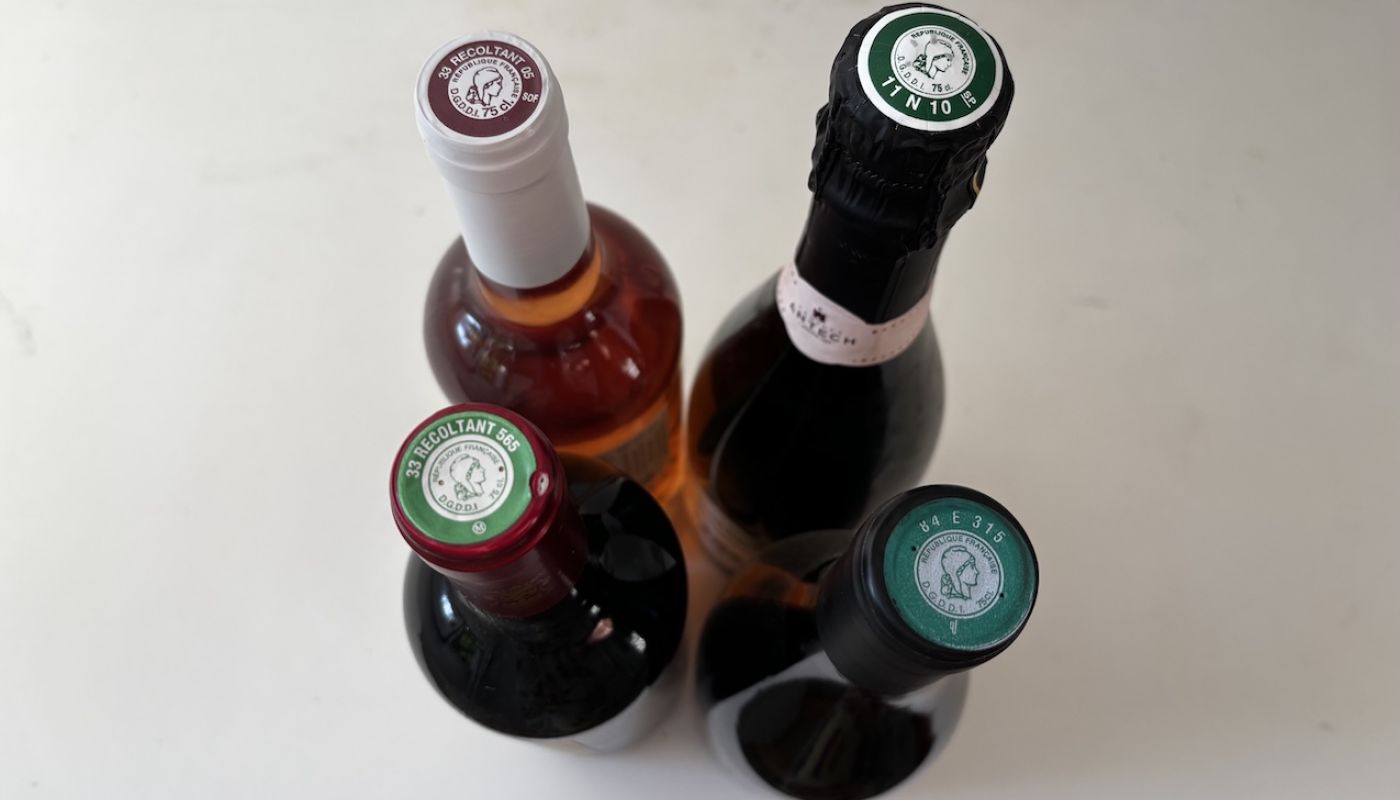
The British have a special relationship with French wine. Until the recent resurgence of viticulture in England and Wales, France was the nearest wine-producing country, after all. Handy for cross-Channel raids to stock up on bottles, many of them topped with that important sign of freedom from the UK’s very much higher alcohol taxes, the capsule-congé with its little portrait of France’s Marianne (see the photo above).
France was the obvious choice for a holiday, or even retirement home. The English community created Promenade des Anglais, Nice’s main drag, more than two centuries ago. They colonised the Dordogne long before settling on Spain’s Costas.
But with Bordeaux it was much more than that. The British have long felt proprietorial about Bordeaux, with good reason. Eleanor of Aquitaine’s dowry on marrying Henry II in the 12th century brought most of south-west France under the English crown, which continued to govern the Bordeaux region for three centuries with Britain the principal export market for Bordeaux wines.
We even have our own name for red bordeaux: claret. Use of the word, instead of ‘bordeaux’, defines a Brit as readily as the word football instead of soccer. (The Bordelais have recently borrowed the name for a new category of light, soft, fruity reds aimed globally and, hopefully, at younger drinkers.)
When auctioneer James Christie conducted his first sale in 1766, it featured considerable quantities of ‘high-flavoured claret’. Exactly two centuries later Christie’s was to play a seminal role in establishing London as the world’s focus for trading in fine wine, largely claret. Bordeaux is France’s leading producer of tradable wine, most of it red, made in quantity and designed to age, making it an ideal commodity for a secondary market.
In 1966, Christie’s was the first London auction house to establish a wine department, headed by the late Michael Broadbent, followed four years later by Sotheby’s. Broadbent was particularly good at ferreting out the venerable contents of dusty cellars around Britain, and London’s wine auctions became so successful that they spawned dozens of fine-wine traders (see below), which went on to sell to collectors all over the globe.
They were, and still are, complemented by top-quality storage facilities, some of them boasting ideal underground conditions, so that collectors were happy to keep their wines in bonded warehouses in the UK, especially if they lived somewhere hotter and without dedicated facilities. In recent years, wine warehouses – generally above-ground and always controlled for temperature and humidity – have proliferated in Bordeaux. But I remember Baroness Philippine de Rothschild of the Bordeaux first growth Château Mouton Rothschild declaiming in the 1990s that her wines always tasted better from an English cellar than from her own in Pauillac.
Even before that, British wine merchants such as Ronald Avery and Harry Waugh, of Avery’s and Harvey’s of Bristol respectively, made regular buying trips to France’s classic wine regions – and introduced Petrus, now the most expensive red bordeaux of all, as well as a host of other Pomerols, to British wine drinkers.
Broadbent of Christie’s not only sold wine, he wrote about it, carefully logging a note on every single wine he tasted, however humble, in a series of little red notebooks. The curated contents of these were eventually published between hardcovers in three unparalleled collections of vinous reminiscences: two volumes of The Great Vintage Wine Book in 1980 and 1991 and Vintage Wine in 2002. Even in his most recent book, more than two-thirds of the wines tasted are French.
But in this century things have changed considerably. The abolition of duty on wine in Hong Kong in 2008, followed by the mushrooming of wine-storage facilities there – together with the extraordinary increase in wine-buying in Asia – saw Hong Kong rival London as the centre of the world’s wine trade, and China and the US overtake the UK as Bordeaux’s most important customers. Billionaires, many of whom are evidently keen on wines at billionaires’ prices, have become even more common in the US than in Asia. The hegemony of the British wine trade has been severely dented, even if it tends to have such a monopoly on mature bordeaux that the Bordeaux wine trade frequently imports wine back across the English Channel.
But the democratisation of wine in the UK means that the British wine market is no longer the preserve of those assembling a cellar of fine wine. British wine drinkers are famously fickle and adventurous (as well as penny-conscious) and their tastes today are by no means confined to the French classics, as a look at any UK supermarket shelf confirms. In 2000, 26.1% of the wine imported into the UK was French. Last year that proportion had declined to under 13%.
Even in the fine-wine sector, French influence has been declining – despite the rise in interest in Burgundy. In 2010, 98% of the wine sold by leading fine-wine trader Farr Vintners was French. By 2025, that proportion had fallen to 75%. Their rival Bordeaux Index (which gave up its attempt to change its name to the less French BI Wine) reports that between 2010 and 2015 its sales of bordeaux became less significant as burgundy, and champagne especially, became far more widely traded on the secondary market and in greater global demand. Trades on the Liv-ex platform confirm this, with the value of burgundy traded in the UK almost equalling that of bordeaux in 2025. Italian wine is of increasing interest, too, representing just 7% of UK trades on Liv-ex in 2015 but 12% last year.
However, wine still figures heavily in the British notion of what makes France French – probably too heavily to be accurate, now that wine drinking in France has been plummeting. When we envisage a holiday in France, sipping wine that is virtually untaxed, unlike at home – and ideally under a sun-dappled arbour of vine leaves – is, for many, an important part of the picture.
On the other hand, we Brits are increasingly aware that we know much more about wine than our counterparts across the Channel. Pre-Brexit there was a massive tide of young French sommeliers eager to work in Britain because they knew they would be exposed to an infinitely wider choice of wines. And, if they were London-based, they would be able to take advantage of far more tasting opportunities than back home. Some days in London there is a choice of four quite different, often extremely comprehensive professional tastings, whereas such events are relatively rare in Paris.
It would perhaps be especially tactless to remind the French of the vital role played by the English in the development of their quintessential sparkling wine, champagne. It was the English who introduced coal-fired furnaces that were much hotter than the French wood-fired versions, and could produce bottles strong enough to resist the pressure of a sparkling wine in them. And it was an English scientist, Christopher Merret, who in 1662 was the first to outline how adding sugar to wine before bottling would reliably provoke a second fermentation, thereby giving off carbon dioxide, which could be trapped in a sufficiently strong bottle. At that time, most of the wines produced in Champagne were still, and those that fizzed, as they sometimes did, were regarded as faulty.
But then the French would probably point out that the first truly successful English sparkling wine was made at Nyetimber by a Frenchman.
Fine-wine traders’ wines
The following all sell mainly classic fine wines, of which most are French classics; but some of them also have other specialities worth recommending.
Farr Vintners
Verget of the Mâconnais
Ch Les Cruzelles and Ch La Chenade of Bordeaux
Kumeu River Chardonnays of NZ
Bordeaux Index
Rose & Arrow of Oregon
Bass Phillip of Victoria, Australia
Berry Bros & Rudd
Leclerc Briant of Champagne
Prager of Austria
Sadie Family of South Africa
Lingua Franca of Oregon
Ramey, Au Bon Climat, Racines and Tensley of California
Justerini & Brooks
Wide range of German and Piemonte producers
Raúl Pérez of north-west Spain
David & Nadia and Lismore Estate of South Africa
Corney & Barrow
Tardieu-Laurent of the Rhône
00 Wines of Oregon
Idahue Estate of Chile
Michelini i Mufatto of Argentina
For tasting notes, scores and suggested drinking dates of wines from these merchants, see our tasting notes database. These traders also sell these wines internationally.
Back to basics
A guide to prominent UK fine-wine traders |
|
Bordeaux Index is perhaps the trader with closest links to finance. It was founded in 1997 by ex-City trader Gary Boom and from 2011 has had City grandee Michael Spencer as chairman. It pioneered a secondary market in champagne, attracting investment from Bollinger. It has its own online trading platform LiveTrade and has diversified into whisky. Farr Vintners was formed almost 20 years earlier and has grown from modest beginnings to be widely respected in much of the world. It was the first (of many) to open a branch in Hong Kong, and has been voluble in its criticism of Bordeaux’s en primeur pricing strategy. Wilkinson Vintners, a London company run by Patrick Wilkinson and ex-Christie’s Paul Bowker, specialises in mature bordeaux, burgundy and vintage port.
Then there are the Big Three, traditional London wine merchants with treasured Royal Warrants and a fine-wine trading division on the side. Berry Bros & Rudd is the oldest and most diversified, with warren-like premises in St James’s, a fine-wine shop, an active events company and wine courses. It also has extensive storage in Basingstoke and investment in the Hambledon English vineyard, alongside a shop in Washington DC and (like the other two) several outposts in Asia. BBX is its trading platform, whereas its St James’s rival, Diageo-owned Justerini & Brooks, has the stocks to operate an active broking business. Corney & Barrow, based east of the Tower of London, is the exclusive UK importer of the hallowed Domaine de la Romanée-Conti and enjoys a chunky allocation of Petrus. It has a department dedicated to broking its customers’ reserves.
Seckford is, unusually, based in the Suffolk countryside and has its own bonded warehouse, an attribute shared only with Berry Bros and a sister company of Lay & Wheeler. Fine + Rare, Goedhuis Waddesdon and Turville Valley also trade in fine wine. |