The nouveaux riches are notoriously soft targets and James Conaway duly has enormous fun with the Sweeneys of Vine Hill winery and their international magpie style of interior decor, and with Garen and Shari Staglin's claim that 'we've got a lot of lifestyle here'.
But most of the book is about the battle for this old land, and specifically the current bitter squabbles about land use. The main issue is whether the vintners of the Napa Valley have ignored conservation issues in their quest for dream wineries and blockbuster wines. This of course makes it a much duller tale than the early snippets about antique rotisseries, 'McMansions', vanity vineyards, red Ferraris and stretch limos. Committee meetings and planning applications are not the stuff of legend and Conaway has to work hard to keep much thread or pace in the book.
He does it by using liberally the extremely irritating device of imaginative hindsight, as in this description of the musings of one of the wicked creators of a hillside vineyard about one of his chief adversaries: 'Beyond the last, highest bit of vineyard, Napa Valley opened up, the foreground sprinkled with live oaks and volcanic rock, Mount Diablo lowering far to the south, and to the right Atlas Peak. Chris Malan's house was down there somewhere. She had come out of nowhere to marshal incredible power, Jayson thought.' How on earth does this ex-Washington Post reporter know what Jayson Pahlmeyer was thinking at that point on that particular Saturday morning?
The book may irritate the general reader but it has irritated Napa Valley's wine producers far more because of the pertinence of the central issue. The vinous posturings of some dot.com millionaires do not matter a great deal in themselves, and some of Conaway's scorn seems to be levelled rather simplistically at wealth per se. But if they are part and parcel of the wholesale destruction of an environment in pursuit of what he dismisses sternly as 'personal gratification', this is more serious. And it is perhaps timely for all of the world's vine-growers to become a little more aware of the environmental effects of their apparently bucolic existence. Toxic winery waste is a serious issue everywhere and nowhere more so than in the Napa Valley with its serious shortage of clean water.
The Napa Valley is a special case partly because it is so exceptionally beautiful, and mainly because it has attracted an unparalleled concentration of well heeled egotists used to getting their own way. Conaway is vitriolic in his descriptions of incomers moving hillsides, consequent erosion and possible pollution, with Pahlmeyer and Della Viader as specific villains. He casts the popular vineyard manager David Abreu as a particular agent of evil, and throws in for good measure the accusation that the powerful American wine critic Robert Parker is too close to him.
The environmental campaigners chronicled by Conaway have already made considerable progress towards devising an ordinance for the greater protection in particular of the waterways in the Valley. The county held a public hearing on it last month which attracted vigorous opposition, less from vintners than realtors [estate agents] whose objections have successfully reduced the proposed setbacks, riparian land designated for planting and erosion control.
This land is typically extremely lucrative planted vineyard at the moment and some of the Valley's most illustrious producers could lose a very substantial proportion of their production. John Shafer, for example, has calculated that if the environmentalists get their way, it will cost him $80,000 a year. There is already tension between oldtimers such as he who planted some slopes in what is now known as the Stags Leap District as long ago as 1972 (and reckons he is owed a bit of precedence) and the more recent arrivals.
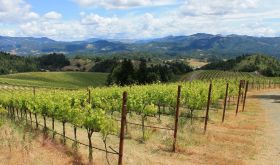
Shafer's most famous wine is Shafer Hillside Select which like all good Napa Valley Cabernets is much more expensive than one would expect at about £200/$300 a bottle for the delicious 1997 vintage. Virgil may have known that vines love hillsides (Bacchus amat colles – because they are less fertile, they produce more concentrated fruit) but many Californians do not. The main reason why so much Napa Valley hillside has been cleared for viticulture is that there is hardly any suitable land left on the much-easier-to-work valley floor. Post-Conaway, the word 'hillside' may carry some negative connotations.
One of the most striking issues concerning Napa Valley viticulture is that of labour, which Conaway unexpectedly almost ignores. The extraordinary fact is that all these fancy wines and even fancier lifestyles are completely dependent on Mexican vineyard workers, many of whom are highly skilled. Nevertheless, while the winery owners sleep in McMansions, those who know how to prune and pick live in very much less salubrious quarters in local suburbs, and some of the seasonal workers even sleep rough.
Much of the proceeds of the famous Napa Valley Wine Auction held each June have gone to fund various clinics for the Valley's low-income families, of whom 70 per cent are Latino. And thanks to a recent initiative these clinics now have access to low-rent accommodation in the form of the Napa Valley Vintners Community Health Center.
But it is heartening to sense the beginnings of some serious flow of capital to this crucial element in the mix that gives us Napa Valley wine. Luis Ochoa is beginning to develop a site on the Napa side of Carneros. The Ceja family is already producing some interesting, particularly delicate, Carneros Pinot Noir while Salvador Renteria and his son Oscar have shown they can produce extremely serious Cabernet and Pinot at the Renteria winery not far from John Shafer's. Shafer has acknowledged a debt to his longstanding winemaker Elias Fernandez, the first Chicano to study oenology at the University of California at Davis, with a Syrah bottling supposedly named after him: Relentless. Rafael Rodriguez, once vineyard manager at the Niebaum estate now owned by Francis Ford Coppola, set up a profitable vineyard management company long ago.
Things are changing in Napa. Not least a new superfluity of grapes – but that did not stop someone offering 36 bottles of the cult Harlan Cabernet from the mid-1990s to a London wine merchant at £475 each last week.