
Alsace cuts yield limits
Last week I reported that Champagne is cutting their yield limits largely because sales have declined and they want to avoid an oversupply and keep prices stable. Now Alsace has followed suit. According to Vitisphere, the general assembly of the Association des viticulteurs d’Alsace, the AVA, has agreed to target a yield of 900,000 hl for both this vintage and 2025. This is in line with projected sales of 918,000 hl for 2024. And to further balance the scales they tightened yields on Gewurztraminer and Pinot Gris, both of which are in oversupply.
Per Vitisphere, the president of the AVA, Gilles Ehrhart, told the assembly that it was necessary to keep values up so that winegrowing will still be a desirable profession for the next generation.
I said it last week, I’ll say it again: I think that regulating yield for both quality and the protection of the profession is a good move. If the whole market collapses, you lose generations of knowledge and infrastructure. Better to limit growth to market capacity.
Australian imports up in China
China’s tariffs on Australian wine lifted just four months ago. On 24 July Chinese wine publication Vino Joy reported that in June, China imported 4.89 million litres of Australian wine – more than from any other country. While this is good news for Australia, the import market has grown only 1.63% by volume compared to the first half of 2023. Which means that the increased volumes of Australian imports have come at the expense of imports from South Africa, France, Spain, Germany and Italy. And while total volume of imports are slightly up, this doesn’t necessarily correlate to sales – which were reported by importers to be sluggish.
All of this is to say, while the Chinese market may offer Australia temporary respite, it’s not a long-term solution. China’s wine consumption has been in free fall since 2017.
A break for British Columbia’s wineries
Back in January, British Columbia experienced a freeze that wiped out 90% of the 2024 crop. On 25 July the Ministry of Public Safety and Solicitor General announced that a temporary measure had been passed to allow BC’s ‘land-based wineries’ or LBWs, which, until this year, have always made and bottled wine entirely from BC-grown grapes, to sell wine made with imported grapes. (This is separate from BC’s ‘commercial licence’ wineries, which have always been able to import grapes.) The measure will last from 1 April 2025 until 31 March 2026.
Now, I recognize that I have often highlighted the importance of checking labels to make certain that the local wine you just bought is in fact local. Wine Growers BC has said that none of the wines produced from internationally imported grapes will be allowed to be labelled as a product of Canada. However, if next year you’re looking at a 2024 bottle of wine from a BC producer and you turn it over it will likely say, ‘blended in Canada with wine from [insert whatever country the producer sourced from]’. I still encourage you to buy these. The only reason this is being done is because these producers will not survive otherwise. They’re not looking for a handout – they’re looking to stay afloat until they can harvest a crop from their vineyards.
Why wine sales are in decline
The drinks-market analysts IWSR released a report on 22 July that sheds light on why wine sales by volume are seeing such a steep decline. As they highlight, the UK drinks 14% less wine than in 2000, Australia drinks 11% less, and France, Italy, Argentina and Spain have all seen consumption decline since the turn of the century. But the number of wine drinkers has grown in many major markets. So what’s happened?
The issue seems to be fourfold:
- moderation is a growing trend, with 67% of wine drinkers between legal minimum drinking age and 27 years moderating intake; 61% of Millennials; 49% of Gen X and 43% of Boomers
- there is increased competition from other categories and younger drinkers are not category-loyal
- younger consumers are simply not drinking as much wine
- and finally, consumers of all ages are trading up to more premium wine but drinking less often.
Lightweighting sparkling-wine bottles
OK, truthfully, this started being announced last April but I’m telling you about it now because it seems that the bottles are finally being produced en masse.
The glass manufacturer Verallia is at the forefront of reducing bottle weights. In 1994 they reduced the weight of champagne bottles from 900 g to 835 g. Four years ago, they started trials for an 800-g bottle (please keep in mind the pressure of champagne necessitates a thicker and thereby heavier bottle). Last year Champagne Telmont finished trialling that bottle and this month it’s ready for mass production. The reduction in weight represents a 4% reduction to each bottle’s carbon emissions. Verallia has promised to share the blueprint with other companies.
And while we’re talking about reducing bottle weights – I highly suggest you go check out Tam’s wine of the week today because it is a snazzy bag-in-box and offers insane reduction in carbon emissions.
A shipwreck full of champagne
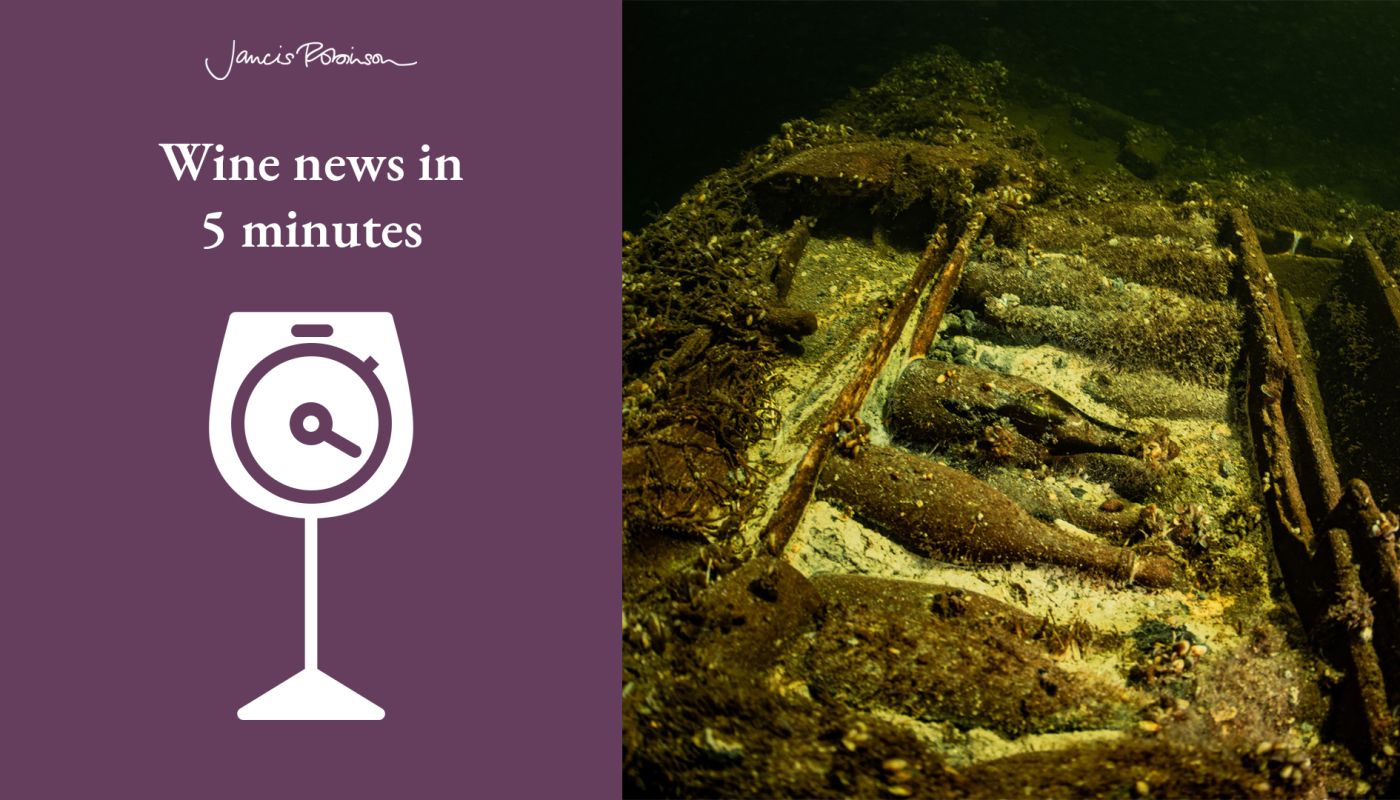
This one is all over mainstream news! On 24 July a group of Polish divers belonging to a company called Baltictech were diving off the coast of Sweden when they found a 19th-century shipwreck about 60 metres deep. The wreck contained around 100 bottles of champagne as well as bottled mineral water and porcelain. On further investigation, inscriptions on the corks indicate that the champagne was most likely produced by Louis Roederer. The seals on the water bottles suggest that the ship sank between 1850 and 1867 and it is thought to have belonged to Russian Tsar Nicholas I or Tsar Alexander II.
While much of the champagne seems to be intact, permissions would need to be granted by Swedish authorities to bring it to shore.
While I generally find the trend of underwater-ageing a bit extra, this is one I’d be very interested in trying!
That’s all for this episode of the wine news. If you enjoy this newscast and would like to see it continue, please consider subscribing to JancisRobinson.com.
This is a transcript of our weekly five-minute news broadcast, which you can watch below. You can also listen to it on The Wine News in 5 Podcast. If you have breaking news in your area, please email [email protected]. And if you enjoy this content and would like to see more like it, please subscribe to our site and our weekly newsletter.