
See my tasting notes on 139 superior current Alsace Rieslings.
It's not just the Greeks who are fearful of the Germans. The wine producers of Alsace in eastern France have reason to be grateful for the German tourists who flock in to buy their wares, but they are starting to be seriously worried about the competition posed by Germany's new generation of dry wines.
For a long time Alsace vintners had the dry Riesling field to themselves. Until recently the Germans made a completely different style of Riesling: light-bodied and fruitily sweet wines rather than the steelier, food-friendly versions for which Alsace has long been famous. But now that German summers are warmer, and Germans see sweetness as a cardinal sin, Riesling grapes can be persuaded to ripen sufficiently to make good dry German wines. So Germany is now the source of a significant amount of top quality dry (trocken) Riesling, including some particularly sought-after examples labelled Grosses Gewächs, a fact that has not escaped international wine markets.
The Alsaciens are feeling the need to put a very obvious stake in the Riesling sand. They may grow all sorts of other grapes too – Gewurztraminer, Pinots of all shades, Sylvaner and a little bit of Muscat – but Riesling is their most planted and most revered variety. They feel as though the Germans have become just a bit too proprietorial about the increasingly fashionable Riesling grape (which the Austrians are also rather good at nowadays).
The result of all this soul-searching was the recent Journée du Riesling, one day earlier this month when the dark exhibition centre of which Colmar is so proud (see above) was invaded by 56 Alsace wine producers invited to show off their finest Rieslings to media, trade and public. Normally events like this are pretty patchy. All the biggest producers, including the most careless merchants and worst-run co-ops, have to be represented for reasons of local politics. But because La Journée du Riesling was the brainchild of an independent Colmar entrepreneur, wine-loving Marc Rinaldi, he was allowed to choose who exhibited.
The result was that I spent the day in Riesling heaven, flitting from peak to peak rather than trudging up foothills, reminding myself just how good Alsace Riesling can be. We tasters were interrupted only once, to hear the inevitable speeches from local worthies whose committees had underwritten the exercise, and from M. Rinaldi himself, who argued, 'our grand cru Rieslings are great wines which should command the same price as top white burgundies. Riesling is dry and I believe that in future people will increasingly seek dry white wines.'
He has managed to assemble an eight-million-euro marketing budget and is particularly keen to aim it at American and Japanese wine media, as well as the best known wine guides. In fact he clearly felt rather miffed that the two French journalists who give their names to the Bettane et Desseauve guide did not actually attend the event themselves but sent a colleague instead.
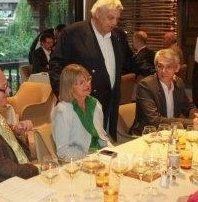
Those of us who had come from Britain, Denmark, Sweden and Norway (Riesling is especially strong in Scandinavia) and were only too keen to taste in person were rewarded in a major way the night before. A dinner with some of the top producers at the famous three-star Auberge de l'Il was devoted to showing how wonderfully well Riesling can age. (The picture above shows Marc Rinaldi standing at the Auberge de l'Ill behind me and Thierry Fritsch of the local Comité Interprofessionnel.)
We started with an 1865 from the Auberge's own cellars that was the most extraordinarily youthful 147 year old. Admittedly there was no proof that it was made from Riesling as varietal labelling was yet to be invented, and it may well have contained some other varieties, too, but it was a heartening start. We fast forwarded over the long period when Alsace was known as Elsass and under domination by You Know Who (twice) to arrive at a most stunningly vibrant 1947 Riesling from the Mandelgarten vineyard made, just off dry, by Preiss. This was a wine that seemed at its peak – at 65 years old!
After that, carefully matched with classic dishes from the Auberge such as mousseline de grenouilles Paul Haeberlin, and ragout de homard Breton aux morilles fraîches et au vieux Riesling, we made a serious impact on the world's remaining reserves of some of Alsace Riesling's greatest hits, wines such as Trimbach's Clos Ste Hune 1995 and 1990 and the Vendange Tardive Hors Choix 1989. Another standout from the 1990 vintage was Domaine Weinbach's Cuvée Sainte Catherine from the Faller family coven, while a 1989 Rangen was the most memorable Riesling from Zind Humbrecht. And the particular joy was that all but the oldest of these wines was served from handsome, tall, fluted magnums.
I learnt several things from the following day's tasting: how well the 2007 Alsace Rieslings are now showing; how expressive the 2009s will be – eventually; how tiny and also backward the 2010 vintage is; and how the 2011s may well be ready before the 2009s and 2010s.
I also learnt about the new appellation Alsace Communale, somewhere between the basic Alsace appellation and the Alsace grands crus, whose boundaries have, as you may imagine, been so hotly disputed. Eleven different communes such as Ottrott, St-Hippolyte and Wolxheim have jumped through the bureaucratic hoops required to establish their own sub-appellations. It is notable that these new communal appellations do not include any of the most famous wine villages; these already have glory in the form of their own grands crus. I'm afraid that, as so often, this new development in labelling will not help the consumer very much. As a local expert observed, 'these 11 villages don't necessarily make better wine than the rest; they're just better organised'. The new and long overdue permission to cite lieux-dts on labels should be more genuinely helpful.
According to Jacky Barthelme of Domaine Albert Mann, the UK market was 'superb' for Alsace wines 15 years ago but those darned New World wines got in the way and it's now very difficult. This is a shame because Alsace can offer some real bargains. Rolly Gassmann, for example, hold on to their wines for an extraordinarily long time. They don't plan to release their Kappelweg Riesling 1990 until 2014, and ask only 19 euros a bottle from the cellar for their delicious Plaenzerreben Riesling 1997. Go, Alsace! But be warned: Germany has the brilliant 2011 vintage up its sleeve.
SOME ALSACE RIESLING OVERPERFORMERS
J B Adam
Agapé
Émile Beyer
Albert Boxler
Agathe Bursin
Marcel Deiss
Josmeyer
Albert Mann
Frédéric Mochel
Ostertag
Rolly Gassmann
Schoffit
Trapet-Alsace
F E Trimbach
Weinbach-Faller
Zind Humbrecht
See my tasting notes on 139 superior current Alsace Rieslings.













