
A horizontal wine tasting is not what many might think. It is of course a comparison of similar wines from a single vintage year. (A vertical tasting is a comparison of the same wine over several different vintages.) After many a stop and start, a horizontal tasting first proposed in 2019 but delayed by lockdowns finally took place last October.
In most horizontal tastings you expect a few disappointments. There will inevitably be some under-performers – especially if the vintage in question is fully mature. Not all wines evolve gracefully. But this particular horizontal tasting was of wines that were 150 and 155 years old. And of the 18 wines in question, only one was in anything other than peak condition. This was nothing short of miraculous.
Wine geeks will already have guessed what the wines were: Madeira, the longest-lived wine of all and one that, so usefully, remains hale and hearty in an opened bottle for as long as it takes you to drain it. Nor do bottles need to be kept horizontal in order to keep the cork damp; bottles of ancient Madeira are quite happy to be stood upright forever since exposure to oxygen, unusually for wine, poses no threat.
This collection of Madeiras from the 1870s (including three 1875s) had been assembled by, as you may imagine, a keen Madeira enthusiast. He began collecting them more than 40 years ago when, as he puts it, ‘they were dirt cheap because no one else was interested’. Nine Madeiras, one from 1795, had been served at his 50th birthday celebration.
Not knowing our host personally in advance, and knowing how many fake, or at least incorrectly labelled, Madeiras there have been on the market, particularly but not exclusively those claiming to come from a solera with an ancient date, I was a little wary when initially approached to lead the tasting. So I sent the list to British Madeira expert Paul Day, who approved of it, identifying most of the wines as having come from an impeccable source, the late Patrick Grubb, who retired as head of Sotheby’s wine department to concentrate on his favourite wine.
Day also gave detailed advice on exactly when to open the bottles and how to prepare them. He advised opening them a full two days in advance to allow any ‘bottle stink’ to dissipate, carefully pouring them off any sediment into a clean decanter, rinsing the bottles carefully and then pouring the wines back into them.
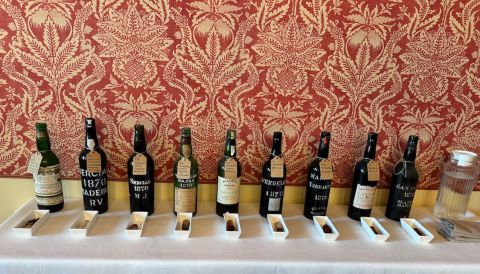
In the event our host, enlisting the help of hardworking local sommeliers, decided to open all the bottles just before the first of two tasting sessions on consecutive mornings so that we could compare the effect of opening the wines an hour or two and 24 hours in advance. Bottles for the first session are shown below, with corks. (Day was right; the wines were even more expressive at the second session.)
Our host’s wife had prepared an illustrated book reminding us what was happening in 1870. The Franco-Prussian war had just begun. The term Impressionism had yet to be coined. Charles Dickens died. Lenin was born. But on the island of Madeira 1870 was a particularly significant vintage. The characteristically tiny vineyards had by now recovered from a devastating outbreak of powdery mildew in the 1850s. But demand for Madeira from across the Atlantic, once hugely significant, had shrunk as a result of the American Civil War in the 1860s. The opening of the Suez Canal in 1869 further diminished the island’s wine trade because far fewer ships called in there.
But worse was to come. The dreaded phylloxera vine-root-munching insect arrived on the island in 1872 and was even more destructive. Vineyards disappeared in favour of the many other crops such as bananas that flourish on this fertile island, and farmers replaced the classic, pale-skinned varieties with the hardier, dark-skinned Tinta Negra. The result was a severe shortage of grapes such as Sercial, Verdelho, Bual, Malvasia, Terrantez and Bastardo and, with no wine regulations in place in such an isolated corner of Europe, the approach to labelling became casual to say the least.
So our 1870s fitted neatly between two viticultural scourges and, with the exception of a Sercial described as Ricardo Vasconcelos Wedding Vintage, gave the assembled 15 tasters (a number that allows generous pours for each from a 75-cl bottle, even one with a lot of sediment) a great deal of pleasure. Thanks to Madeira’s naturally high acidity, we also rose from the tasting table feeling refreshed rather than clobbered by the alcohol.
The 18 wines we tasted included three wines that were not 100% from the 1870 vintage but were labelled 1870 Solera, meaning that they were blends in which the oldest ingredient was an 1870. Interestingly, one of the group’s (and my) two favourite wines was Blandy’s Verdelho Solera 1870. The other group favourite was a wine served blind at the end, D’Oliveiras Malvazia Reserva 1875 bottled in 1999. My personal other favourite was another Verdelho Solera 1870, from Leacock & Co.
Fortunately I have had two opportunities to wallow in my desert-island wine since that October tasting. The first was while tasting for my sweet and/or strong recommendations for Christmas for the FT. The second was a generic Madeira tasting organised in London at the end of November. There are all too few Madeira producers left on the island so it was no surprise that only six of them were represented.
This is partly because, as on that other popular holiday island Santorini in Greece, it is so much more financially attractive to sell land for development than to farm vines. As a result, there are only a few hundred hectares of vineyard on the island. And the situation is exacerbated by the shortage of traditional grape varieties with familiar names.
Nowadays you can be sure that a wine labelled, say, Verdelho really is Verdelho, but the great majority of modern Madeira is made from Tinta Negra, also called Negramoll, the variety that’s planted on a good 80% of all Madeira vineyard and is also common on Spain’s Canary Islands. It doesn’t have the same reputation as the old classics and is only starting to be seen on labels, even though Ricardo Diogo Freitas of Barbeito and H M Borges have made some serious Madeira from it. It is also the basis of the increasing proportion of table wine produced on the island.
The upshot of all this is that Madeira of any quality or style is, justifiably, expensive – especially relative to the port and sherry that are produced in infinitely greater quantity. Blandy’s is the dominant producer, owned by the family who have staked their fortune on many other aspects of the island’s economy. Chris Blandy has taken the wine company in hand and repackaged their 10 Year Old classic bottlings so that they now look extremely handsome, and have a recommended retail price of £39.99 (although they can be found for less). Blandy’s Colheitas, again from each of the four classic grape varieties and currently 2011s, are priced at £90 a bottle, no more than a classed-growth claret of more or less the same age.
Quite apart from the quality of the wines listed here, I particularly enjoyed one aspect of the generic Madeira tasting. When writing tasting notes I usually have to try to work out a suggested drinking window. In the case of Madeira, instead of this I could cheerfully write ‘drink anytime’.
Recommended Madeiras
Dry
Blandy’s 10 Year Old Sercial NV Madeira 19%
£32.95 Fareham Wine Cellar, £34.95 The Whisky Exchange, £148 for six (ex VAT) Turville Valley Wines
Justino’s 10 Year Old Sercial NV Madeira 19%
£42 Quercus Wines
D’Oliveiras Sercial 2013 Madeira 20% (bottled 2024)
£50 (ex VAT) Turville Valley Wines, £79.95 Perfect Cellar
Blandy’s, Sercial Colheita 2011 Madeira 20%
£390 for six in bond VinQuinn
Medium dry
Henriques & Henriques, 5 Year Old Verdelho NV Madeira 19%
£17 for 50 cl Highbury Vintners
Henriques & Henriques, 10 Year Old Verdelho NV Madeira 20%
£22 for 50 cl Tanners
Barbeito, Single Cask Agostino Vineyard Verdelho 2007 Madeira 19.1%
£63.50 for 50 cl Cork of the North
Barbeito, Rainwater Lote Especial NV Madeira 19.1%
£68.50 for 50 cl Cork of the North
Medium sweet
H M Borges, 10 Year Old Boal NV Madeira 19%
£39.95 The Whisky Exchange, £44.50 Clark Foyster
Henriques & Henriques, Medium Rich Single Harvest 1998 Madeira 20%
For 50 cl: £33.99 The Wine Reserve, £41.95 Bacchus N4 Wine, £42.98 Alexander Hadleigh
Blandy’s, Bual Colheita 2011 Madeira 20%
£89.95 The Whisky Exchange
Blandy’s Bual 1994 Madeira 20%
£150 (ex VAT) Turville Valley Wines, £178 in bond Vin Quinn
Sweet
Blandy’s, 10 Year Old Malmsey NV Madeira 19%
£38.99 Taurus Wines, £34.95 The Whisky Exchange, £32.95 Fareham Wine Cellar, £39 Cambridge Wine Merchants, £40 Hedonism
Justino’s, 10 Year Old Malvasia NV Madeira 19%
£42 Quercus Wines, £43 Grape Minds
H M Borges Tinta Negra Doce 2015 Madeira 20%
£46.11 Clark Foyster
Barbeito, Single Cask San Jorge Vineyard Malvasia 2009 Madeira 19.2%
£62.50 for 50 cl Cork of the North
For tasting notes and scores, see Madeira ancient and modern and Strong stuff. For international stockists, see Wine-Searcher.com. See also all of these articles about Madeira.
Back to basics
A Madeira primer |
|
Along with embroidery and Cristiano Ronaldo, wine is one of the most famous products of Madeira, the volcanic Portuguese island in the middle of the Atlantic. Madeira is made, like sherry and port, by adding alcohol to the fermenting grape must so that the wines are generally almost 20% alcohol, and is then aged in cask. But Madeira’s distinction, inspired by what happened to it historically during long voyages in the tropics, is that it is deliberately exposed to heat – which adds depth of flavour to its natural tanginess and explains why it is so robust.
Traditionally Madeira was sold as a varietal wine, named after the grape variety from which it was made. These were the four classic varieties, presented in ascending order of the usual sweetness of the wine made from them:
Today there is a chronic shortage of these pale-skinned grapes and the majority of Madeiras are blends based on the island’s most common grape Negramoll, once known as Tinta Negra or Tinta Negra Mole. Most of them are labelled Dry, Medium Dry, Medium Sweet or Medium Rich, and Sweet or Rich, to vaguely correspond to the four traditional styles, often with an indication of age such as 5 or 10 Years Old.
Madeiras from a single vintage are quite rare today and are labelled Colheita or, for wines aged in cask for more than 20 years, Frasqueira.
Specialist retailers of Madeira in the UK include Cork of the North, Fareham Wine Cellar, Turville Valley Wines, VinQuinn and Vintage Wine & Port.
For delve even deeper, see the Oxford Companion to Wine entry on Madeira. |













