
Michel Rolland 1947–2026
Michel Rolland, arguably the world’s most influential wine consultant, died today, 20 March at 78 years old. While Rolland was born and raised in Bordeaux, his consultancies spanned the globe, with clients in Argentina, Armenia, Italy, Spain, South Africa, New Zealand, Uruguay, India, Croatia and Israel. Our site will publish a short profile on him on Saturday which I hope you’ll read.
Rising oil prices reverberate in wine world
On 28 February the United States and Israel launched coordinated air strikes on Iran, targeting missile infrastructure, military sites and leadership, and killing Iranian supreme leader Ayatollah Ali Khamenei. Iran then launched counterattacks on US and Israeli military bases and energy infrastructure across the Middle East and blocked the Strait of Hormuz, one of the world’s most important oil shipping channels.
The continuing escalation has resulted in thousands of deaths and mass destruction, but I’m here to talk about the wine industry – and the thing that most concerns the wine industry outside of the Middle East is energy prices.
According to AAA, diesel in the US has gone up 39% in the last month and regular petrol has gone up by 33%. According to The Guardian, UK gas prices have more than doubled. The rest of the world is similarly affected.
Natural gas is a key ingredient in the production of nitrogen fertiliser and gas and oil are responsible for most of the energy used to convert aluminium sheets to screwcaps, to melt down sand and soda ash for wine bottles, to run tractors and forklifts, and to transport closures, bottles, barrels and finished wines. As energy costs rise, the prices for all of these inputs rise. This week Pavel Zahariev, sales director for closures firm Herti UK, told The Drinks Business that, ‘some people are already introducing force majeure clauses’ – provisions excusing businesses from prior obligations in the case of uncontrollable circumstances. In this case, clauses are being introduced because previously negotiated prices and timelines are becoming untenable.
Wine shipments between Europe and China have been affected by delays, Australian farmers have been plagued by fuel theft due to rising fuel prices (agribusinesses keep diesel tanks on property to refuel tractors), Ciatti – the world’s largest international broker of bulk wine – and the French publication Vitisphere have both reported ocean carriers implementing war-risk surcharges and nitrogen-based fertiliser costs have gone up by an average of 20%.
Argentina’s declining consumption
Argentina’s annual per-capita consumption of wine fell to 15.7 litres in 2025, its lowest level in history. This is a drastic decline from the height of consumption in 1970, when Argentinians consumed 90 litres per person per year. Between then and now, 3,276 ha (8,095 acres) of vineyards have been removed. Adding additional pressure to the industry, exports declined by 6.8% in 2025, reaching their lowest level since 2004.
Germany’s changing export market
On 16 March, the German Wine Institute (DWI) released their annual export report, showing a 1% growth in volume of wine exports but a 2% decline in the value of exports. Due to Trump’s tariffs, exports to the US, Germany’s top market, fell by 11% in volume to 118,000 hl and 19% in value to €51 million. Growth in exports to Norway, Sweden, Finland, Poland and China have very nearly made up for this shortfall – driven by an increasing market demand for white wines.
California’s declining vineyard acreage
On 13 March, California’s Department of Food and Agriculture released its preliminary report on the 2025 grape crush. 2025 saw a 6.2% decrease in the volume of grapes processed: 1,316,716 tons of white wine grapes were crushed, down 6% from 2024; 1,306,727 tons of red wine grapes were crushed, down 10.8% from 2024. The average price of all varieties dropped by 3.8% to $978.60 per ton. Chardonnay accounted for the largest volume of grapes processed. Cabernet Sauvignon came second. Of California’s main grape varieties, only Sauvignon Blanc and Pinot Gris saw their crush levels increase.
Major US wholesaler enters THC drinks trade
On 19 March Breakthru Beverage Group, one of the US’s largest beverage wholesalers, announced that they would be entering the THC beverage category with Delta-9, hemp-derived THC beverages and edibles. 41 states now allow the sale of Delta-9 beverages and edibles; most allow these products to be sold anywhere that beer or wine could be sold, including gas stations and convenience stores. In the last two years, headlines (here, here, here and here for starters) have declared that consumers are replacing alcohol with THC.
Oregon’s new sparkling-wine organisation
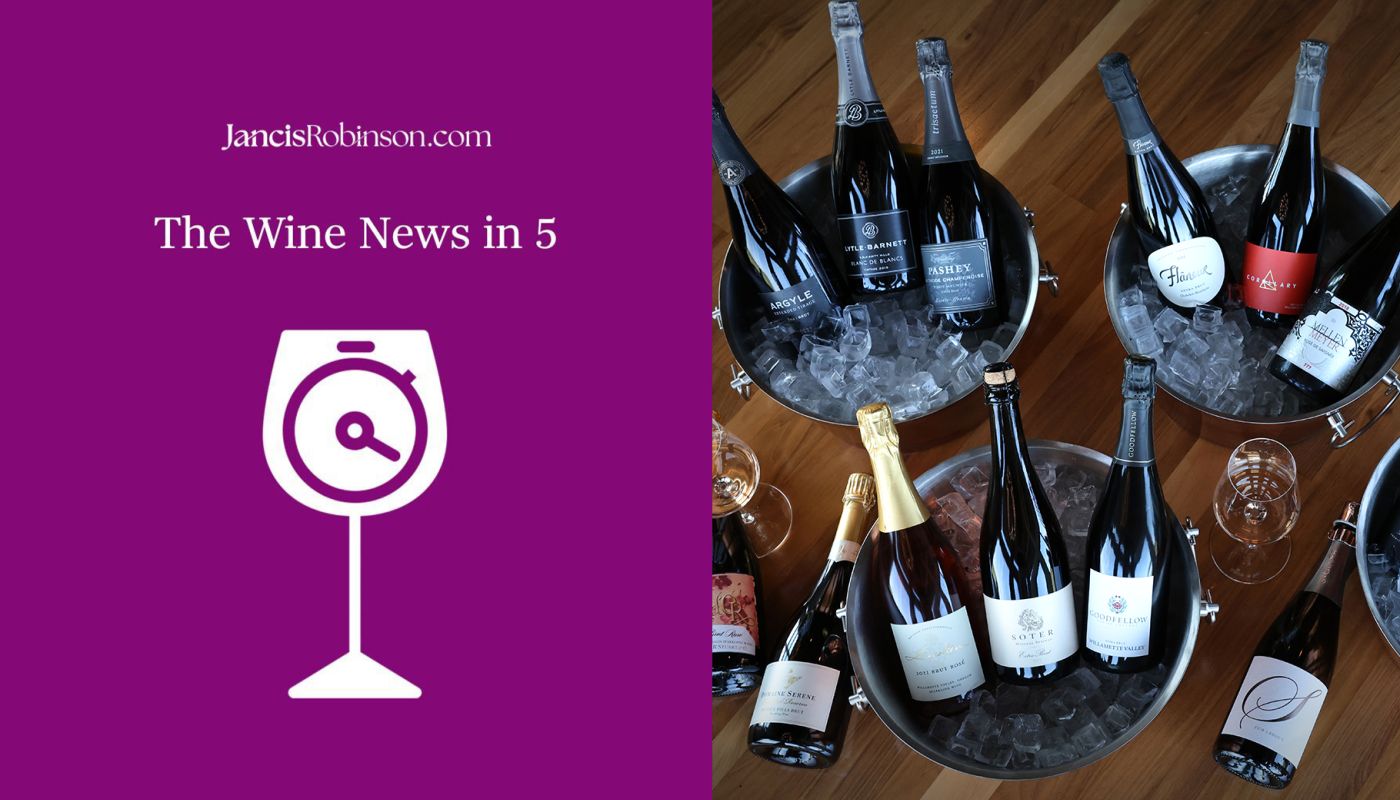
On 17 March I received a press release declaring the launch of Method Oregon, a non-profit organisation establishing a standard for traditional-method sparkling wine in Oregon. The 45 founding producers agree to use 100% Oregon fruit, traditional-method production with secondary fermentation in bottle and to age wines for a minimum of 24 months on lees. Starting in 2029, producers will be required to grow or source fruit farmed only with organic-approved inputs or from LIVE-certified vineyards farmed without synthetic herbicides. Labels will be required to include disgorgement dates and AVA identification. To my knowledge, this is only the second producer’s association outside of Europe to focus on self-regulating the quality of their sparkling wines. The first, of course, was South Africa’s Cap Classique Producers Association. Please do correct me if I’m wrong!*
That’s all for this episode of the wine news. If you enjoy this newscast and would like to see it continue, please become a member of JancisRobinson.com. And if you have breaking news in your area, please email [email protected].
*23/3/2026 Our readers have brought two sparkling wine producers’ associations to my attention – both established well before Method Oregon:
- Pinto Bandeira Wine Producers Association, established in 2001. In 2022, the standards set out by this group became the basis of the first non-European DO for sparkling wines, DO Altos de Pinto Bandeira.
- Méthode Marlborough, established in 2013.
Photo at top from Method Oregon.
This is a transcript of our weekly five-minute news broadcast, which you can watch below. You can also listen to it on The Wine News in 5 Podcast. If you enjoy this content and would like to see more like it, please become a member of our site and subscribe to our weekly newsletter.