Ventoux must be one of the southern French appellations that has changed the most in the last 20 years or so.
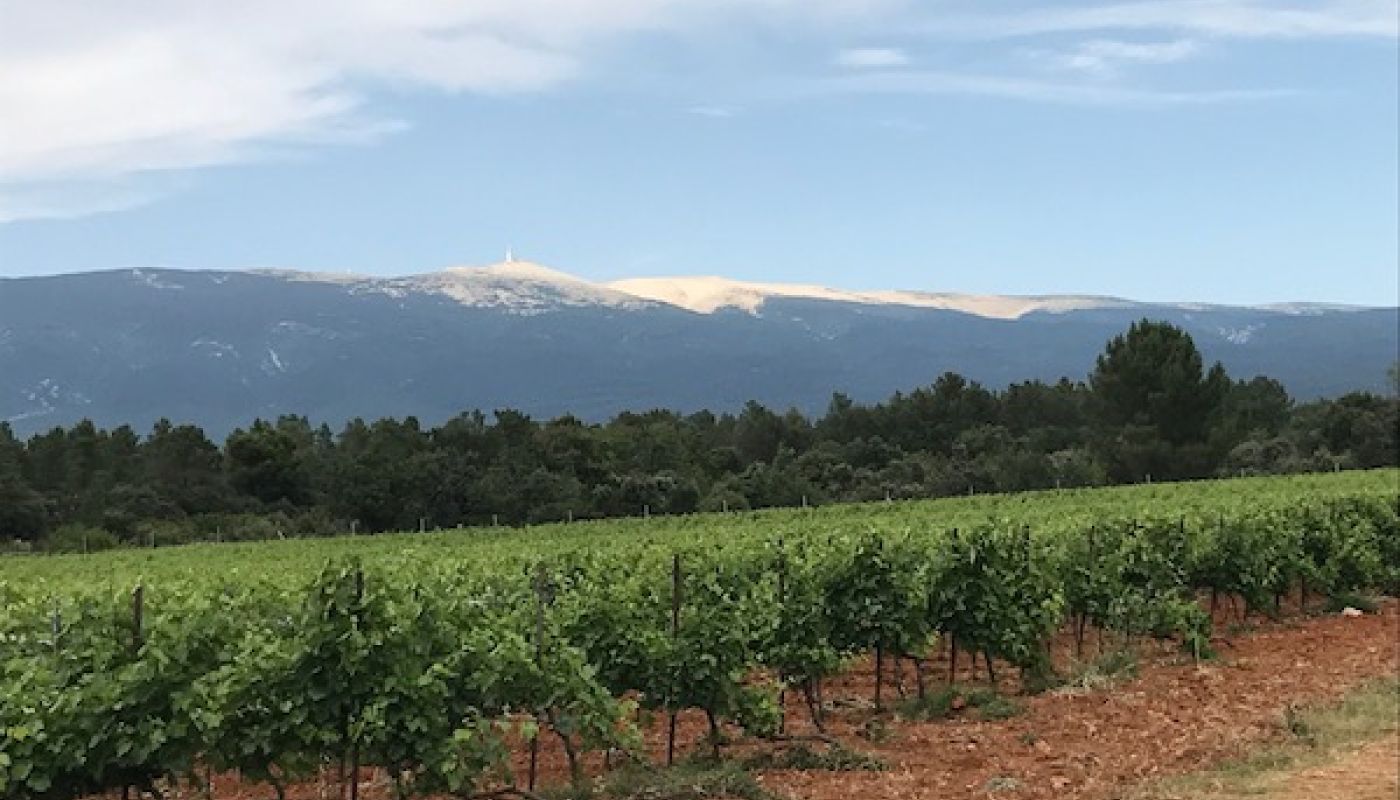
The name has changed for a start, from a tentative Côtes du Ventoux to the proud single word, one that has such resonance for cyclists and armchair followers of the Tour de France. You can see the testing white-tipped cone that is Mont Ventoux from miles around and the local vignerons make much of the cooling influence of this landmark, by far the highest mountain in western Provence.
So cooling was it in the 1970s when I spent a year in the Luberon that the local wines were vapid liquids that only just qualified as reds, but over recent years Ventoux rouge seems to have taken on almost as much colour and body as the Châteauneuf-du-Papes made downhill and west of here.
Such are the taste-able effects of climate change. When I arrived last June at Domaine de Fondrèche, one of the standard bearers of the appellation, Sebastien Vincenti acknowledged that since the mid 1990s ‘climate change has really done us good – but we don’t want any more.’ The outside temperature was 37 ºC (99 ºF). The cicadas had apparently struck up their high-summer soundtrack two days before. He suggested we keep our pre-tasting tramp round the vines to a minimum, although he did point out that the temperature was likely to fall to something closer to 17 ºC at night, thanks to the currents of cool air that descend every evening from Mont Ventoux, as you can see in this diagram on show at Ch Pesquié, one of the appellation's leading lights.

The big difference between Ventoux and the appellations to its immediate west Gigondas and Beaumes-de-Venise is not its varied mix of soil types but climate – particularly and usefully the variation in temperature between day and night. The local town of Carpentras, for instance, is one of the hottest of the region by day but one of the coldest at night. This has the effect of slowing down the growing season so that Ventoux vines bud notably later than those of, for instance, Châteauneuf-du-Pape. The harvest is much later too, well into October, so the grapes are much cooler when they are picked, and have benefited from an extended growing season.
Despite its obviously wind-derived name, Ventoux is less buffeted by the famous mistral that can sometimes plague the more open countryside of the more famous wine appellations to the west.
The grapes grown are very similar. Increasingly fashionable Grenache is dominant, but Ventoux’s cooler nights make it more suitable terrain for the Syrah of the northern Rhône, particularly on higher sites, than the southern Rhône’s hottest appellations such as Châteauneuf. But Vincenti admits they are at the northern limit for the late-ripening Mourvèdre, the third member of the grape triumvirate in this part of the world. Cinsault can be a valued ingredient for rosés, which tend to be a little meatier here than the Provençal norm.
Marselan, the relatively recent crossing of Cabernet Sauvignon and Grenache, was added to the grape varieties allowed for Ventoux about 10 years ago and the Chaudière brothers at Château Pesquié profess enthusiasm for its ability to withstand the fungal diseases that can plague vines that don’t benefit from the drying effect of the mistral.
But a touch of mildew is as nothing compared with what happened on 19 April this year when temperatures fell to -5 ºC in some vineyards that were, disastrously, two weeks ahead of usual in their growth because of the mild spring and so succumbed to the worst frost in 50 years. ‘We like to brag that we’re the coolest appellation in the southern Rhône', observed Frédéric Chaudière, but added gloomily, ‘and now we have the proof'. About the 2017 harvest currently drawing to a close, he reported that not only was it the earliest ever, a week earlier even than 2003, but also the smallest, down by 40% on average.
Unlike Gigondas over the beautifully jagged Dentelles de Montmirail ridge, Ventoux wines come in all three colours and the hotter summers have narrowed the range of suitable terroirs for white wine production. Grape varieties for whites are the usual suspects for this part of the world: Grenache Blanc, Roussanne, Viognier, Rolle (Vermentino) and Clairette.
As elsewhere, there was a fashion for oaky whites but now barriques are used less and less and Fondrèche for instance installed quirky concrete eggs all of seven years ago and now have Stockinger of Austria’s fashionable large oak vats. Pesquié’s brand new top red, the delightfully tense 2015 Ascensio (98% old-vine Grenache, 20% stems), is, after comparative tastings, deliberately aged not in wood but in their new concrete vats.
Until now anyway, Ventoux’s top wines are less expensive than the most famous wines of better known southern Rhône appellations. Fondrèche’s Persia retails in the UK for well under £20 a bottle and Pesquié’s Quintessence for not much more. (The magificent ancient avenue that leads up to Ch Pesquié is shown below.)

Most local vine growers live in rather more modest quarters, and still take their grapes to one of the dozen or so caves co-opératives in the appellation, of which those of Bédoin and Cayron (which supplies raw material for the highly successful La Vieille Ferme range owned by the Perrin family of Châteauneuf-du-Pape) are the most quality-focused.
But no enterprise could be more determinedly focused on quality than Chêne Bleu in the far north west of this extensive and distinctly heterogenous appellation, the most extensive by far in the southern Rhône. The property, La Verrière, one of the highest in the appellation at up to 600 m elevation, had been chosen by Xavier Rolet, head of the London stock exchange, to fulfil his wine dream even before he courted his wife Nicole. Researching every soil type and grape variety over 12 years, she has restructured it entirely. ‘It’s the hardest thing I’ve ever done', says this refugee from the think-tank world.
She uses the Ventoux appellation for only some of the range, made incidentally by Xavier’s sister and brother-in-law, for others valuing the flexibility of the IGP designation, successor of Vins de Pays. She argues that La Verrière is too far from Mont Ventoux to be influenced by it – as the force of the northern wind on her tennis court, with its jaw-dropping view of the distant alps, suggests.
Because the potential is becoming clear, Ventoux vineyard land prices have been rising, but are still only about €20,000 to €25,000 a hectare, less than a recognised cru in the Languedoc, a tenth as much as Gigondas and only a twentieth of Châteauneuf land prices. If I were – perish the thought – setting up as a young vigneron, I would look carefully at one of the better sites in Ventoux. As Nicole Rolet says, ‘Fifteen years from now, Ventoux could be truly great.’
FAVOURITE VENTOUX VINS
You can find global stockists at wine-searcher.com and tasting notes in From the slopes of Mont Ventoux.
WHITES
Ch de Fondrèche, Persia 2016
Vintur, Séléné 2014
REDS
Clos de Trias, Vieilles Vignes 2010
Ch de Fondrèche, Divergente and Persia 2015
Ch Juvenal, Les Ribes du Vallat and La Terre du Petit Homme 2015
Ch Pesquié, Ascensio, Artemia and Quintessence 2015
St-Jean du Barroux, La Pierre Noire 2010
Dom du Tix, Cuvée Bramefan 2015