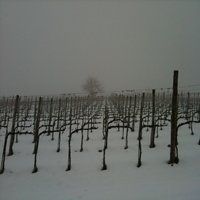
Looking over my notes for the 2010 season, one could only describe the season as a disaster, and with incredible lack of sunlight that lasted from winter through to mid spring. There was so little sunlight that solar panels used to generate power for the local weather station were insufficient for the first time since their installation more than 15 years ago. The lack of sunlight also delayed the start of the vine growth by as much as three weeks, especially in our older vineyards.
Towards the end of April, soil temperatures started to rise just enough to send the young vines off to the races, while the older vines remained sceptical. As the young vines exploded with growth, the older vines were not convinced that spring had arrived. As a result, in early May when the young vines' new shoots were reaching the top wire, also later than average, the older vines had a mere 30-45 cm (12-18 inches) in length, reaching not even half way to the top wire.
Poor sunlight exposure in the early season produced reduced cluster formations (bunches shorter in length and width) than in a typical year. The bunches were also missing their winged lobe off the main bunch (ali), classic to Sangiovese, and the berries were smaller and fewer.
In the young vineyards, the combination of an abundance of winter rain and the vegetative growth starting in the warmer month of May resulted in an excess vigour that we would not normally experience in an area as cool as Panzano. This meant that we had to be more vigilant with our canopy management, returning to the young vineyards several times to thin lateral shoots and excessive leaves, also utilising our antifungal sprays more frequently than in years past.
Monte Bernardi, having a majority of older vineyards, probably suffered more yield loss than most farms. The smaller bunches and berries and hail damage lead to a 50% reduction in the older vineyards. The younger vines, on the other hand, suffered an overall 20% reduction due to smaller bunches and berries – a crop loss probably more representative of the average crop loss for the area in 2010.
In the end, lower yields in both the younger and older vineyards saved the ultimate quality of the vintage. As we headed towards the end of the season, we had frequent rains that increased disease and mould pressure. The lower yields allowed the vines to ripen the remaining fruit quicker than we would have expected given the late start, so that we were able to harvest ripe, balanced fruit, while the smaller berries and looser bunches reduced the potential for mould infection.
Clones – old v new
When planting new vineyards, one encounters diverse opinions on whether the more historic clones in Chianti Classico were selected for quantity over quality. Although fruitfulness surely was important, no one can argue that quality was not desired. It does seem, however, that over the past decade or more the new direction in Italian viticulture has been increasingly focused on easing demands on vineyard management (ie reducing disease pressure through vine and bunch characteristics) and impacting the general 'quality' indicators of wine (colour, tannins and sugar content). While these sound like a reasonable objectives, it seems that smaller berries, thicker skins, and looser bunches, although helpful in reducing disease pressure, lowering yields naturally, and providing more colour and tannins, may have been gained at the expense of classic Sangiovese aromas and flavours.
We are strong believers that when good vineyard management is applied in the vineyards to the more established clones, including green harvest (removing bunches), the results are superior in terms of classic Sangiovese characteristics. At Monte Bernardi, the majority of our new plantings are clones with at least a 30-year history of producing good-quality Sangiovese in Chianti Classico.
Two hailstorms
Over the past 20 years we have only had two incidents of hail prior to this year. This year we experienced two hailstorms within two months of each other. At Monte Bernardi we tend to be quite protected from hail. The areas of Chianti Classico most susceptible to hailstorms tend to be the southern parts of Gaiole and Castellina, which have warm valley floors at their southern borders. This creates the volatile mix of hot and cold necessary to create a hailstorm. This season's erratic weather caused odd spikes in heat and drops in temperature that made for frequent violent storms and also hail.
The first storm in May was intense and lasted about five minutes. The hail was pea-sized and did not cause much damage – scarring on leaves and shoots was minor and the storm came early enough not to cause berry damage. The second hailstorm, which came at the end of July, just before veraison (when berries turn from green to red) was of similar hail size and duration, yet it destroyed berries on the side exposed to the hail. These berries were still young enough to not have the sugar accumulated so fortunately they did not start disease problems, but we did suffer a further reduction in yields of up to 10-20% in some of our vineyards.
In the cantina
Due to this year's small production, we have made the least amount of Sangiovese ever made from our estate vineyards. Unfortunately this means that we had to make the tough decision to not produce our single-vineyard Sa'etta Chianti Classico nor our immensely popular rosé. In order to produce both the Sa'etta and the Monte Bernardi Chianti Classico from the limited 2010 harvest, we would have had to make a stylistic compromise which would have impacted on the elegance and finesse in both wines.
A cork of form and function
It gives me great pleasure to report that with the 2009 bottling we have moved to 100% DIAM closures for our Retromarcia Chianti Classico and our Monte Bernardi Rosé.
Over the years I have become increasingly frustrated with the quality and consistency of the corks I have received from various suppliers. In fact I have used five different suppliers in seven years of bottling at Monte Bernardi. Every year I test the material prior to bottling and every year the corks that are supplied from the same supplier showed higher mould or TCA and poorer structural properties, yet prices consistently continued to rise. This is particularly true of the high mid-range cork I choose for our early-drinking wines. I am convinced that there are good natural corks out there, but we are constantly forced to pay more for them and be vigilant with the suppliers in order to maintain cork quality year in and year out. I am resigned to continue to do this for our top wines, some of which hopefully will be cellared for more than a decade. For those wines we anticipate consumption to be within ten years, I am convinced that DIAM is the best closure on the market.
(DIAM is a technical cork that is made from treated natural cork. The natural cork is ground to a uniform grain, and then washed with supercritical carbon dioxide. This process eliminates all taints, moulds, and off odours from the raw material – the same process used to remove caffeine from coffee. The powder is then shaped into a cork form using a polymer that is used to manufacture contact lenses. The closures are highly standardised so the chance of random oxidation is drastically reduced and they are guaranteed 100% TCA free.)
Biodynamics
Are we becoming too extreme as biodynamic and organic producers?
At times the exuberant return towards 'natural' techniques or practices reminds me of the movement towards modern vineyard and winemaking techniques in Europe during the 1980s and 1990s. There were clear benefits to viticulture and winemaking with the shift toward modern practices such as improved viticultural techniques, cleanliness, and the desire for pure Sangiovese. But the movement also tended towards the extreme in the winery, ie 100% barrique, incorporating non-traditional varieties for colour and structure, and the idea that bigger wines meant better wines. This resulted in many wines becoming formulaic, uncharacteristic and mediocre.
I hope that the movement (or return) towards more 'natural' techniques, will not result in a new 'extreme' fashion. Although unlikely to become formulaic, 'natural' producers may forget that the ultimate reason for choosing organic or biodynamic growing methods is to make a better product. This is the feeling I sometimes get when I participate at natural wine fairs.
I hope we are just in a sort of (re)discovery phase of trial and error. I wouldn't want to sacrifice fruit purity, cleanliness or overall balance for the sake of a 'traditional' technique or practice.
As a small producer in a global industry, we are among a minority who actually grows, processes and packages a product which is then sold, often by us, to the end consumer.
Let us enjoy wine for what it is, an enjoyable beverage that makes us happy. The reality is that neither extreme (modern or natural), does justice to our grapes, our wine or our consumers.