
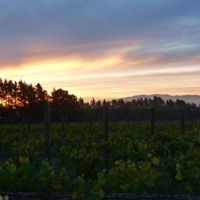
These are my notes (and images) from visits to producers in New Zealand's Waipara Valley at the end of 2012. Tomorrow I report on two producers further north and west in the area officially known as North Canterbury. The wines for each producer are listed in the order tasted.
BELLBIRD SPRING
Owner and vigneron Guy Porter came back to New Zealand in 2002, to his family origins in Canterbury. Having studied hotel and catering and worked in wine retail in the UK, he wanted to do something more practical so he set off to Mosswood in Western Australia to do a winter's pruning. He ended up studying winemaking at Roseworthy and working as a contract winemaker in WA. He and his family bought what is now known as the Home Block in 2002, a river terrace to the south of the Waipara characterised by free-draining Glasnevin gravel. One hectare of this site is planted with a field blend of Pinot Gris, Gewürztraminer, Riesling and Muscat Ottonell which goes into the Home Block white. Their second vineyard, Block Eight, bought in 2004, is composed of stony clay over sandstone, which ripens the fruit earlier and gives richer wines.
Porter has two labels: the higher level Bellbird Spring and lower-priced The Pruner's Reward, the latter sometimes made from bought-in fruit (or bought-in wine for the reds). Bellbird Spring he describes as 'more artisan and more traditional' than many NZ wines but also focusing on 'bright fruit'. He's looking for palate weight and persistence, he says.
The vineyards are farmed organically, which means he needs to do a lot of leaf plucking to keep the fruit healthy. This also means it is warmer in the fruit zone, reducing the methoxypyrazines (the compound that contributes mainly capsicum flavours) in the fruit. Porter uses a water-flipper system (see the photo in my introductory article) – part of the irrigation set up – for frost protection, and irrigation needs are assessed using soil-moisture probes. All their own fruit is hand harvested.
His first vintage, 2008, was made in another winery, which is still used for some of his wines but he now also has his own small winery, built in the last couple of years, and he is gradually moving his production across. Winemaking is straightforward: he oxidises the juice, adding no SO2 at the crusher, taking it from a holding tank at 25 ºC through the chiller to bring the juice temperature down to 10 ºC, thus stopping yeast activity for long enough to allow 15 hours' settling, though he also uses enzymes to encourage settling. Whites are whole-bunch pressed and reds hand plunged. Fermentation happens of its own accord and he prefers older oak.
Bottling is done at Pegasus Bay. All Bellbird Spring wines are bottled under cork, to 'allow the wine to age in a certain way' but also because this is apparently preferred at the restaurants where their wine is sold. The wines are available in the UK via Winetraders.
Guy's parents live on the Home Block and produce olive oil and his sister Alex runs the office. Like many of those I visited, a staunchly family affair.

BLACK ESTATE
Like so many in Waipara, this is a family business. The original Black Estate, in Omihi, a little further north of Waipara than Mountford and Greystone (as shown on this map), was planted by Russell Black in 1993/94, working with pioneering viticulturist and Pinot Noir proponent Danny Schuster*. Rod Naish and his family bought 8 ha of the estate in 2007 and they have since planted nearly 4 more. Naish's son in law, Nicolas Brown, is the winemaker. Brown needed little persuasion to show me the beautiful sunny vineyards rather than the winery, which is housed in a very attractive new building, resembling a long, elegant black shed, designed by Rod's architect nephew Richard Naish, which is also home to Nicolas Brown, his wife Penelope Naish (general manager of the estate) and their small children, plus a modern, welcoming cellar door and 'eatery' (excellent local produce including great cheese) with lovely views.
Their soils are mainly dark clay loam over tight, dense clay with limestone underneath, with more active limestone in some vineyards than in others but any one vineyard has a high degree of variation within it. They are well drained and require no irrigation; much of the older vineyard is on own roots (and other growers are not allowed to drive through). Brown believes that the clay gives aroma and suppleness to their wines, limestone giving structure and minerality. The older vineyards are half Pinot Noir and half Chardonnay. The new vines are again Pinot Noir (2 ha) and Chardonnay (1 ha) but also Chenin Blanc (1/2 ha) and Cabernet Franc (1/3 ha). The last seems to perform well on the vineyard in front of the winery, where there is a good deal of iron in the soil and the water. All the vineyards have been farmed organically for the last three years (BioGro certified 2012) and the wines are bottled under screwcap with no additions except for SO2 at bottling. All wines are fermented with ambient yeasts.
In the cold snap in the spring of 2012, they had to hire a helicopter to combat the threat of frost damage (NZ$700 per hour, during which time it can cover 6 ha), but helicopters, like windmills, are effective only if it is a radiation frost, creating an inversion layer. Brown told me that Brancott estate have 3 helicopters of their own and a 'helicopter budget'.
*Almost everywhere I went, Daniel Schuster's name cropped up. Described by Michael Cooper in his Wine Atlas of New Zealand as 'a guru of the Canterbury wine scene', his St Helena Pinot Noir 1982 was only the second ever NZ Pinot to win a gold medal in an international wine competition. Over the years he consulted for producers as prestigious as Ornellaia in Bolgheri and Napa's Stag's Leap. The fact that in 1986 he chose to plant his own vineyards in Omihi, north-east of Waipara, was a significant endorsement for this small but promising wine region.
CLOS ST WILLIAM
If ever there was a labour of love, this is it. Kim and Fiona Nankivell both have full-time jobs – software engineering and real estate respectively – but their 30-year dream of making their own wine, inspired particularly by Alsace and Burgundy – has not released them from its clutches. They explained that the vineyard and wine are named in memory of their son William, who died from cancer at the age of four while they were on a tour of Europe with their young children.
In 2005 they planted their 5-ha vineyard in the Waipara Valley on the road out to the Weka Pass, Kim pounding every one of the massive support posts into the deep glacial and alluvial gravel soils by hand. They do most of the vineyard work themselves but have a contracter to spray and help with pruning. Plantings are relatively dense for New Zealand – 1.8 m x 1 m – and although the vineyard is flat, 2012 was the first year they had been affected by frost because the land is 'early lambing country' and warms up quite early in the season. At the time I visited in November, it was hard to tell how much damage had been done.
2009, their first vintage, was a good one and they produced 700 cases. 2011 and 2012 were more difficult and lower yielding – in 2012, for example, they harvested just 1 tonne of Riesling instead of 8 tonnes. 2010 was a heartbreak year: for practical reasons they had to entrust the winemaking to a contract winemaker and their small and precious harvest of fruit was neglected and pretty much ruined.
My heart went out to the Nankivells. It was clear just how difficult it was for them to make their dream a reality, to make time to do all the work in the vineyard, let alone try to market the wine, but the progress in the wines themselves was encouraging despite what Kim describes as a bit of struggle to assert his views on wine style over those of the winemakers he depends on.
I have recently found out that they have put the vineyard on the market. In the meantime, it is contracted to a local grower, who is farming it organically for Black Estate (see above). Kim wrote: 'Ideally, we don't want to exit the industry and can afford to continue as we were, but it doesn't make sense from a financial perspective (or sanity perspective either!). So we are looking at our options and would consider selling or taking on equity investment.'
18 g/l. Much more aromatic than the 2009. Definitely Alsace...
Old barrels. Cloudy. Still fermenting. Very sweet and honeyed...
RS 12 g/l. Barrel fermented in old barrels. Pale gold. Oily...
RS 12 g/l. Fine pear and quince aromas and Pinot Gris's mineral...
RS 12 g/l. Bright pear fruit. Attractive sour pear freshness and...
GEORGES ROAD 
Kirk Bray is very much a one-man band. Needs must when you leave behind chartered accountancy in Hong Kong (which 'didn't agree with him') and start spending money on a vineyard and making wine. In between those two points, he did a postgraduate diploma in viticulture and winemaking at Lincoln University and gained practical experience at Sonoma Cutrer in California and worked for two years with Rainer Lingenfelder in the Pfalz.
In 2003 he and his wife Alison bought their land in Waipara. Even with limited resources he has managed to plant 8 ha on two terraces above the Waipara River, mainly on Canterbury gravels, ie free-draining gravel and loess, over very rocky subsoil, on Georges Road south west of Waipara, where several other producers are located. Riesling is his first passion (4 ha), along with Pinot Gris (2 ha) and Syrah (2 ha). Spacing is 2 m x 1.5 m and some at 2 m x 1 m. If he had had the money, he would have done all the planting at that closer spacing. He never harvests more than 2 kg per plant but he restricts the Syrah, which he describes as a weed (ie extremely vigorous), to one bunch per shoot. (Full details of rootstocks and clones, and much more, are given on the Georges Road website.) Frost is rarely a problem at this end of the valley, Bray says.
At the moment he vinifies his wines in Christchurch but he would obviously love to have his own winery. Total production is currently 1,000 x 6-bottle cases of each variety and he buys in the Pinot fruit. He had planned to plant it himself but the results at other vineyards on similar soils discouraged him and instead he planted more Riesling, which, he lamented 'is not the consumer's first choice'. He already exports to Denmark, Singapore and Australia and is disheartened by the fact that 90% of wines in NZ supermarkets are sold for less than NZ$15 and/or on special offer.
Unusually among the producers I visited, he uses Diam technical closures, believeing that the use of screwcaps is the 'blind following the blind' and that wines under screwcap are 'delayed in their development'. He is a firm follower of Lingenfelder's methods: juice oxidation (no gas protection prior to fermentation); all whites are whole-bunch pressed, not too cool (15-18 ºC) and left on gross lees for as long as possible. He is not aiming for a simple 'fresh and fruity' style.
2010 was his first vintage under his own label.
100% Syrah. Deep pinky orange. Barrel fermented after two hours...
GREYSTONE
Named after the grey limestone rich in marine fossils that is so prevalent on the Teviotdale Hills just north east of the town of Waipara, Greystone was set up 10 years ago by brothers Peter and Bruce Thomas. They have nearly 40 ha of vineyard, planted between 2003 and 2005 at altitudes of 60-150 m above sea level on the mainly west-facing slopes of the hills that provide shelter from the easterly winds off the sea.
Pinot Noir dominates (60%) but they also have a wide range of white varieties including Riesling, Pinot Gris, Gewürztraminer, Chardonnay and Sauvignon Blanc, plus a little bit of Syrah (in 2012 this last was not picked until mid May). Their vineyards at the base of the hills need water sprinklers – running from the irrigation system – for frost protection. Apparently, there is a good supply of artesian water but you do have to have a licence to draw on it, and they also need irrigation for the vines at the top of the slope. Viticulturist Nick Gill (on the left in the photo), originally from Australia, confirmed what others had intimated – that the frosts are getting more frequent.
In 2011 they bought the neighbouring Muddy Water estate (planted 1993-2005) but the wines are still sold under that name, which is the literal translation of Waipara. The winemaker for all the wines is Dom Maxwell (right), who started in the Greystone vineyards fresh out of college and by 2011 had already won New Zealand's Winestate Winemaker of the Year.
A young company with a young team, they all seem to love the outdoors (the leisure pursuits of those assembled in nearby Amberley at the tasting dinner included skiing, snowboarding, fishing, tramping and hunting, not to mention herb gardening and cheese-making), which is just as well when you have to get up in the middle of the night to respond to the frost alarm. Their enthusiasm for this particular patch of the Earth shines through the wines. As one of the team said during the course of our tasting, you wouldn't come to this part of New Zealand to make wine if you were risk averse.
Low-yielding vintage with some losses to frost. 30% new oak...
Starfish and shellfish fossils in the vineyard. Fully botrytised...
PEGASUS BAY
I'm not sure if it was the mature gardens or the number of wines or the very popular restaurant, but everything about Pegasus Bay speaks of a well-established and prosperous business but still one that is founded on the strength of a family's hard work and commitment over many years, beginning with the pioneering persistence of neurologist Ivan Donaldson, who planted his first vines in the Waipara Valley in 1986, after variously (un)successful hobby-scale experiments at their home in Christchurch prior to that. In the 1970s it was very difficult to get planting material and his first planting of 'Merlot' vines turned out to be Chenin Blanc.
Ivan, who continues to oversee the vineyards and the overall wine styles, drove me round the vineyards at dusk on the day I arrived, carefully avoiding the wind machines. (You can just make one out in the photo below. During operation, each one rotates every four minutes, thereby protecting an area of up to 5 ha, dragging the air down from about 100 feet. The frost risk also prompts them to use some herbicide around the vines to keep the ground bare.) He explained how he had worked at the National Hospital for Nervous Diseases in London before taking up the post of consultant neurologist in Christchurch in the mid 70s. The first book to provoke his enduring love for wine was Hugh Johnson's Wine.
As darkness fell at around 8.45 pm, it became noticeably cooler, highlighting the strong diurnal temperature variation which is typical of this area – in addition to a very long growing season, with fruit often hanging on the vine 6 weeks longer than the average growing season in Europe. They even get two crops of figs a year.
They now have 40 ha of Pinot Noir, Riesling, Chardonnay, Sauvignon Blanc, Semillon, Merlot, Cabernet Sauvignon, Malbec and Cabernet Franc. The vines are planted on gravelly, north-facing terraces down to the river, with only very shallow top soil.
The beautiful landscaped gardens are the fiefdom of Ivan's wife Christine, and their eldest son Matt Donaldson is winemaker, a role which he shared for many years with Lynnette Hudson until she left Pegasus Bay at the end of 2012 to work as a consultant, but who was my excellent guide through the wines when I was there in November, patiently explaining such topics as aldehyde bridging*. I did not meet the other family members but another son, Edward, runs the restaurant and marketing and son Paul is the administrator.
In addition to Pegasus Bay, an important part of their business is the Main Divide brand – wines made from younger vines and bought-in fruit, mostly from Waipara but also from other regions such as Marlborough. (Main Divide is the local name for the Southern Alps, the backbone of New Zealand's South Island.)
Pegasus Bay label wines are all made from their own fruit. Reserve wines all have operatic names – very small volumes (eg just 1,500 litres of Prima Donna compared with 18,000 litres of the Pegasus Bay Pinot Noir 2011) and made in some years only and stylistically different from the main range – selected parcels of older vines on own roots – and consistently from the same parcels.
All their wines are bottled under screwcap because of the lack of consistency with cork, both in terms of TCA and oxidation. According to Hudson, most New Zealand restaurants refuse to take wines without screwcap except from a few producers such as Fromm or Larry McKenna.
All the red wines are fermented with ambient yeast, and long post-fermentation vatting of up to three weeks is encouraged. From 2012, they have made some reds with whole bunches (more details in the tasting notes below).
*'Some wines, especially Pinot Noir, benefit from over-wintering without SO2 so that aldehydes develop which bond with tannins and anthocyanins, fixing the colour and tannins. I know that in Bordeaux MLF is typically immediately after alcoholic fermentation, but not so in Burgundy [in addition to overseas experience in Oregon and Romania, Lynnette worked harvests with Christophe Roumier, Nicolas Potel and Pascal Marchand]. My experience at Pegasus Bay with Pinot Noir was that if wines went through MLF in the spring (overwintered with no SO2), then the wines had deeper colour, were more robust with bigger tannins, losing primary upfront fruitiness for becoming more structured with greater ageing potential. This does depend on the wine, however, and if a Pinot is particularly tannic, then an early MLF is a good idea as it makes the wine more fruity and less tannic, although more simple and primary in fruit flavours. Typically at Pegasus Bay we let most Pinots go through MLF naturally in the spring and any aldehydes giving porty flavours are cleaned up by the action of the malo bacteria.
'Nicolas Rossignol, Volnay, has experimented with this and I remember tasting with him where he used broken glass stems in many of his barrels over winter to encourage aldehyde production, his aim being to increase colour and tannin polymerisation.'
Bright crimson. Really bright cherry fruit – aromatic and fresh...
Dark red cherry. Slightly dusty, mineral note. Austerity in the...
Merlot, Malbec, Cabernet Franc, Cabernet Sauvignon. Meaty – and...
Malbec, Merlot and some Cabernet Sauvignon and Cabernet Franc...
Intense grapefruit freshness. Almost a touch of orange. Ripe and...
Smells more Sauvignon-dominated than the 2007 but then it is a...
Lively and lemony. On gravel soils. Picked a little earlier than...
Older vines. Two to three puncheons in total. More mineral and...
Select bunches with 30% botrytis or desiccation. Inoculated with...
TONGUE IN GROOVE
This is a brand new Waipara label, launched in 2012 and set up by a group of six old friends who knew each other when they were students at Roseworthy (now part of Adelaide University). They had always wanted to do something together and were goaded into action by the Christchurch earthquake of 2011 and the energy they felt came out the rubble. The winemaker is Lynnette Hudson, formerly of Pegasus Bay (see above) and their spokesperson is Angela Clifford (who had a key role in both New Zealand's Summer of Riesling and Pinot Noir NZ 2013). The quirky Tongue in Groove website is a model of fun but rather self-conscious obfuscation, giving away very little about the wines or those behind them, though Clifford says the anonymity is no longer necessary and the website will be updated. Lynnette is also New Zeland's representative on the board of the International Riesling Foundation.
The team's home base is a 16-acre organic property in the Waipara Valley called The Food Farm but the fruit may well come from different vineyards in different vintages. So far they have produced a Rielsing and a Pinot Noir. Clifford says 'We are fortunate enough to have access to some wonderful grapes. There will be two 2012 Tongue in Groove Pinot Noirs, one from the clay slopes of the Cabal Vineyard in the Waipara Valley and the other from Clayvin – a truly great New Zealand Pinot Noir vineyard in Marlborough. But wherever the fruit is sourced, Tongue in Groove will always be based in the Waipara Valley/North Canterbury.'
Richly aromatic: bright citrus with a touch of apricot and a...













