
It was while visiting Tenuta San Guido, the Tuscan estate responsible for Sassicaia, that I realised the extraordinary fact that there may be more subtle Cabernet being made in Italy today than there is in Bordeaux.
Scrolling over my hugely privileged drinking – sorry, tasting – experiences over the last year or so, I am aware that many of the greatest wines I’ve been lucky enough to have been exposed to were wines dominated by Cabernet Sauvignon, but Cabernet in its most refined form, as a communicator of time and place, with thrilling nuances and often relative delicacy. I’m thinking of great, refined, fully mature red bordeaux that has benefited from several decades in bottle and of some of its imitators from elsewhere.
What is so impressive about Sassicaia, the unexpectedly successful hobby wine that pioneered a host of brasher wines from the Tuscan coast, is that it is consistent rather than insistent. With the possible exception of the extraordinary and apparently indestructible 1985, the wine is always elegant and refreshing – and continues to be so right up to the most recent release, the 2010. (None of this unseemly en primeur business for Sassicaia.)
It began in 1944 when Mario, father of the current Marchese Nicolò Incisa della Rocchetta, thought he’d try clearing a small, east-facing area in the woods above the little village of Bolgheri high above the Tuscan coast, still plagued by malaria then. His idea was to plant vines there to make a wine for the family to drink. Inspired by his Piemontese great uncle who had been a great plant collector and was one of the first Italians to import vine cuttings from France, by the ineffable complexity of fully mature red bordeaux, and by the fact that some of the wine produced on his friends’ estate in Migliarino near Pisa had the same bouquet as classic claret, he planted various cuttings from the Migliarino vineyard. Of these, the Cabernets proved the most successful.
By the late 1960s this house wine had such a reputation within their extended family, which included Nicolò’s cousin Piero Antinori of the ancient Florentine merchant house, that the latter suggested it be vinified and commercialised by the Antinoris under the auspices of their talented in-house oenologist Giacomo Tachis. The first proper commercial release was the 1968, thought to contain quite a bit of 1967 and 1969 (a vintage that was never released), and this arrangement continued for a few years until production and control was restored to Tenuta San Guido, the Incisa della Rocchetta’s Bolgheri estate where things went from good to superlative. (Mario Incisa della Rocchetta was never entirely happy ceding control entirely to the Antinoris and continued to make his own wine, Vino di Verso, from a small portion of the grapes, a wine which the late Italian wine commentator Luigi Veronelli apparently deemed superior to the commercially available version made by Antinori.)
It’s important to realise that the whole informing doctrine at San Guido is to try to replicate a fine red bordeaux as closely as possible. To that end they follow what they see as quintessentially traditional bordelais production techniques: picking not too ripe, full de-stemming, two-week fermentation, all French barriques but only one third new, regular rackings each year, barrels stored with the bung at two o’clock to avoid any oxidation, bottle storage after bottling and so on.
But my point is how unlike modern red bordeaux Sassicaia is today. The odd modern vintage of Château Lafite (with whose owners Nicolò Incisa discussed a joint venture quite seriously in the mid 1980s) shows similar elegance but overall, modern red bordeaux is a much beefier, more concentrated essence nowadays...
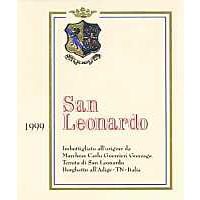
It took a recent vertical of Sassicaia and another of a similarly refined Cabernet blend, San Leonardo, the jewel of Trentino in the north of Italy, also the product of bordeaux-besotted nobleman, Carlo Guerrieri Gonzago, to drive home to me how much red bordeaux has changed over the past few decades.
The only other Cabernets that have this sort of delicacy and subtlety belong to another era: the finest red bordeaux made in the mid-twentieth century, and California Cabernets from the 1960s and 1970s. All of them are quite different from the style of wines being made today from the same grape varieties and much the same vineyards. The big difference of course is the timing of the harvest. At Sassicaia they pride themselves on picking earlier than many of their neighbours but in general both California Cabernet and red bordeaux is made from grapes picked much later than they used to be in those regions and, often, at lower yields. Quantifying the amount of visceral and intellectual pleasure I have had from these wines ancient and modern, I find myself questioning the wisdom of the mantra that the lower the yield, the higher the quality. Balance appeals to me far more important than sheer concentration.
But since both red bordeaux and California Cabernet are now increasingly rated on the basis of how they taste as babies from barrel as opposed to mature grown-ups from bottle, it is perhaps not so surprising, if slightly regrettable, that sheer power is overvalued.
A vertical of either Sassicaia or San Leonardo shows the influence of different vintages to be sure but overall what distinguishes them is the quite remarkable consistency of style. A vertical tasting of a Bordeaux château’s wine on the other hand is much more likely to show increasing intensity from the 1980s, often a flirtation with excess and possibly obvious Merlot influence at some point in the 1990s or even the early years of this century, and then increasing balance and rigour together with marked concentration today.
The big question is how these beefier, riper red bordeaux, made as no red bordeaux was made in previous centuries, will age. We already know on the other hand how today’s Sassicaia and San Leonardo will age because the recipe has changed so little.
Who makes subtle Cabernet today?
• 4 min read


Choose your plan
Member
$135
/year
Ideal for wine enthusiasts
- Access 297,198 wine reviews & 16,153 articles
- Access The Oxford Companion to Wine & The World Atlas of Wine
- Access askJancis, our AI wine assistant


Inner Circle
$249
/year
Ideal for collectors
Everything in “Member”, plus:
- Early access to the latest wine reviews, 48 hours in advance
- Early access to the latest articles, 48 hours in advance
Professional
$299
/year
For individual wine professionals
- Access 297,198 wine reviews & 16,153 articles
- Access The Oxford Companion to Wine & The World Atlas of Wine
- Access askJancis, our AI wine assistant
- Early access to the latest wine reviews & articles, 48 hours in advance
- Commercial use of up to 25 wine reviews & scores for marketing
Business
$399
/year
For companies in the wine trade
Everything in “Professional”, plus:
- Commercial use of up to 250 wine reviews & scores for marketing
- Access to submit wines for review
- Offer memberships to your employees and manage them from a single place
- API access available for an additional fee
More Free for all

Free for all
Leading new-wave South African wine producer is looking to the future. A version of this article is published by the...

Free for all
Jancis remembers the most charming wine producer she has ever met. Above, Neill in his Two Paddocks vineyard. The worlds...

Free for all
After a first round of judging, we’re delighted to begin publishing the best of this year’s writing competition entries. All...

Free for all
Extraordinary seafood and the magic of a good pairing at The Rocket Store. Boscastle harbour is pictured above. The restaurant...
More from JancisRobinson.com

Tasting articles
Concluding Walter’s report on this notably accessible vintage. Today, reviews of wines from the southern and eastern villages of Castiglione...

Tasting articles
A final report on a tricky vintage that now shows remarkably fresh and accessible. Today, reviews of wines from multiple...

Inside information
Mexico’s wine industry offers lessons in dealing with climate challenges, says Mexico-based journalist and sommelier Carlos Borboa. Above, vineyards in...

Vinomakase
Richard’s new Vinomakase column explores how the experts match wine with Japanese cuisine. For the first edition, a traditional sushi...

Bite-sized
A 15th-century pub with bang-up-to-date feasting in the Cathedral Quarter of St Albans. The front bar is still reassuringly pubby...

Wines of the week
Thirst-slaking freshness in a red from Central France. From £15.50, $26.95. For a variety so maligned for much of the...

Book reviews
Three additions to the Classic Wine Library plus a self-published guide to Portuguese wine. Three of the reviews below are...

Tasting articles
A revealing vertical that traces the evolution of South Africa’s most sought-after white. The wines were shown by UK importer...