The winegrowers of the world are generally being terrific at one of the three pillars of sustainability, concern for the environment. Their use of agrochemicals has plummeted – despite some challenging growing seasons – and the evidence of more and more producers being certified organic, biodynamic, regenerative or HVE (France’s Haute Valeur Environnementale) is there for everyone to see on an increasing number of back labels.
Financial, as opposed to environmental, sustainability? Not so much. In a highly competitive, shrinking market with rising costs, taxation and tariffs, it’s becoming increasingly difficult for the great majority of wine producers to make a decent – sometimes any – profit. Like any stereotypical farmer, they complain loudly about it.
Which leads directly on to the third pillar of sustainability: social. How very tempting it must be today to pay vineyard workers a pittance and skimp on their working conditions. This is true of many forms of agriculture, of course. It’s an aspect of what we eat and drink that we like to think of as rarely as we confront the reality of an abattoir.
Hence the title of a recent workshop organised in London by the UK’s co-operative buying organisation The Wine Society: Breaking the Taboo – raising labour standards in the wine industry. Wine Society staff apart, there were exactly as many attendees as panellists: 12, although 70 wine and sustainability media had been invited. Taboo indeed.
The Society’s in-house sustainability expert Dom De Ville kicked things off, pointing out that vineyard work is extremely seasonal and, as with most fieldwork, doesn’t appeal to locals. When the labour force is migratory, they tend to be people desperate for jobs who can all too easily be exploited.
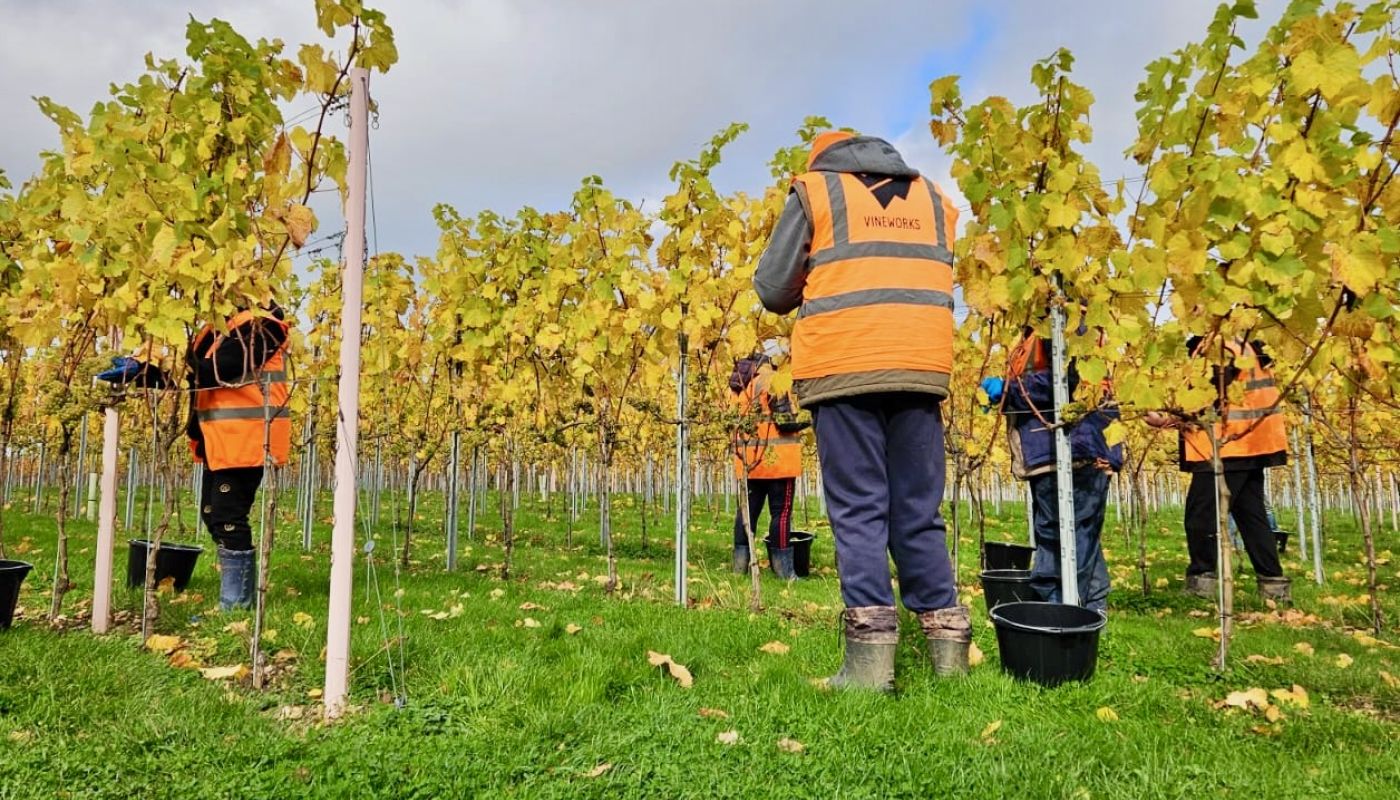
Local workers are not necessarily desirable anyway. I’ve been told by several English vignerons that foreigners tend to pick grapes four times as fast. Not that it’s as easy as it was pre Brexit to hire foreign labour. James Dodson runs one of England’s biggest vineyard management companies, VineWorks. Until 2016 it relied mainly on a skilled team of Romanians. Since Brexit, however, as he explained, ‘seasonal workers have to be sourced through one of five Home Office-approved agencies, but they often have little or no vineyard experience and there is no guarantee that you will be sent the same workers throughout the job. The current situation means that we are slowly, through natural attrition, losing an experienced workforce that has been nurtured over the last 15 years.’
He's turning more and more to mechanisation – the most obvious solution to any labour crisis – but the rules for English traditional-method sparkling wine, which represents more than two-thirds of the wine grown in the UK, stipulate hand picking.
Anna Turell specialises in advising big retailers on sustainability and observed at the start of her presentation, ‘I don’t know many companies that would bring the trade and press together to discuss this.’ She called The Wine Society brave, to which De Ville responded afterwards by email, ‘How have we managed to get ourselves into a situation where we think you have to be brave to organise a panel discussion about reducing the risks workers in the wine industry face!’
After the event Laura Falk, who worked for 10 years on sustainable sourcing with Sainsbury’s supermarket and has been advising The Wine Society for the last two years, was due to organise online training sessions in five different languages for 160 of The Society’s suppliers. The idea is to explain to them how to start tackling labour issues, and The Society is keen to share all this with others in the wine trade.
It can be difficult, however, for big retailers to collaborate on topics such as this for fear of being accused of anti-competitive practices. The independent organisation Sustainabile Wine Roundtable offers a platform via which they can work together. The SWR is currently benchmarking the more than 40 sustainability standards that exist globally, and finding that many of them are distinctly light on labour issues compared with environmental ones.
One of the most interesting panel members was Allan Sichel, president of the CIVB, Bordeaux wine’s generic body representing the region’s almost 5,000 producers. He pointed out that many of their members, especially the smaller-scale growers, are currently ‘overwhelmed’ by the myriad requirements of different buyers. ‘It tends to be the same stuff being presented in a different way, so a collective approach would really work.’
Along with Bordeaux’s admirable environmental sustainability initiatives and generally rather lamentable financial sustainability, it seems as though it has been working unusually hard on social sustainability, improving standards for its considerable workforce (despite the inexorable move towards machine harvesting, responsible for about 80% of the crop in Bordeaux).
Sichel explained that growers in Bordeaux, like so many of their counterparts elsewhere, thought that if they employed a vineyard management company, of which there are more than 550 in Bordeaux, some very small, then it was that company that was entirely responsible for pay and working conditions. Not so. ‘Twenty years ago we thought we were protected by social laws, but it was a few well-publicised cases by the press or whistleblowers [of worker mistreatment] which made us aware of the responsibilities of growers, too. Many of the growers are surprised that it’s up to them to be sure all the people they employ are old enough and legal, that they have decent pay and accommodation – not just a tent in the woods – and access to medical care.’
The local Préfet, the national government representative, noticed that his area, Aquitaine, had France’s highest rate of accidents at work, mainly in wine production. As a result he was instrumental in drawing up a labour charter in 2022 which so far has 67 signatories, including many vineyard management companies and producers including those whose wines are recommended below.
New Zealand has a similar scheme that requires employers, often vineyard management companies, to provide accommodation units for their workforce, now made up substantially of Pacific Islanders who may be offered contracts for up to seven months of the year. Mechanical harvesting, particularly suitable for the dominant Sauvignon Blanc vine, is the rule here.
Gonzalo Entrecanales, CEO of the particularly sustainability-conscious northern Spanish wine company Entrecanales Domecq e Hijos, made the point that, unlike clothes, wine is largely made in developed countries, so there tends to be more scrutiny than, for example, in the Indian subcontinent. But, he observed, the wine-grape market is extremely fragmented and the smaller growers simply don’t have the tools to understand social sustainability issues. So many consumers buy on price, without realising that if a wine is really cheap, someone is suffering – usually the agricultural worker.
Daniel Hart of UK wine importers Hatch Mansfield, owned jointly by Louis Jadot of Burgundy and Errázuriz of Chile so able to take a relatively long-term view, has a very concrete proposal to counter this. SWR has successfully launched the Bottle Weight Accord whereby all manner of retailers sign up to use bottles with an average weight of no more than 420 g (14.8 oz) by the end of 2026. Hart, armed with a battery of figures showing the total tax take on wine sold in the UK, points out that on the average UK bottle price of £6.63 ($9) and average alcohol of 13.5%, the government takes £4.20 so that, taking account of packaging, transport and retail margin, only about 64p (60 cents) will have been paid for the wine in the bottle, ‘barely enough to ensure ethical treatment of workers’. He pleaded, ‘we need a number, like we have for bottle weights, a fair price for a bottle of wine which takes away the risk of exploitation of workers.’
Master of Wine Jo Ahearne used to be a professional winemaker and blender for one of Britain’s big supermarkets. She pointed out that the KPI (key performance indicator) pressures buyers are under are getting tougher and tougher. ‘In the places I’ve been as a blender, I’ve seen some terrible things in vineyards. The workers tend to have their own gangmaster so you can’t talk to them directly – even if you speak their language. [To solve this] it has to come down to people refusing to buy wine that’s too cheap.’ Although she added by email later, ‘I don't want people to think that merely buying more expensive wine releases anyone from the responsibility of (inadvertently) supporting bad labour practices. That’s why The Wine Society starting the conversation is so important.’
In her experience it has been labour conditions set out in tender documents that have been most effective in encouraging suppliers to do the right thing. The powerful Nordic drinks-buying monopolies have been trailblazers in this respect, refusing to buy wine unless suppliers treat their workers well in schemes administered by organisations such as Stronger Together, whose purpose is to address human-rights issues in supply chains.
Peter Stanbury of SWR chaired the session and summed it up thus: ‘The tax take is reducing the money available for importers to pay for wine. Consumers have to understand that they have a role to play.’
Bordeaux from the socially aware
All these high-scoring, ready-to-drink fine wines are made by signatories to Bordeaux’s charter for responsible employers.
Château Branas Grand Poujeaux 2015 Moulis 13%
£294 per dozen in bond Cru World Wine
Château Grand Puy-Ducasse 2015 Pauillac 14%
£58 per magnum Cuchet & Co
Château Canon, Croix Canon 2016 St-Émilion 14%
£33.85 Justerini & Brooks and others
Château Meyney 2015 St-Estèphe 14%
£40.20 Four Walls Wine Company
Château Duhart-Milon 2009 Pauillac 13.5%
£89.39 Lay & Wheeler
Château Rauzan-Ségla, Ségla 2016 Margaux 13.5%
£95.94 Four Walls Wine Company
See also earlier related articles on this subject, including Oregon leads the way with vineyard worker care (2016), Vineyard labour – deportations v deposits (2018), What California vineyard workers want (2021), Vineyard management companies – Napa beginnings (2021), Vineyard management companies' virtues (2022), Bordeaux runs short of labour (2022) and How to own a vineyard without getting your boots dirty. (2024).
Back to basics
| What needs to be done in the vineyard? |
|
After the harvest, vine leaves and sap fall, the vine is dormant and its dry canes can be pruned any time during an extended winter. As Gonzalo Entrecanales pointed out during the labour workshop described above, pruning has become a skill now that wine production is focused on quality and no longer simply on quantity. With a few snips of their secateurs, pruners can help shape how the vine grows over the next few months and the likely crop level, which plays a crucial part in determining wine quality.
Pruning was once routinely undertaken in early winter but now that spring frosts are increasingly common, it may be delayed until the end of winter so as to delay the appearance of the first buds that can be destroyed by a particularly severe frost, shrinking and delaying the final harvest. This is the time for vineyard maintenance, mending the now fully exposed posts and wires.
Once the vines have started to grow, shoots may be trimmed or tamed, another specialist job – and in some vineyards leaves are strategically removed and/or excess bunches are snipped off in the summer. Vines are prone to a wide range of pests and diseases, so, depending on the year, they may need to be sprayed multiple times. Cover crops may need to be mown in summer. In some areas vines need to be covered with nets to protect against birds or hail.
And all that is before the all-important grape harvest in early autumn or, increasingly, late summer. This can be back-breaking work in high temperatures, although grapes are increasingly picked under searchlights at night so as to keep them sufficiently cool – or at least in the mornings only. |