Whether it be Kellogg’s, Jack Daniels, Heinz or any other brand, there is no shortage of predator companies, including supermarkets with their own brands, circling overhead and hatching plans to manufacture look-alikes to take advantage of others’ successes. Victims may head for the courts to do battle, or just take a view and roll over, but one comfort is that the predators and their knock-offs are, at the very least, visible.
Now step away from this scenario to the other end of the spectrum. The absolute unknown. Predator counterfeiters either local, or as far away as China, are invisible. Their copies maybe distinguishable by a handful of knowledgeable experts, but the average consumer will not spot the difference. Either way the brand-owner victims may never be able to account for the damage done, as there are no figures to work from. It is very common that the damaged companies are not even aware that their brands are being counterfeited. In short, they are working blind.
For the wine industry, some brand owners take the issue seriously and invest in anti-counterfeiting products such as hologram-type labels. These are a start, but they are never a practical solution for a number of reasons, including the fact that the Chinese, for example, counterfeit every reasonably priced anti-counterfeiting product there is.
So, is all lost? No. I believe there is a self-help solution in the form of just one item: the common-or-garden glass wine bottle. Look at the bottom, or punt, and there before you is an array of insignia permanently cast into the bottle, with each element importantly telling a story, and offering traceability. This is the anti-counterfeiting solution, and all within the cost of the bottles bought regularly from suppliers. The methodology is as follows.
Bottle producers must have traceability so that they can detect any problem with their manufacturing processes. To fully appreciate the intricacies one needs to visit a bottle manufacturing plant, but in short they comprise giant, and fantastically expensive, machinery that creates molten glass which, at over 1,000 ºC (1,832 ºF), is then fed into bottle-shaped moulds to produce the final bottle. Any manufacturer would rightly scoff at this elementary summary as there are many more highly sophisticated steps and processes involved, particularly quality control. However, if any element of the production develops a glitch, one could end up with bottles fracturing, chipping or breaking at a wine-bottling plant, or even in the hands of a consumer at home, or anywhere in between.
In this eventuality a bottle manufacturer needs rapidly to know what has happened in order to trace the source of the problem immediately. And this is where the moulded insignia comes in. Each bottle has sufficient information to identify the manufacturer, the geographic location of the plant, even down to the mould that produced the offending bottle, helped by a series of braille-like pimples, or so called dot-codes.
No other components of a finished bottle of wine possess such traceability. For example, testing wine itself for its origin is often nearly impossible and, due to ease of counterfeiting, a wine label, cork and capsule are about as untraceable as Santa Claus himself. The most reliable source of information is the glass bottle.
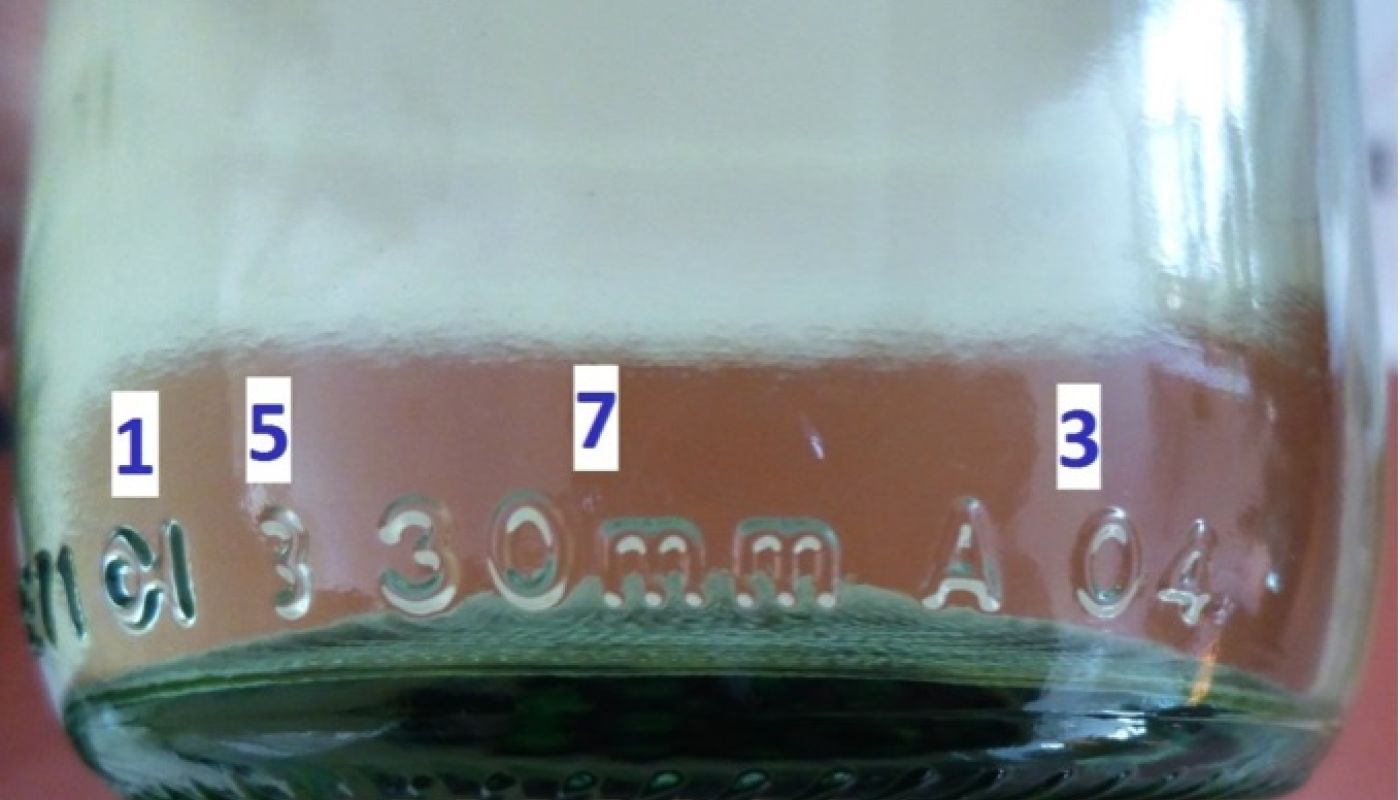
The insignia on bottles vary considerably between manufacturers, and even between plants of the same manufacturer. For the anti-counterfeiting system proposed and discussed in this article, these variances are an absolute positive. So, looking at the adjacent pictures, while reading the following, will explain all.


At the top of the insignia list is the manufacturer, which in this instance is O-I Owens & Illinois (1). E71 (2) is the factory identification, the E being for Europe and the 71 being the plant in Italy. The A 04 (3) is the identification of the mould that produced the bottle. And finally the all-important dot-codes cum braille pimples (4) that enable the final production-inspection equipment to read the bottle identification information and then store it on a computer. The following insignia are irrelevant to the wine bottle manufacturer’s traceability, but are required by law: the ɜ (5) is for bottles made in Europe, the 75cl (6) is total liquid in the bottle, and the 30mm (7) is the ullage level.
Insignia on bottles may vary considerably but they will, one way or another, provide all the information as detailed above. The main element, however, is the dot-code and it is this information, and the other insignia, that must be passed to a wine bottler for them to match which wine they are putting into which bottle, and with which label. A total of up to 13 dots are generally on each bottle but to provide a code, the combinations, permutations and exact positions of the dots of course vary, and they may be changed without additional costs.
It is this one area of knowledge that, metaphorically, ties the wine bottle, wine and brand together such that it is almost impossible to achieve a passable counterfeit. For this to happen, though, the bottler of the original wine will have some extra administration to manage. In the first instance the bottler must ask for an email from the bottle manufacturer that includes a drawing of the dot-codes, and other insignia, of batches delivered. It would be helpful if this could be just one drawing, but as the bottle-mould equipment produces numerous different bottles, and therefore dot-codes, in one cycle, several drawings may accompany each delivery. This is unavoidable, and arguably an advantage since it makes the job of a counterfeiter more difficult.
Once the bottler begins the bottling process they must record which brand of wine is put into which batch of bottles, and this should be stored on computer in order that the bottler has irrefutable traceability matching wine labels and wine bottles together, something that currently does not happen anywhere on this planet, at least to my knowledge. The trick here is for the records to be stored in such a way that the bottler can quickly and effectively search, at any time in the months or years to come, for any dot-code.
From the above explanation comes the key to the anti-counterfeiting methodology. For wine counterfeiters to execute the perfect crime they must first find a glass-bottle manufacturer who is prepared to counterfeit a competitor’s bottle, O-I in this instance. Imagine their giant competitor Saint Gobain agreeing to that one. In fact imagine any western glass-bottle manufacturer, most of whom are publicly listed companies, agreeing to blatant counterfeiting.
Even in China where counterfeiting is rampant, many of the relatively few wine-bottle manufacturers are vast organisations, not pop-up businesses able to shift their manufacturing base at the first sign of trouble. They have fantastically expensive machinery, administrative structures and workforces of many hundreds, any one of whom, with some sort of grievance, could so easily blow the whistle – a not uncommon phenomenon. Any company considering such a madness would think long and hard before attempting to counterfeit a competitor’s product, especially taking into account the fact that the volumes, and therefore profit, would be comparatively trivial when put against their total production.
But even if, for some extraordinary reason, there were such a rogue bottle manufacturer, then that manufacturer would have to point out to the bottler that he or she must first come up with a quantity of bottles with sufficient variety of dot-codes. Or to put it another way around, if the bottle manufacturer were to counterfeit just one bottle, and so just one dot-code pattern, then the market would be flooded with a disproportionate number of identical bottles that would immediately attract the attention of any buyer aware of this proposed anti-counterfeiting system.
In addition any manufacturer would have to produce a number of different moulds which the wine counterfeiter would have to pay for, which would exponentially push up the cost of each bottle. The final element is the moulds themselves. The average engineer would find it next to impossible to manufacture exact replicas such that the insignia is indistinguishable from the original one. One final bonus is that it would be extremely difficult for a renegade bottle manufacturer to combine the correct cocktail of raw material to match the exact colour of an original bottle.
So, to summarise: the manufacturer of original bottles must provide digitally recordable (not paper) drawings to the bottler, who shall in turn keep records of which wine goes into which batch of bottles, and with which label attached. But finally, it is for everyone concerned with the distribution chain through to the consumer to be made aware this traceability exists, and for them to report back to the brand owner anything suspicious, or just perhaps simply conduct routine checks. This would mean some additional label wording such as ‘anti-counterfeit bottle dot-code tracibility’. Thus everyone in the supply chain, including the end consumer, becomes an unpaid spy.
Of course the more wine brand owners used this system, the more awareness there would be in the market. An additional bonus could be more market feedback of a general nature which may provide valuable intelligence.
There is one trump card in this proposed anti-counterfeiting system that has not yet been discussed. Deterrent. If counterfeiters are aware that a brand of wine is subject to such detailed traceability, they would most likely move on to some other brand that is not traceable in the same way.
© Nick Bartman
















