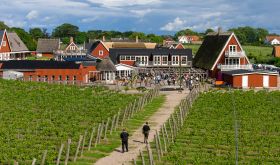
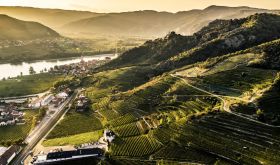
A drive round the Barossa Valley in South Australia with veteran winemaker Colin Glaetzer last February made an indelible impression of this extraordinarily distinctive wine region currently in transition. Glaetzer, whose training included ferrying half-bottles of champagne to the late Ronald Avery of Bristol when he was in hospital, was famously responsible for E & E Black Pepper Shiraz, one of the Barossa Valley’s gold standard reds of the current era. With his winemaker son Ben, he still specialises in making concentrated, savoury, warming reds based on fruit bought in from old, dry-farmed Shiraz vines grown in the Ebenezer district in the north west of the Valley.
We leave his winery on the outskirts of Tanunda and pass neat, freshly painted versions of Australia’s vernacular 1930s bungalows. Blinds are drawn to keep the glaring sunshine off three-piece suites. Rockeries are popular and lovingly maintained. Tall, pink, long-stemmed Easter lilies line the roadsides.
En route to the venerable vineyards of Ebenezer, oneo f Barossa’s distinctive terroirs, Glaetzer and his other son Sam who works for Foster’s Barossa Valley wine division, point out the famous Kalimna vineyard, source of some of Penfolds’ most revered raw ingredients. We pass the tiny Ebenezer community hall on a wide dirt track and a little tin-roofed church surrounded by trees – both obviously lovingly maintained.
At one point there are vines on both sides of the road. About the vineyard on the right, its vines weighed down with purple bunches, Glaetzer growls, “the owners of that one are too keen on water. It’ll get to the point where we stop buying from them.” He approves of the much more sparsely-fruited, gnarled old vines on the left though. “Some of the grapes from here go to us, some to Penfolds for Grange,” he says with a reference to Australia’s most famous wine. “The fruit we use is mostly hand-picked”.
“By whom?” I ask, knowing how serious the labour shortage is in rural Australia. He keeps on driving but his brow furrows. “They’re from – what’s that country, Sam?” “Cambodia.” “That’s right, Cambodia.” Throughout my time in South Australia I see vineyards worked by people who look as though they would be more at home in paddy fields.
At the next vineyard we get out of the car and walk through the soft, red soil to inspect the vines more closely, because they will soon be picked by those useful Cambodian first-generation Australians. Colin is particularly pleased by the crop level in this vineyard planted early last century. “Good, small clusters,” he observes approvingly.
“The yield here’ll be about half a tonne per acre. If yields go over two tonnes an acres, you may as well buy your fruit upriver. Anything over two and you’ve lost the plot quality-wise.” South Australia’s most famous wine region is certainly very, very different from the state’s biggest, the heavily-irrigated Riverland, a vast tract of factory-farmed vines that stretches along the banks of the Murray River in Australia’s scorched interior.
The reputation of old-vine Barossa Valley Shiraz is now so high that the best fruit costs between eight and ten thousand Australian dollars a tonne (compared to 800 for basic Riverland grapes). And such is demand for the most acclaimed labels that for every plot of ancient Shiraz vines there are now dozens of ambitious winemakers anxious to get their hands on the particularly concentrated fruit they produce.
In most wine regions there is a certain tension between vine growers and wine producers, but the very particular character of the vine growers of the Barossa Valley makes it one of the least volatile relationships in the wine world. The reason lies in the surnames of Barossa’s growers, names such as Schulz, Schubert, Marschall and Mattschoss. The Barossa Valley was originally settled in the 1840s by God-fearing, German-speaking immigrants from Silesia, hard-working victims of religious persecution.
“About 90 per cent of Barossa vineyards are freehold, mostly owned by staunch Lutherans who don’t believe in chasing the dollar,” Christie Schulz of Turkey Flat Vineyards told me in the 150 year-old, thick-walled lath and plaster bottle shop where her husband Peter’s great great grandfather originally sold meat to the settlers of Tanunda. You don’t (yet) see many of these names on a wine label because the growers, many of them sixth-generation by now, have generally been content to grow, leaving the winemakers to make. The Glaetzers and Schulzes are unusual in having made the transition from vineyard to cellar.
On the face of it there is a yawning gulf between the simple grape farmers to be found in the Ebenezer church every Sunday and, say, Torbreck’s Run Rig allocated at $200 a bottle by Wally’s Wine & Spirits in Los Angeles. But now that an increasing proportion of Barossa Shiraz enjoys international acclaim, some Barossa growers are tempted to try their hand at winemaking – the son of one of the Glaetzers’ growers, for instance. At a gathering of some of Barossa’s newer wine producers over lunch at Barr-Vinum in Angaston I was told, “We know how dependent we are on our ‘gardeners’, and most unusually it works because both sides are well organised. Growers tend to think winemaking’s easy and it’s true. Making wine is not that hard, but selling it is. The big companies, who have always determined the grape prices, used to have a very patronising attitude to the growers. But there’s been a cultural shift recently to recognise that we all do it together.”
Louisa Rose, a winemaking star at Yalumba, the biggest family-owned company in the Barossa, added, “In the last 10 years, we’ve spent much more time with the growers. We go out and taste with them and make sure they know what their grapes go into.”
The story of Barossa Shiraz and its renown today is all the more extraordinary in the light of the Vine Pull Scheme of the 1980s. The big companies, most of which have processing plants in the Barossa, decided that, in the words of the Growers Liaison Officer in 1985, “Shiraz is the Sultana of the Barossa”, meaning it was fit only for dried fruit and table grapes. The local Shiraz was scorned. Growers could hardly give it away. Winemakers bleached the colour out of it and blended it into cheap whites. Financial incentives were offered to those who would pull it out. Then, according to long-serving Barossa Valley wine producer Bob McLean, “the Masters of Wine came and toured Australia in 1986 and really admired our Shiraz, at a time when we were obsessed by Cabernet Sauvignon.” Cabernet was then novel and French while Shiraz was regarded as the local weed. But visionary producers such as Peter Lehmann and Robert O’Callaghan of Rockford Wines began to re-assess the true value of the Valley’s greatest resource, and the rest is modern history. I suspect we will see more of those old Germanic names on wine labels.
I find many Barossa Shirazes unbalanced: picked too late they can be too alcoholic, dry and/or overripe, but the following represent animated rather than dead fruit and manage to combine depth of flavour with energy, interest and refreshment value.
Heritage, Barossa Shiraz 2002 £11.49 Australian Wine Club of Datchet
Hewitson, Ned & Henry’s Shiraz 2003 £14.50 Noel Young, Wine Raks of Aberdeen
Teusner, Albert 2003 £150 a case in bond, Bordeaux Index of London
Schwarz Wine Company, Nitschke Block Shiraz 2003 £18.95 Cellar Door of Overton
Glaetzer, Shiraz 2002 £28.99 Noel Young of Trumpington, Great Western Wines of Bath
Rusden, Black Guts Shiraz 2002 £36.95 Cellar Door of Overton
For full notes, scores and background on well over 100 more wines, see Barossa tasting notes – big, bold and sometimes beautiful