Do management consultants ever look at the champagne business?
After 48 hours in Champagne enjoying intensive visits to nine of the most famous houses there (see A tour of nine major champagne houses), I suspect not. In the cool cellars of several famous names I found chefs de caves continuing to follow habits that anyone interested in efficiency would surely immediately ban.
Perhaps the most extreme example is the most distinctive of what the Bollinger team regard as the ‘five pillars’ of Bollingerness: vineyards (their own supply more than 50% of their needs); Pinot Noir (which constitutes at least 50% of all their blends); barrel fermentation (unusual but an important factor in all their vintage and prestige cuvées); time (at least three years for their non-vintage blend when 15 months is the legal minimum); and, finally, reserve magnums.
‘Reserve magnums – what the heck are they?’ I hear you ask. It is absolutely the norm for the non-vintage blends that constitute about 95% of all champagne produced to blend in some wine older than the most recent vintage. This is called reserve wine and is generally kept in stainless-steel tanks. Some of the grander houses may keep a portion in large old wooden casks. But, either way, adding their contents to the great big holding tank of the blend is not a particularly difficult operation.
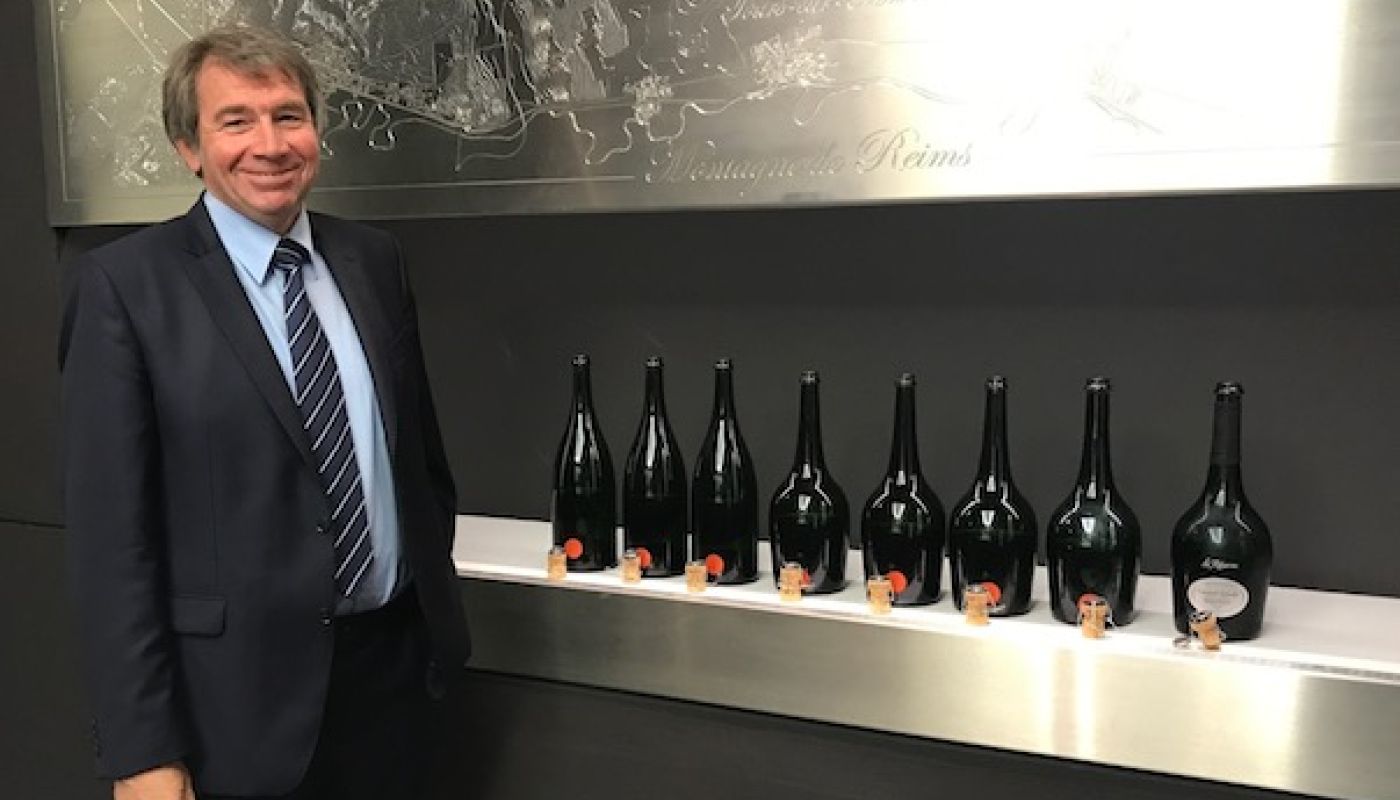
Bollinger, on the other hand, keep reserves of some their older wines in hundreds of thousands of magnums (double-sized bottles), stoppered not with the easy-to-manage crown caps that are the Champagne norm, but with old-fashioned corks and those super-traditional metal clips called agrafes that have to be painstakingly levered off one by one.
So for the first two months of every year when all the champagne houses are blending their latest non-vintage cuvées, eight of Bollinger’s employees have to devote their working weeks to opening thousands of these reserve magnums. Does this sound like the sort of thing a management consultant would approve of? It doesn’t to me. But when Jérôme Philipon joined the house as CEO in 2007, the first thing the famous chef de caves Jacques Peters of LVMH-owned Veuve Clicquot said to him was, for heaven’s sake keep the reserve magnums; it’s Bollinger’s point of difference.
The truth is that, being a private company, Bollinger is allowed to do what it feels is best for the quality of their wine – and they are convinced that the very lightly sparkling contents of these reserve magnums with the lees of the fermentations that took place inside them provide the crucial seasoning that makes Bollinger so distinctive. Bollinger Special Cuvée, with its dry, deeply savoury, often mushroomy character, is certainly hugely recognisable and a different animal from other champagnes. The Bollinger team themselves admit that, were it a listed company, they would almost certainly not be allowed to continue this cumbersome practice.
At another famous house in private hands, stainless-steel-loving Laurent-Perrier, I enjoyed another champagne legend that seems to defy current commercial logic, their prestige cuvée Grand Siècle. Ever since it was first conceived in the mid twentieth century by Laurent-Perrier’s guiding spirit the late Bernard de Nonancourt, whose daughter Alexandre directs the house today, Grand Siècle has always been a Chardonnay-dominated blend of three vintages of their finest wines.
Tasting with their long-serving winemaker Michel Fauconnet (pictured above right), it became clear that he has an almost religious attitude towards Grand Siècle. It is the last vestige of the spirit of de Nonancourt, who devised a recipe which must not be deviated from. The idea is that no single vintage dominates the wine. Instead the three vintages serve to maintain the platonic ideal of Grand Siècle that should be as constant as possible, no matter what the ingredients.
The wine itself is a marvel of finesse. Even the current blend that is made up of 1999, 1997 and 1996 – rather old vintages by the lights of any other house – tastes extremely fresh, polished and featherlight. It’s very unlike any other champagne I can think of, perhaps stereotypically feminine, and almost the polar opposite of Bollinger’s style.
But from the knowledgeable consumer’s point of view there is a problem. There is no way of knowing by looking at the bottle which vintages are in it. The wine is released when M Fauconnet reckons it is ready to drink and consumers are meant not to cellar it, but simply to sup it up – within 18 months of release. But what happens if stock gets stuck in the pipeline? Admittedly this is a luxury product available in strictly limited quantities, but it does seem to me wildly out of line with today’s thirst for knowledge, and vagaries of distribution.
I also wondered out loud, marvelling at Grand Siècle’s extraordinary finesse, whether it could really stand up to food – and was assured that it is a great match with white meats, truffles, risotto and crayfish. Fauconnet positively smacked his lips at the mention of white truffles in particular. Eat your heart out, Barolo.
And then a third house of the nine I visited, Lanson, also had me scratching my head. As it happens, Bernard de Nonancourt was brought up by his Lanson grandfather, his father having been killed in the First World War. Perhaps partly because of this, he seems to have been determined to make his champagne house distinctly different from Lanson.
Lanson’s distinguishing feature, through the recent vicissitudes of its ownership and access to vineyards, has long been its suppression of the softening malolactic conversion of harsh malic acid to gentler lactic acid which is de rigueur in the majority of champagnes. The result of this policy is that the wines have been extremely high in acidity when young, sometimes uncomfortably so.
A new winemaker, Hervé Dantan from the well-regarded Mailly co-op, arrived in 2013 and has gradually been introducing a little wine that has gone through malo to the non-vintage Black Label cuvée blend – which I for one think is an extremely good thing. But he is planning to keep the no-malo policy for their vintage-dated wines.
I tasted the five last vintages of no-malo Lanson Noble Cuvée Blanc de Blancs – from 2002 back to 1989 – and in my view neither the 2002 nor even the 1997 were ready. A 20-year-old wine that is still a bit too tart to enjoy seems a bit of a commercial mistake to me. I wonder what a management consultant would think?