
See our guide to coverage of this review of the 2010s, including all the tasting notes.
I spent last week, a week when, thanks to the Lord Rennard affair, discussion of sexual relations in the UK workplace reached fever pitch, as the only woman closeted a room with 19 male co-workers. I do this every January, a three-day total immersion in the bordeaux vintage harvested three and a bit years before and I have to say that my fellow tasters, always exclusively male, are increasingly well behaved – mainly perhaps because of age. Not only am I well past the age of a flirty run around a filing cabinet, but the least sexually politically correct members of the original tasting team are alas no longer with us. The younger tasters, all members of the posh end of the British wine trade, are much less likely than their predecessors to compare the wines we're tasting to women, although the late Bill Baker of Reid Wine's exclamation 'tart's wine' is still heard at this annual gathering from time to time – particularly when we are tasting the lesser St-Émilions.
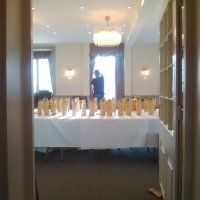
From Wednesday to Friday we laboured from 9 am until 6 pm in the upper room shown here of Southwold's Crown Hotel on England's east coast, blind tasting a total of 328 bordeaux 2010s – far more than usual in deference to the vintage's reputation. The previous year we had succumbed to the flashy, super-ripe charms of the 2009 vintage. Both before and immediately after bottling, the 2010s had also shown extremely well, albeit with decidedly more framework for their flesh than the 2009s had had. At the end of the three days last week, having tasted all the most respected wines of both colours and even more of the lesser ones, some of our group expressed mild disappointment that the 2010s seemed to be exhibiting less obvious charm and class than had been expected. But I am still extremely optimistic about this vintage. In general it has real concentration and the best have a heavy charge of wonderfully ripe tannins. The 2009s are much easier to love at this early stage but I think the better 2010s will eventually provide great drinking.
The finest wines – the first growths and equivalents – really are wonderful by any measure. Their prices are so high nowadays that their owners can afford to make the strictest selections, so I fully expect them to manage to make respectably superior wines even from the poor hand dealt by nature in 2013, albeit in relatively tiny quantities. But they cost so much more than wines just one layer down in Bordeaux's pecking order, the top second growths and equivalents (£6,000 to £9,000 a dozen bottles rather than £800 to £2,000), that one of the keys to finding the best buys of any Bordeaux vintage is to identify the best performers at this level – those capable of giving the first growths a run for their money. In recent vintages, Château Pichon Longueville has been one obviously reliable candidate, as has Château Cos d'Estournel (with the exception of its rather odd 2009 vintage).
But these recent tastings confirmed that there is value to be had in 2010 bordeaux much lower down the scale. Unlike 2009, this is not a vintage so chock full of fruit that even the most basic wines have a certain appeal. Many of the second wines made at smart addresses are disappointingly weedy – as though all the scrawny, underripe fruit was chucked in. And the same is true of some of the lesser classed growths, those wines that rely for sales on the fact that they are fifth growths or whatever. But I noticed a marked contrast between them and the most ambitious of the crus bourgeois, the châteaux in the Médoc that are not crus classés, classed growths, but have to apply each year, on the basis of that year's wine, for cru bourgeois status. You might call them the try-harder brigade. Some of these can offer seriously good value (see my recommendations).
Mind you, I should qualify that comment about second wines. There is a world of difference between a wine such as Écho de Lynch Bages, which is a second wine in the pure sense of being a repository for wine that did not make it into the (very respectable) grand vin Château Lynch Bages, and Les Forts de Latour, a wine produced in the same cellars as the grand vin of first growth Château Latour but from specific plots assigned to the production of Les Forts. Les Forts de Latour 2010 is one of the most impressive wines of the vintage, but is priced accordingly.
In general on the left bank, Margaux was – yet again – the most disappointing appellation, while St-Julien and St-Estèphe both produced some stunning wines. The Pauillacs seemed more wildly varied than usual. Of course, with three first growths, Pauillac fielded some of the most glorious wines of all, but also some of the weediest.
On the right bank, the lesser St-Émilions seem to be slowly improving with every vintage, with fewer pastiches of overripe fruit and under-seasoned oak in evidence. Pomerol next door produced a host of delicious 2010s, not all of them from the top drawer.
Two of the most disappointing flights were those devoted to dry white bordeaux, a category of which many of us had such high hopes when the wines were shown en primeur in April 2011. Some of them tasted like a throwback to a pre-technological age (why does Château Talbot in St-Julien bother to make a dry white?). La Mission Haut-Brion Blanc that had once been so gorgeous seemed at an awkward stage, and we suspected that our sample of Pavillon Blanc de Château Margaux had been damaged by excessive exposure to light. The better sweet white bordeaux 2010, on the other hand, from those châteaux that can afford to make a real selection of the best fruit, were exceptionally luscious.
Talk of sweet wines inspires mention of 'the ladies' in a certain quarter. My contribution to the sexual politics debate is that I wanted to ask each of my 19 fellow tasters, from a range of the most respected fine-wine merchants in the UK, whether they genuinely believed they were a better taster than any woman who works for their company. Perhaps next year they might consider giving some of the many talented younger women in the wine business a break and some additional experience and send someone along to bump up the distaff side.
BEST VALUE 2010 BORDEAUX
Prices given below are very approximate: the international average price per bottle (often minus taxes) according to wine-searcher.com, which also cites retailers. Particularly good buys are in bold type.
L'Enclos, Pomerol £31
Quinault l'Enclos, St-Émilion £24
Haut-Bergey, Pessac-Léognan £31
de Fieuzal, Pessac-Léognan £30
Deyrem Valentin, Margaux £18
Croizet-Bages, Pauillac £24
Phelan Ségur, St-Estèphe £33
Tronquoy Lalande, St-Estèphe £30
Haut-Marbuzet. St-Estèphe £30
Cos Labory, St-Estèphe £29
Capbern Gasqueton, St-Estèphe £16
Sociando Mallet, Haut-Médoc £27
Belgrave, Haut-Médoc £26
Chasse-Spleen, Haut-Médoc £24
de Camensac, Haut-Médoc £20
Lestage, Listrac-Médoc £18
Fourcas Borie, Listrac-Médoc £13
Bel Orme Tronquoy de Lalande, Haut-Médoc £15
de Lamarque, Haut-Médoc £12
Malescasse, Haut-Médoc £12
Tour St-Bonnet, Médoc £11
Beaumont, Haut-Médoc £11
Classic 2010 bordeaux reviewed
• 1 分で読めます
This is a longer version of an article also published in the Financial Times.


購読プラン
スタンダード会員
$135
/年間
ワイン愛好家向け
- 296,928件のワインレビュー および 16,142本の記事 読み放題
- The Oxford Companion to Wine および 世界のワイン図鑑 (The World Atlas of Wine)
- askJancisへのアクセス(AIワインアシスタント)


プロフェッショナル
$299
/年間
ワイン業界関係者(個人)向け
- 296,928件のワインレビュー および 16,142本の記事 読み放題
- The Oxford Companion to Wine および 世界のワイン図鑑 (The World Atlas of Wine)
- askJancisへのアクセス(AIワインアシスタント)
- 最新のワイン・レビュー と記事に先行アクセス(一般公開の48時間前より)
- 最大25件のワインレビューおよびスコアを商業利用可能(マーケティング用)
ビジネスプラン
$399
/年間
法人購読
「プロフェッショナル」プランの内容に加えて
- 最大250件のワインレビューおよびスコアを商業利用可能(マーケティング用)
- レビュー依頼用のワインを提出可能
- 従業員向けにメンバーシップを提供し、一元的に管理可能
- APIアクセス(※別途料金)
More 無料で読める記事




More from JancisRobinson.com

今週のワイン
フランス中部の赤ワインに見る、渇きを癒すフレッシュさ。 £15.50、$26.95から 。...

書籍レビュー
クラシック・ワイン・ライブラリーへの3つの新刊と、ポルトガル・ワインに関する自費出版ガイド。 以下のレビューのうち3冊は、アカデミー・デュ...

テイスティング記事
南アフリカで最も人気の高い白ワインの進化をたどる、示唆に富んだヴァーティカル・テイスティング。このワインは...

テイスティング記事
ボルドーの伝説的なシャトーによる25年分のワイン。 ボルドー・ヴァーティカル・テイスティング・ガイド[/ja/articles/guide...

Bite-sized
うま味中毒者よ、東へ向かえ。顎が痛くなるほど美味しいフュージョン料理と本州サワーが待っている。 巧みな汎アジア料理の再解釈で高い評価を得て...

テイスティング記事
並外れたバランス、明るい酸、そして近年の記憶にないほど素晴らしいグーツヴァインの年。さらに、素晴らしいリースリングが大量に生まれた...

今週のワイン
ニューヨーク州フィンガー・レイクスを米国のリースリングの聖地として確立した辛口白ワイン。そして、その品質は向上し続けている。31...

現地詳報
ワインとチーズの冒険 – チェダー、最高のチーズか? 本物のワインには本物のチェダーを。 ちょっとした奇跡で...