ヴォルカニック・ワイン・アワード | The Jancis Robinson Story (ポッドキャスト)

Competition – Jessica Green

2018年9月26日 水曜日 • 3 分で読めます
Image

‘Jessica H. Green came to wine via a background in scholarship and journalism. During a high school year in France, she toured a vineyard for the first time and developed a life-long interest in wine. She was a Morehead-Cain scholar at the University of Chapel Hill and earned an MA in Renaissance Studies at Yale. She studied at the University of Bologna and later spent a year in the Chianti Classico region of Tuscany. For five years, she lived in Lyon, France, between Beaujolais and the wines of the Northern Rhône. She has pursued a career in publishing, as a book and magazine editor, a literary agent, and now as a writer. Her articles on wine have appeared in trade and consumer publications including The Wall Street Journal, American Express Publications, and Beverage Dynamics. She earned the WSET Diploma in 2009 and is a candidate for Master of Wine. She was recently awarded the inaugural SommFoundation David A. Carpenter Master of Wine Scholarship to support her studies. At the International Wine Center in New York, she teaches WSET Levels 1 through 4 (Diploma).’ Her (unedited) entry in our seminal wine competition follows. 

It wasn’t a celebrated vintage. It wasn’t in a bottle. In fact, I didn’t even taste it—I felt it.

One fall morning in the Languedoc, a bus struggled up a winding, dusty road and brought twenty-odd classmates and me to a small patch of vines on an arid plateau where little else grew. I was 16 years old.

As we tumbled out of the bus, unfolding gangly limbs, we shielded our eyes from the unfamiliar sun. We were visiting from Brittany, where it hadn’t stopped raining for a month. A farmer, the vigneron, shook each of our hands as we got off the bus—a gesture that seemed more formal than we deserved. This was a serious visit. I was excited.

I didn’t grow up in a wine-drinking family. In the United States in the 1970s, wine was an exotic rarity. My parents bought an occasional bottle of Matteus or Blue Nun for parties in our home, served alongside beer or cocktails. Later, though, my step-mother, Sylvie, whose father was French, introduced me to the tradition of wine with dinner. Even as a pre-teen, I was allowed a glass of wine mixed with water at the table, and by high school, I was served a proper glass alongside them, in modest quantities. It felt civilized and grown-up. Most of all: it was delicious.

On my school year abroad, I lived with a French family who also drank wine at dinner, and to my delight, I was offered a small tumbler as well. Most days, the wine was poured from unlabeled bottles that we filled in the basement from two large casks—one for white wine, one for red. We mostly drank red. On special occasions, like New Year’s Eve or an engagement party, a glass of Kir would precede the still wine, and it would all be followed by an eau-de-vie with a handwritten tag—pears from Madame le Bayon, apples from grandmother’s house. The spectrum of delicious expanded, but still wine delighted me most.

I had never considered the source of the flavor, though. It sounds silly, but wine struck me as a kind of magical elixir, rather than a man-made product. In New England, I never saw a vineyard. I saw orchards with cider presses, maple trees and sugaring houses transforming sap into syrup. I loved to pick wild blueberries in Maine and raspberries from prickly bushes in Connecticut. I once picked all the cherries from a tree at our Massachusetts home and proudly baked a pie with them.

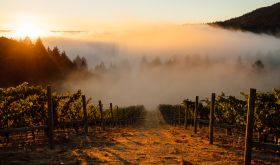
But here in Southern France, the landscape was wild. It looked like a place you would find a cactus rather than a vine—but what did I know? Nothing at all. Here were rows of little knarled trunks with spindly wooden arms and some colorful leaves—no fruit. The grapes had all been picked already. I suddenly had the naïve realization that wine began with a plant, and one that grew in a specific place, with specific challenges of weather and soil. One that needed tending.

The vigneron then brought us out of the sun into the darkness of the chai, which looked like a barn. The smell enveloped us. You know the smell--but I had never smelled it before: fermenting grapes. Strong, unique.

We followed him single file past harvesting equipment, sinks, and large foudres on the first floor up a creaky wooden staircase to the loft, where open wooden vats were lined up near the open barn windows. The thrilling smell grew stronger. A gentle sound came from the vats: bubbling.

It is difficult to explain how engaged all of my senses were at that moment: the cool dark air after the bright arid vineyard, the sound of wooden boards groaning underfoot, the mysterious gurgling—and the almost overwhelming aroma. We all stared at the vats.

The vigneron then did something I will never forget. He grasped my wrist and thrust my hand over the nearest vat. Chaud! I said. It was hot! Are they heated? I asked stupidly, and the kind vigneron smiled. That’s fermentation, changing the grapes into wine, he said quietly, with respect for the awe I was feeling.

It has never left me, that awe. 

この記事は有料会員限定です。登録すると続きをお読みいただけます。
スタンダード会員
$135
/year
年間購読
ワイン愛好家向け
  • 288,380件のワインレビュー および 15,869本の記事 読み放題
  • The Oxford Companion to Wine および 世界のワイン図鑑 (The World Atlas of Wine)
プレミアム会員
$249
/year
 
本格的な愛好家向け
  • 288,380件のワインレビュー および 15,869本の記事 読み放題
  • The Oxford Companion to Wine および 世界のワイン図鑑 (The World Atlas of Wine)
  • 最新のワイン・レビュー と記事に先行アクセス(一般公開の48時間前より)
プロフェッショナル
$299
/year
ワイン業界関係者(個人)向け 
  • 288,380件のワインレビュー および 15,869本の記事 読み放題
  • The Oxford Companion to Wine および 世界のワイン図鑑 (The World Atlas of Wine)
  • 最新のワイン・レビュー と記事に先行アクセス(一般公開の48時間前より)
  • 最大25件のワインレビューおよびスコアを商業利用可能(マーケティング用)
ビジネスプラン
$399
/year
法人購読
  • 288,380件のワインレビュー および 15,869本の記事 読み放題
  • The Oxford Companion to Wine および 世界のワイン図鑑 (The World Atlas of Wine)
  • 最新のワイン・レビュー と記事に先行アクセス(一般公開の48時間前より)
  • 最大250件のワインレビューおよびスコアを商業利用可能(マーケティング用)
Visa logo Mastercard logo American Express logo Logo for more payment options
で購入
ニュースレター登録

編集部から、最新のワインニュースやトレンドを毎週メールでお届けします。

プライバシーポリシーおよび利用規約が適用されます。

More 無料で読める記事

Meursault in the snow - Jon Wyand
無料で読める記事 この困難なヴィンテージについて我々が発表したすべての記事。発表済みのワイン・レビューはすべて こちらで見ることができる。写真上は、レ・グラン...
View over vineyards of Madeira sea in background
無料で読める記事 しかし、偉大な酒精強化ワインの一つであるマデイラは、この特別な大西洋の島での観光開発にどれほど長く耐えられるだろうか...
2brouettes in Richbourg,Vosne-Romanee
無料で読める記事 イギリスの商社による2024年ブルゴーニュ・アン・プリムールのオファーに関する情報。写真上は、ヴォーヌ・ロマネのリシュブール・グラン...

More from JancisRobinson.com

Vietnamese pho at Med
ニックのレストラン巡り Nick highlights something the Brits lack but the French have in spades – and it’s not French cuisine. This week...
South Africa fires in the Overberg sent by Malu Lambert and wine-news-5 logo
5分でわかるワインニュース Plus an update on France’s ban on copper-containing fungicides for organic viticulture. Above, fire in South Africa’s Overberg, sent by...
A bottle of Bonny Doon Le Cigare Blanc also showing its screwcap top, featuring an alien face
今週のワイン You need to know this guy . From $23.95 or £21 (2023 vintage). Whenever I mention Bonny Doon, the response...
Wild sage in the rocky soils of Cabardès
テイスティング記事 The keystone of Languedoc viticulture, explored. See also Languedoc whites – looking to the future. ‘Follow me!’ And I do...
the dawn of wine in Normandy
現地詳報 Turning tides have brought wine back to the edges of north-west France, says Paris-based journalist Chris Howard. This is part...
Nino Barraco
テイスティング記事 マルサラの評判を復活させる新世代の生産者たちを詳しく見るウォルターの記事の第2部。写真上は、この運動のスターの一人、ニーノ・バラーコ...
Francesco Intorcia
現地詳報 Perpetuo, Ambrato, Altogrado – these ancient styles offer Marsala a way to reclaim its identity as one of Sicily’s vinous...
La Campana in Seville
ニックのレストラン巡り スペイン南部のこの魅力的な街を訪れるべき、さらに3つの理由。 1885年にセビリアで初めて扉を開いたコンフィテリア・ラ・カンパーナ...
JancisRobinson.comニュースレター
最新のワインニュースやトレンドを毎週メールでお届けします。
JancisRobinson.comでは、ニュースレターを無料配信しています。ワインに関する最新情報をいち早くお届けします。
なお、ご登録いただいた個人情報は、ニュースレターの配信以外の目的で利用したり、第三者に提供したりすることはありません。プライバシーポリシーおよび利用規約が適用されます.