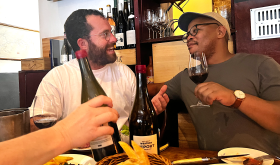
Phil Freese is best known as the man who looked after Robert Mondavi’s vineyards in the Napa Valley, designed the first Opus One vineyards and, with NASA, came up with some hi-tech ways of monitoring vines and wine quality. He has consulted widely in both California and South Africa and has just launched Vilafonté, ‘South Africa’s first luxury wine brand’, a project he and his partner Zelma Long with Mike Ratcliffe of South Africa and Bartholomew Broadbent of California have been nursing over the past few transhemispherical years.
But he has a new passion, to judge from this email recently received: “I have become infected with an interest in Grenache! This interest comes partly from a new project here in Sonoma County. We’ve set our standards high and want to see if we can do something of good standing with the variety, using the wines of the Priorat and specifically of L’Ermita as a benchmark! I’m at the point where going and seeing seems to be the next step…”
Freese is far from the only internationally renowned wine producer currently re-evaluating a red wine grape that is the world’s fourth most planted – and is more common even than Chardonnay – but for years has been rather despised outside Châteauneuf-du-Pape where it forms the backbone of the heady, herby reds made there. Grenache is mainly grown in a great swathe round the north western Mediterranean coast. About 80,000 hectares (200,000 acres) of it grow, mainly as gnarled old bushes, all over the south of France, and about the same area is devoted to it in north east Spain where it is known as Garnacha and has until very recently been regarded almost as a weed in comparison to the supposedly much more noble Tempranillo vine.
Chris Ringland of South Australia is another recent convert to the virtues of the G grape. His powerful Barossa reds, which used to be called Three Rivers until the Washington state winery of the same name objected and so are now sold under the Chris Ringland label, sell for hundreds of dollars a bottle, but his most recent project has been in the little-known northern Spanish region Campo de Borja. In conjunction with US importer Jorge Ordoñez and the local wine co-operative, he has fashioned some amazingly rich, sophisticated wines out of the dry-farmed, bush-like Garnacha vines that dominate the Campo de Borja landscape. These vines yield just three or four bunches of grapes per vine which produce extraordinarily concentrated wine. Ringland’s Alto Moncayo is widely available in the US for around $30 a bottle (about the same price as a decent Châteauneuf-du-Pape).
As Phil Freese suggests, the inspiration for Grenache’s return to fashion is just as likely to have been Priorat as Châteauneuf. This small, mountainous Catalan wine region was catapulted to fame in the 1990s by Alvaro Palacios whose L’Ermita bottling of mainly old-vine Garnacha grown on precipitous schist rapidly became one of Spain’s most expensive wines. Of course not every Grenache or Garnacha vine is capable of producing such a great, terroir-driven wine but, being so widely grown, there is no shortage of raw material, and a considerable amount of it can, with care and low yields, be made into deliciously juicy, rich, red – and pink – wine. In both Provence and Navarra, at opposite ends of the Grenache belt, it is particularly valued for the pink wines it produces. But more or less everywhere, the amount of tannin in red Grenache/Garnacha is determined by how little water the vine was exposed to during the growing season.
About a quarter of the world’s Grenache/Garnacha vines have been ripped up since the late 1980s because it has not been fashionable. But it is still relatively common, so grape prices are generally low, and because it has not been planted recently, the average vine age is high. This alluring combination of cheap grapes and old vines (the older the vine, the more complex and concentrated the wine it produces) has given rise to a new category of inexpensive wine, Old Vine Garnacha or Old Vine Grenache. The raw ingredients can be sourced all over north east Spain and particularly in Roussillon, France’s Catalan enclave. Here Grenache comes in several colours, including light-skinned grapes which were for years used in sweet, strong wines such as Rivesaltes and Banyuls but have shown recently that they are capable of making fascinating, full-bodied white wines such as Gérard Gauby’s.
Having been ignored for years in both Australia and California, Grenache is suddenly being sought out. For years in California it was chiefly associated with sweet, pale pink, vapid, just-wine labelled White Grenache. But today seriously exciting all-Grenache wines, and Grenache blends, are being made in California’s southern Central Coast wine regions by the likes of Alban, Beckmen, Garretson and Sine Qua Non, often thanks to better clones of Grenache imported from the Rhône Valley by the Perrins of Ch de Beaucastel of Châteauneuf-du-Pape to their Tablas Creek nursery in California. All of these producers are members of the so-called Rhône Rangers, the informal group of Californians who for years concentrated on other Rhône varieties, Syrah in particular, but this year chose King of Garnacha Alvaro Palacios of Priorat as the guest of honour at their annual gathering.
Australian Grenache is also looking increasingly promising, much of it from ancient vines. Several of my favourite wines in a recent Australian tasting were based on Grenache. Australia in particular specializes in GSMs, Grenache blended with two other grapes from the south eastern quarter of France, the Syrah/Shiraz of Hermitage and the Mourvèdre of Bandol, often known as Mataro in California and Australia (and Monastrell in Spain). Blends such as this, common in the Languedoc and originally inspired by the Châteauneuf-du-Pape recipe, can often be more interesting and long-lived than a 100 per cent Grenache and are also common in California.
Here, in order of increasing price, are the most impressive red mainly-Grenache wines I have tasted recently (apart from Châteauneuf-du-Pape, the archetype).
Grenache Noir 2004 Vin de Pays des Côtes Catalanes £4.99 Marks & Spencer
This unoaked 14.5 per center comes from vines up to 100 years old, according to M&S. It’s sweet, rich, remarkably ready to drink despite its youth and comes in a heavy bottle and perfectly acceptable label that look worth at least twice the price.
Domaine Jorel, Grenache Jeunes Vignes 2004 Vin de Pays d’Oc £5.50 Stone Vine & Sun
Deceptively ordinary name for a ripe explosion of sumptuous summery fruit. I preferred this to the more expensive, tougher, oaked bottling from older vines.
Baltasar Gracián, Garnacha Viñas Viejas 2002 Calatayud £6.99 Adnams of Southwold
Gentle, soft, flattering yet savoury with a neat, dry finish. For drinking or keeping a year or so.
Turkey Flat Grenache 2002 Barossa Valley £10.99 Portland Wine of Cheshire
Fabulous value from 90 year-old vines. Sweet, opulent berry flavours – almost reminiscent of Zinfandel. Very, very sweet and pretty tannic with the slightest of holes in the middle but lovely round texture.
Ross Estate, Old Vine Grenache 2003 Barossa Valley £11.99 Australian Wine Club of Datchet
Rich and ultra fruity with a freshness on the nose that is missing on most Shirazes. Very luscious and frank. Lovely kerpow fruit with a certain frankness. Dry tannins on the finish again but lovely up to that point.
Charles Cimicky, Grenache Pressings 1999 Barossa Valley £13.95 Australian Wine Club
Very rich and gorgeous on the nose. Sweet berries and luscious smooth texture with tannins only on the very finish. A little bit cleaner (and simpler?) than the average Châteauneuf.
Alto Moncayo, Aquilón 2002 Campo de Borja From $115 in the US
The top cuvée of the Ringland/Ordoñez Australo-American venture in northern Spain. So rich and sweet it’s almost like cocoa de luxe.
Torbreck, Les Amis 2002 Barossa Valley From $140 in the US
Based on Greenock 105 year old vines and made initially for Les Amis restaurants in Singapore. Extremely intense, masses of sweetness, a bit porty, a bit hot but very serious in intent. Has attracted silly prices at auction.