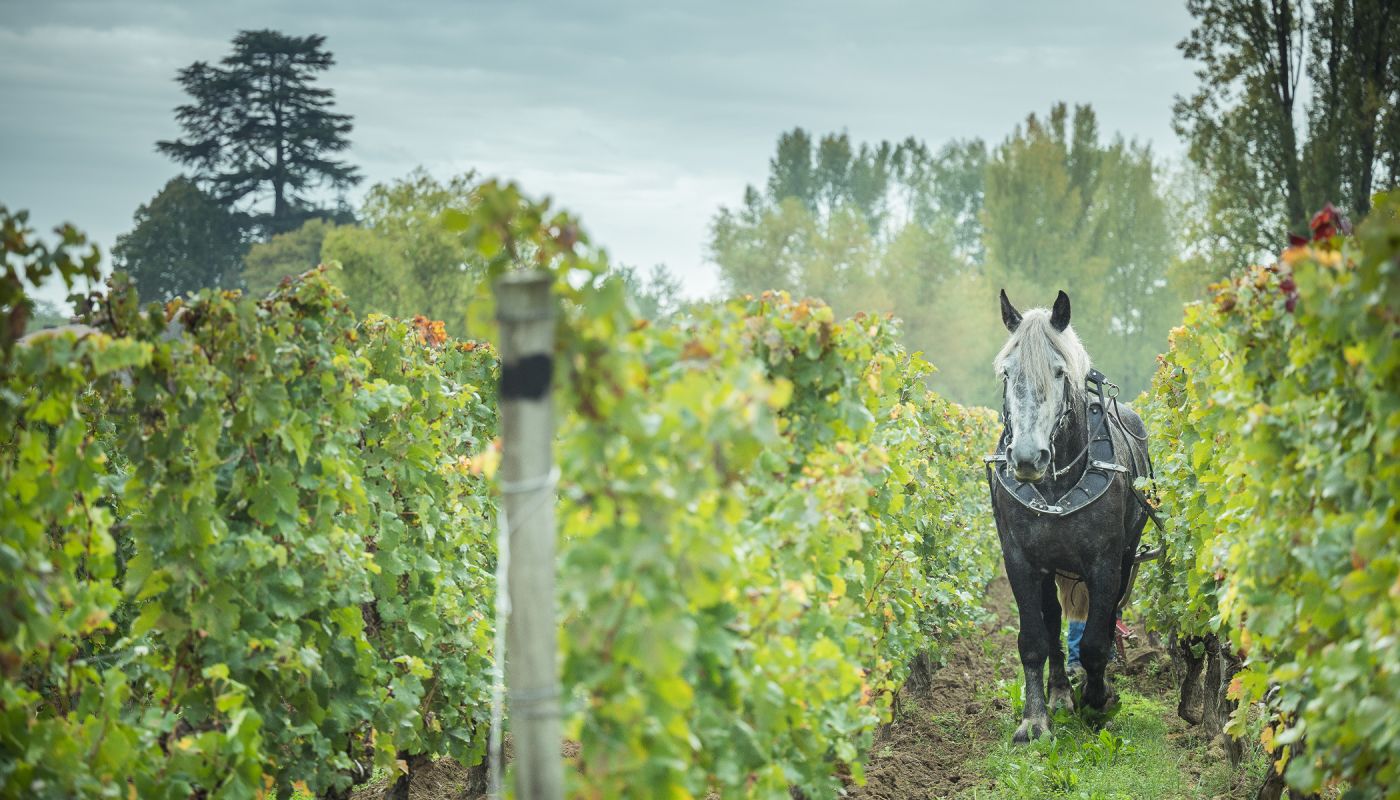
27 February 2025 The agricultural benefits of horses working vineyards are well known – but do we know how to care for them properly? Arnica Rowan suggests it's time for training and animal welfare protections. Above, one of Cheval des Vignes' horses at work.
Blue stands patiently between the vines, her massive rump gleaming with sweat and a bit of mud. Juliette Bouetz pours a hefty bag of seeds into the green hopper, a plastic bin strapped to a wooden frame atop a rusty iron sleigh. She gives Blue a little pat, clucks her tongue and the sensible mare immediately takes a step forward into the row. Her tail slightly raises and a waft of freshly digested hay fills the air. Blue’s polished leather harness flattens, the strong chain guiding the sleigh rattles and, with each soft thud of her four distinct steps, beans, vetch and radish seeds scatter across the ground.

I walk behind the seeder, the air full of bees’ wings, sunlight and the musk of a working animal. How far this daily labour is from the glossy fine-art images I first saw online. In 2021, French agricultural photographer Franck Simon shot Blue and another of Bouetz’s Percherons in the cellar of Château Beauregard in Pomerol, juxtaposing the curious, calm grey draft horses with the massive tear-drop concrete vats. The striking photographs went viral, kickstarting a widespread interest in Cheval des Vignes, Bouetz’s family company. Requests for horse modelling flew in from across Bordeaux, the estates wanting to position themselves in the same curated light as Château Beauregard, or better yet, Liber Pater, the world’s most expensive and famously horse-farmed wine. (Founder Loïc Pasquet actually ploughs his densely planted vineyards with a narrow-framed mule named Carbonero – Blue’s ample backside would never fit between Liber Pater’s staked vines.)
‘Our horses are not for marketing, though’, Bouetz says, laughing about the requests that she routinely turns down from châteaux just looking for a photo op. ‘They are too busy doing important vineyard work.’
Cheval des Vignes, the horse-powered vineyard services company started by her father Sébastien Bouetz in 2010, now serves 42 châteaux across Pomerol, St-Émilion and into the Médoc, working 120 hectares (297 acres) of vines. Blue is one of their 20 working-age registered Percherons, French draft horses bred for their quiet disposition and immense strength. Along with 25 more Percheron foals, breeding mares and draft trainees, the working horses are housed on 70 ha of pasture in Puisseguin, 10 km (6 miles) north-east of St-Émilion. Estates hire their horse-and-driver teams at €70/hour, mainly for décavaillonnage, aerating the soil and incorporating organic matter at the base of the grapevine trunks, as well as seeding, tilling and mowing between the vines.
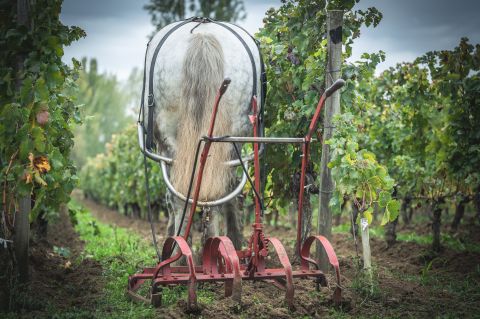
On the right bank’s heavy clay soils, the four hooves of a 907-kg (2,000-lb) Percheron create less compaction than a heavier tractor passing through the vineyard. Better soil drainage means less dampness, and less mildew, on grapes. Draft horses are able to manoeuvre between uneven plantings of old vines, navigate steep slopes and work tight vineyard corners that tractors cannot safely manage. Wide Percheron bodies graze the vertical shoots between bordelais rows, but their narrower legs don’t disturb the grapes in the fruiting zone while they work. The horses deposit fertiliser in the vineyard, with less greenhouse-gas emissions than their fossil-fuelled counterparts. Most importantly, in contrast to a mechanical tractor, a horse can feel resistance on its harness. When a plough touches a root or young vine, the horse simply stops before it’s uprooted. Well-trained draft horses even halt when they feel their equipment coming in contact with a trunk, avoiding damage. As fatal trunk diseases such as esca are introduced by open wounds, a horse’s sensitive touch is highly valued by estates that want to keep their vines healthy and in production.
Vine-longevity benefits have driven demand across the globe for horse-powered specialised services. Cheval des Vignes have trained more than 30 horse-savvy entrepreneurs from France, New Zealand, Belgium, Italy and Spain to start their own local equine vineyard companies.
Initially, Catalonian sparkling-wine producer Gramona contracted an independent draft-horse driver servicing several Corpinnat estates. Export area manager Andrés Rangel explained to me that it was a quiet trial to see if the work made a difference in their best vineyards. Once the improvement in soil quality became apparent, the family decided to invest more deeply in their own teams.

Gramona is one of the most beautiful vineyards I have explored and I don’t say that lightly. The saw-toothed Monserrat mountain range frames the Alt Penedès property along the north end. Rolling calcareous clay-loam hills tumble southerly towards the Mediterranean. Patchwork mounds of red earth, quilted with grass and chamomile, forest copses and vineyard plots, are stitched by tiny streams. The climate is the opposite of Bordeaux: hot, windy and extremely dry, with old vines planted wide apart so their roots can find water.
Tucked into the side of a little hill between vineyard plots is Gramona’s farm. Ripollesa sheep crowd the corner of their pen, waiting impatiently to be let out to mow the vineyards. Flashy black Castilian chickens lead their fluffy mottled chicks under the fences. A flock of angry geese attempt to chase off visitors, while lazy farm dogs observe from the dust, absorbing the Catalonian sun. Long-horned Albera cattle wander through the forest, munching on shrubs and ignoring the beehives scattered in the shade. In the middle of it all, three shaggy draft horses graze in a large, treed horse paddock, resting after a morning’s hard work in the fields.
Farm manager Mireia oversees the whole ecosystem of horses, bees, sheep, cows, birds and herb gardens, each component playing a balancing role in the Demeter-certified biodynamic estate. The riding horses in the horse paddock belong to the Gramona family, for enjoying weekend hacks through the bucolic landscape. However, the heavy draft horses, despite their grand names – Corsaire du Don, Divine du Dol, Altaïr de la Garenne – are solidly functional. The three drafts are currently tasked with ploughing five hectares of the estate’s most prized vineyard plots and three more hectares of American rootstock that will be field-grafted later this year. With drought conditions dramatically impacting recent vintages, the horses have been helping the dry-farmed estate adapt, by creating soil air channels to capture rain and uprooting spring grass so it doesn’t absorb any of the water that’s desperately needed for the vines.

The careful work of ploughing and hoeing is conducted by Gramona’s two full-time handlers, Dabo and Brahim, who, like the horses, were trained in the Aube region of France by Alain Lhopital. Although horses were commonplace in vineyards a hundred years ago, professional know-how is now held by a few interconnected specialists. The horse world is small – Lhopital also makes the harnesses for Bouetz’s Percherons. Just as Lhopital taught Gramona’s draft horses to be guided by voice and reins, sense resistance, pull equipment smoothly and communicate with their handlers, the humans were also trained in how to cue the horses, care for them and work the vines differently than with a mechanical tractor. Mireia, Dabo and Brahim’s professional development required years of training and mentorship. The team at Gramona emphasise that horses do not start by simply turning a key. The living beings require complex, full-time care.
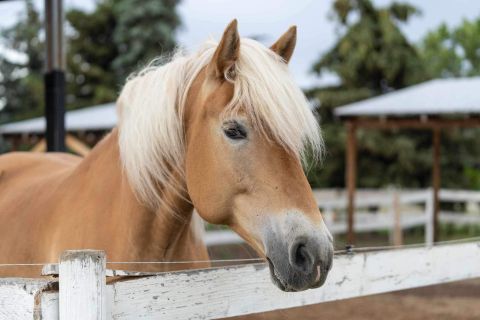
The enormity of this responsibility hit me full force a year and a half ago, when a little draft horse pranced into my own life. I fell in love with flaxen-maned mare at the Armstrong Interior Provincial Exposition, a massive autumn agricultural show in British Columbia, Canada. Two weeks later, Petra stepped off the trailer into the dressage barn in Kelowna, our nearby hometown. The horse trainer scratched her head at my choice: Petra is a registered Haflinger, a burly Südtirol breed not much bigger than a pony, traditionally used to plough fields and carry riders through the craggy Dolomites. She has the strength of a draft horse, but the spicy wilfulness of, well, a Haflinger.
As a first-time horse mom, I made so many mistakes. I paired a green, inexperienced horse with a green, inexperienced rider (my daughter). I fed Petra hay that was too rich, resulting in a stream of indigestion. We spent months finding her a properly fitting dressage bridle for her massive head. Around every corner, there was a lot to learn.
The trainer, the other riders at the barn, horse-vet friends, our animal chiropractor, an equine nutritionist we once house-sat for in France, a friend who runs a winery but used to coach national-level equestrian teams … they all offered wisdom and we incorporated their advice on the fly. Soon we had a happy, healthy, high-performance Haflinger, who is now showing beautifully in the ring (when she’s not bucking, of course).

But it hasn’t been easy, or cheap. Petra is fed low-sugar grass hay three times a day, which we drive an hour every month by truck and trailer to pick up, as well as daily rations of COB (corn, oats, barley) and minerals. The veterinarian floats her teeth (a process of smoothing a horse’s teeth for better chewing) once a year, the ferrier trims her hooves once a month and the equine barber shaves her twice each winter. If her gait is off, we send in the chiropractor. We dispense herbal medicines when she has the snivels or is in heat. There are riding equipment, salt and tick sprays for the summer, warm coats for the winter. Horses also have three essential species-specific needs: friends, forage and freedom. In addition to basic care, my daughter spends more than 20 hours a week between riding and longeing Petra on a long line and cleaning her paddock, with Petra enjoying daily pasture time to graze and horse around with her stablemates.
The level of investment isn’t unique to a pleasure horse: Cheval des Vignes’ working horses have their own support team of veterinarians, a dentist, a blacksmith, an osteopath, a nutritionist, a behaviourist. A draft horse may be cheaper upfront than a mechanical tractor, but there are year-round operational expenses. Even with field grazing, four year-round staff are required for Bouetz’s Percherons, with three more drivers employed during the vineyard-working months of March through November. The responsibilities extend before and well past the horse’s working years, with training and retirement care part of the lifetime commitment. As the farm team at Gramona shares: ‘the costs of horse-work simply aren’t comparable with a tractor’.
To pass professional knowledge about vineyard horse work and draft horse care to farms across the world, Cheval des Vignes recently formalised their apprenticeship model. Qualiopi certification from the French government recognises their 5- to 30-day courses as official training and provides funding for French vignerons and equine professionals to learn in Bordeaux. Incidentally, Bouetz reports that 50% of their trainees have been women, a growth area in the dominantly male viticultural sector.
Reflecting on my own steep learning curve, I realise that I could have caused Petra serious harm if I hadn’t been guided by equine professionals. Now when I encounter horses in vineyards, or the romantic marketing images online, I examine the situation with different eyes. Have the working animals’ guardians invested in knowledge to ensure a happy, healthy life for their horses? Unfortunately, I have seen too many inadequate shelters, overgrown hooves and ill-fitting harnesses.
Horses require a financial and time commitment of specialised care that lasts for decades. With increasing interest in the ancient practice of horse work, perhaps it’s time the contemporary wine world had a serious conversation about the inclusion of animals in viticulture. Official training qualifications support the development of handler professionalism, but ensuring horses’ basic rights as sentient beings through appropriate care is equally important. Sustainability and other existing vineyard certifications worldwide should include an animal-welfare component, especially in light of regenerative agriculture encouraging animal life in vineyards.
There are existing resources to shape our expectations, such as the Canadian National Farm Animal Care Council’s code of practice for the care and handling of equines, which I found helpful, and most countries have support documents in their own languages. In addition to the agricultural benefits of horses in the vineyard, our conversation should include realistic costs, the value brought to our industry and, most importantly, the animal guardianship standards we hold ourselves to when partnering with sentient beings to grow grapes and make wine.
Relevant photos courtesy of Cheval des Vignes and Gramona.
Arnica Rowan is a writer, consultant, agrologist and draft-horse mom based in BC, Canada. See more of her writing here, and more on regenerative viticulture here.
















