
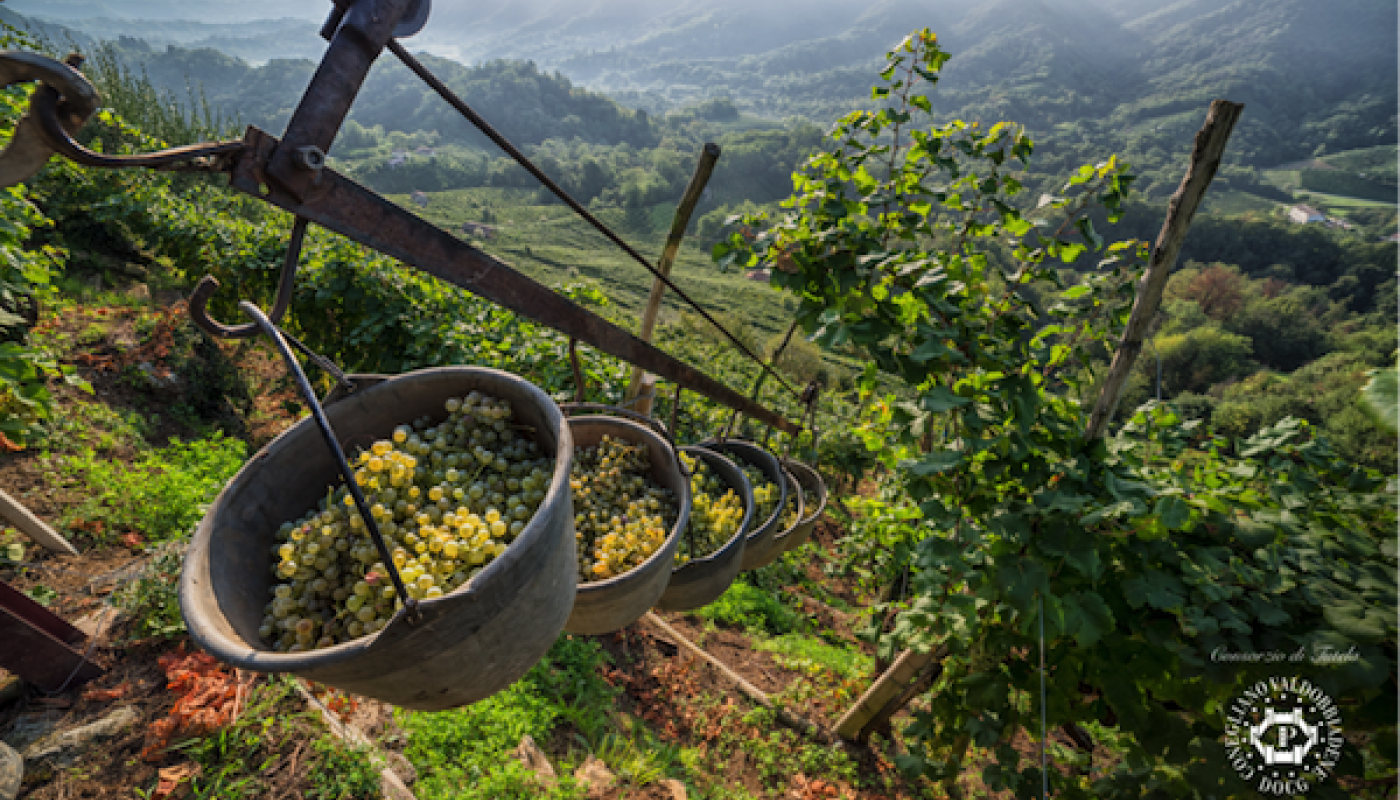
You may like the product, or not, but let’s stick to the facts, shall we?
Prosecco has become such a cash cow that everyone wants a slice of the Prosecco cake. But Prosecco itself isn’t benefiting at all and it certainly doesn’t ‘lend’ its name to anything. Quite the contrary: its name is taken without prior permission, while I don’t see how champagne truffles are any different from this. To suggest this is to create alternative facts, Richard! Believe me, makers of the Prosecco infused-with-whatever do not ask for permission nor do they share the profit with Prosecco producers. They just steal the name. Should one accuse Prosecco for that? How? Does it debase the product? Most likely yes. But it's misappropriation, not ‘lending’.
There are many, many cases of this abuse and to prosecute them all would mean hundreds if not thousands of cases. You only have to ask the Consorzio of Parmigiano Reggiano, for example, about the number of cases they have going regarding abuse of its name, not to mention the endless number of counterfeit Italian products in the global market – all a sign of the huge number of Italian wines and foodstuffs the world wants and is prepared to copy and steal without so much as the blinking of an eye.
While the credit crunch arguably played a part in the success of Prosecco in the UK, I personally think it was more the moment of ignition, with supermarkets especially playing a major role in the downward spiralling of the name.
Supermarkets have disproportionate buying power that can make or break a region. Working with contracts that are signed at least one year ahead of a given vintage and with clear stated volumes negotiated at cut-throat prices (why do you think it is so cheap?), it doesn't take much imagination to guess what happens when a vintage turns out to be so small that the goods literally cannot be delivered. So the fault lies with both parties – supplier and producer. Many supermarket buyers are MWs (some supermarkets insist on having only MWs as buyers) who must realise the cause and effect of the game they are playing. So, on the UK side of the discussion are we all innocent? Let’s not forget the recent headlines of how supermarkets shamelessly abuse Prosecco as a loss leader just to draw in customers. And what do all these mediocre Proseccos say about the professionals who buy them?
Although it is hardly rocket science, most wine professionals, including many in the UK, seem unable to grasp the difference between Prosecco DOC and Conegliano Valdobbiadene DOCG (whose vineyards are pictured above). The first is vast; the second is tiny, with different production regulations, lower yields and higher quality. (Incidentally, the latter is also working towards 100% sustainability, with the future prospect of becoming 100% organic.) But all this, I suspect, doesn’t fit in the UK Prosecco narrative, because none of this is even once mentioned in Richard’s article.
Attention: it gets a bit more complicated. Complication is readily embraced when we are dealing with burgundy, for example, so we can show off our sophisticated knowledge, but in the Italian context, that is too much to ask. It’s all slutty wine, so who cares about nuance?
But I digress. Back to complications: Prosecco DOC was and is also used by producers who make a traditional Col Fondo style, a kind of ‘pet nat’ long before it became fashionable through the natural wine scene (see the Prosecco entry in your online Oxford Companion to Wine). These wines, more often than not from organically grown grapes, are bottle-fermented while remaining undisgorged, and are some of the best sparkling wines Italy has to offer. Previously, these wines could not be labelled under a higher denomination because their production method was not specified in the official rules (a bit like appellation contrôlée for any Francophile who, right now, feels a bit lost). These rules have been changed to allow them in, but regulatory changes take time. Many of these col fondo wines are beautiful artisanal wines, and need additional bottle age to show their complexity. They are also completely dry.
The higher denomination Conegliano Valdobbiadene recently changed its rules to also allow for the production of Col Fondo. In the meantime, many better-quality Prosecco producers are considering labelling their wines only IGT to escape the tarnished image of Prosecco. I always try to convince them not to do this since (a) I think that fine wine is considered fine because it is a unique expression of its origin, and (b) I do not want to leave the playing field to mediocrity. But I am aware of the upward struggle of anyone trying to make great wine. That, by the way, is more easily found in the much smaller Conegliano Valdobbiadene denomination than in the much larger Prosecco DOC. Why not take note of that? Would you look for first growths in Entre-Deux-Mers?
Of course, Col Fondo has its price, which most consumers just don’t want to pay. In the meantime the ignorance I describe above allows the generalisation of ‘Prosecco’ to continue. No wine expert, for example, would dream of taking the huge number of bland generic Bordeaux wines as evidence that the whole of Bordeaux is producing rubbish and the relatively small number of good wines are mere exceptions. But that is exactly what happens time and again with Italian wines. When it comes to French wine, it is a case of top-down marketing, while for Italy down-top marketing is frequently and lazily applied to prove a point.
Those million of bottles of champagne imported by the UK aren’t all Krug either, but who is talking about that [ahem, me, Walter – JR]? And what about dire burgundy? A snappy opinionated article about numbers and lousy quality would create some much-needed balance, but I will leave that one to the champagne and burgundy experts. As an Italian expert I would never pretend to have the knowledge and be taken seriously...
If, after having read this, there is anyone left who wants to know more about Conegliano Valdobbiadene DOCG, see here.













