Even a casual flick through any guide to Burgundy suggests there's something a bit different about the Domaine Georges Mugneret in Vosne-Romanée.
It's not the word 'domaine', which simply means it's the usual complicated tangle of inherited vines and cellars owned and operated by one of the hundreds of proud families who owe their living to this most blessed corner of eastern France. It's the unique phrase underneath the name and address of this domaine that's so telltale: 'Fermé le mercredi' (Closed on Wednesdays).
You need a good working knowledge of the French education system to work this one out though. To the dismay of many a would-be weekender parent, French schools operate on Saturdays but close on Wednesdays so as to give the pupils (or teachers?) a midweek break. The Domaine Georges Mugneret closes on Wednesdays because it is run entirely by mothers, who have deliberately chosen to put their children before their work.
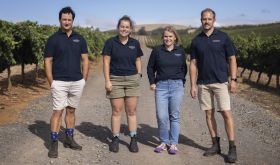
But this is no hobby farm. The mothers in question are the personable widow and two daughters of Dr Georges Mugneret – Jacqueline, Marie-Christine and Marie-Andrée, the younger sister by nine years. These are women for whom the French word sérieux, with its connotations of diligence and responsibility rather than gloom, seems made. (I was not at all surprised to discover on my visit that Madame Mugneret senior had been a teacher; I'd guessed as much when Marie-Christine carefully wheeled my luggage cart way back into the bowels of Dijon's airport when she came to meet me – no social hooligan she.) Madame Mugneret is still distinctly pretty and has a ready smile and the air of one who has delightedly let go of the reins. The Maries are more earnest, very dedicated, anxious to do what is right not just by the wines but by people too. Both scientists by training, they are the opposite of hysterical, the sort of people you would choose for your lifeboat rather than your hen night [that's what we call the party with girlfriends before you get married]. Marie-Andrée, I would guess, is the more passionate. She is a fanatical cook (during my visit she was camping out at the family house in Vosne while her own kitchen in Gevrey-Chambertin was being remodelled, to include a low-level worktop for her daughters). And she dreams regularly of Noirmoutier, the island off the Atlantic coast where they holiday and she met her husband. 'Burgundy has everything,' she sighs, 'except the sea.'
These three well groomed women have been running the domaine since the tragically early death of the dynamic doctor in 1988 and are now widely admired as some of the most punctilious producers in a village known the world over for the likes of the Domaine de la Romanée-Conti, Domaine Leroy and retired master winemaker Henri Jayer (who wrote a flattering inscription to the Mugneret daughters in a recent book).
It is impossible to write about this domaine without mentioning its recent history for, without its being either mawkish or spooky, Dr Mugneret is still omnipresent. He's still at the family table where Madame Mugneret cooks a copious three-course lunch for her daughters every day and delivers her perceptive tasting notes almost as a medium would: 'My husband was always a bit sceptical, unlike most people, about the '83s,' she muses over an obdurate Nuits Chaignots 1983. And he's certainly in the cellar two floors below: 'In my dreams he is on a train. I imagine asking him things,' admits Marie-Christine, as though almost shy of admitting to such a flight of fancy.
Georges Mugneret was the son of vignerons whose Domaine Mugneret-Gibourg comprised about 12 acres of vines around the village of Vosne-Romanée. In those days intelligent young men did things other than make wine, and he became an admired opthamologist in nearby Dijon. In fact his widow can remember him saying that he couldn't understand why winemakers got so exercised about their fermentations. The worst that could happen was the someone didn't enjoy themselves as much, whereas if he screwed up one of his eye operations...
But, as we know today, it is impossible for a sensitive person to live on the Côte d'Or – the famous ribbon of 'golden slope', just half a mile wide and 20 miles long, of world-famous vineyards gently tilted towards the sun and shared between hundreds of peasant farmers – that is Burgundy's pride and joy, without being 'attacked by the wine virus', as Marie-Andrée puts it. By the time he was 27, in 1956, he had bought a little strip of vines in one of the Côte's most famous (if often famously disappointing) Grands Crus, Clos Vougeot, and Domaine Georges Mugneret was born. He claimed he did it because his parents had earlier been forced to sell their holding in this ancient walled vineyard, but by the time he died he owned more than seven acres in five different appellations, as well as having taken over his parents' domaine.
Dr Georges Mugneret was clearly a man who liked to do things well. In fact it was only a matter of a few years before he was even more anxious than his neighbours about the progress of his wines in the family cellars beneath his parents' house in the narrow rue des Communes (sandwiched between those of two of the many members of the Gros family with whom the Mugnerets grew up). 'He was so perfectionist,' Marie-Christine told me. 'It was terrible if ever he climbed up those cellar steps saying 'I've messed up a cuve'. 'Yes,' shuddered Marie-Andrée, before adding ruefully, 'and he's genetically communicated it to us!'
Marie-Christine, the older sister by nine years, had qualified as a pharmacist, was married and had produced the first of the Mugnerets' four female grandchildren (who has already decided she wants to go into wine) when they learnt that Dr Mugneret had only a few months to live. Marie-Andrée was hardly 20 and studying biology as useful preparation for her childhood dream of working alongside her father. She simply couldn't believe it would now never happen.
But the methodical Mugneret nature poignantly came into play. Every Saturday morning there'd be a family meeting and an increasingly serene Dr Georges would instruct his daughters on some new aspect of the domaine. 'Those Saturdays were unreal, as though we were receiving instructions for a journey,' remembers Marie-Christine quietly.
But as the time of departure approached, Dr M decided he was asking too much of his daughters. 'We think he died thinking we'd sell the domaine,' they say sadly. He was determined that if the property was to be sold, then it should be sold whole, and managed by someone he respected. (Already there had been certain overtures from some of their less tactful neighbours: a sly comment after village mass, about some usefully contiguous strip of vines, for example.) Accordingly, he quietly contacted the respected head of one of Burgundy's bigger companies, a man whom the daughters have still never met, and Madame Mugneret has met only once.
This man, whose identity I can only guess at, sounds like a saint. He agreed the deal with Dr Mugneret and, whatever the terms, would have been a lucky man to have got his hands on such prize parcels in some of Burgundy's most precious appellations. After the doctor's death in November 1988 the family had only to pick up the phone to confirm the sale. But this man, amazingly, advised the young women to wait, to have a go at running the domaine themselves and see how they got on. He even offered to put at their disposal someone who would help them, as discreetly as is necessary in one of Burgundy's intensely gossip-prone small villages.
The daughters, and their husbands (both professional men who have done more than their share for the domaine), responded. 'We did it because it was something we could do for Papa. It felt as though we were almost doing it with him. His 1987 vintage was already in cask so we felt we owed it to him to get it into bottle. His last, 1988 vintage was in tank, so we had to put it in cask. And so on.' Marie-Christine looks pale and exhausted just describing these first six months, when most of the work in the chilly cellar had to be done at weekends. Madame Mugneret continued the business side in an increasingly neat, feminine office.
And then gradually, once they realised there were no rich pickings to be had, their neighbours rallied round. 'After a bit they were ready to help, especially the women. A woman can be respected if she does what she has to in the way a woman can, even if we need help from men for the heavier tasks.' (The Mugneret vines have always been tended by others, either part-time employees or sharecroppers, so continued supervision is all that is needed from Marie-Christine who is chief viticulturist.) The sisters' husbands Eric [Teillaud] and Loïc [Nauleau] manhandle the barrels, for example, and the all-important truck drivers know they won't be able to visit the 'domaine des femmes' on Wednesdays and that they won't get a helping hand with the loading. 'But,' says Marie-André with some pride, 'they know the papers will always be in order, and that, unlike some other producers, we're happy for them to call between 12 and two. And, you know, a smile makes up for a lot.'
The Mugneret wines, which have always belonged to the gentler, less flamboyant school of red burgundy which I personally favour, seem to me taste even brighter and truer today than prior to 1988, although I was not so foolish as to mention the F-word to them. 'We don't like it when our wines are described as feminine,' says Marie-Christine firmly. 'First, we respect Pinot Noir, its finesse and delicacy,' says Marie-Andrée. 'Expressive, that's what our wines are.' 'An iron hand in a velvet glove – you know that expression?' 'We respect terroir.' 'We don't want all our wines to have the same taste, or even structure.' 'You have to bring them up just like children; they can't all reach the same level.' 'Like kids, you bring them up how you can, not always how you'd like.' 'And you always have surprises! Especially in cask.'
Inevitably, I wondered what changes the daughters have made, although they'll admit to very few. The sorting table is the most obvious. It allows them to eliminate rotten or unripe grapes, especially useful in 1993. ('Do you remember that Sunday walk through the vineyards in June, seeing all that mildew?' asks Marie-Christine of her sister. 'I thought it was a catastrophe, that we wouldn't manage to get a single decent grape into the cuverie.')
And there is another piece of modern winemaking equipment, an automatic pigeur, a machine that replaces the human stomping down of the 'cap' of grapeskins that floats on top of the fermentation vats, to extract colour and flavour. This is the direct result of their most memorable experience during their first solo vintage, the torrid 1989 harvest.
Dr Mugneret had always taken on the guys who did the pigeage for his neighbour Bernard Gros, so his daughters did the same. They would hose down their purple bodies chez Gros, wrap a towel round their middles and hobble along the backstreet to the Domaine Georges Mugneret. Some supervision and direction of this risky operation is needed, for the atmosphere above the vats is sodden with alcohol and carbon dioxide and the liquid inside is horribly sticky and slippery. So when the team arrived, they asked brightly, 'Where's the boss?'
They were absolutely horrified to find it was the Mugneret sisters who felt they ought to oversee this dangerous operation. Like all good Burgundians, these men believed that nothing other than human flesh should be allowed in contact with something as precious as a grand cru burgundy. There was much hopping from foot to foot before those feet were persuaded to get to work, and they were eventually replaced by a machine that cannot drown and does not blush.
Although nowadays one can think of another dozen – well, half-dozen – domaines run by women (Leflaive, Leroy, Chandon de Briailles, Ghislaine Barthod, Anne Gros, Esmonin), Burgundy has never been at the cutting edge of female emancipation. The sisters told me how people on 'La Côte' used to say 'poor Georges, to have only girls'. But he always had a great respect for women, not least their tasting ability (in the cellar he would always listen even more acutely to the comments of Madame than Monsieur Vrinat of the Parisian three-star restaurant Taillevent, for instance). 'Be warned,' he would say. 'One of these days it'll be women who rule La Côte – and don't underestimate how they'll manage to combine that with family life too.'
Domaines Georges-Mugneret and Mugneret-Gibourg, 5 rue des Communes, 21700 Vosne-Romanée, France
tel +33 3 80 61 01 57, fax +33 3 80 61 33 08
Visits only by appointment – no later than 5pm, and never on Wednesdays.
Wine notes
Total production: about 2000 cases a year
Winemaking distinguishing marks:
- careful selection of healthy, fully ripe grapes only, even in 1996
- selected yeasts
- 10 per cent new oak for Bourgogne Rouge and up to 70 per cent new oak for Grands Crus
- racked after malolactic fermentation and again about six months later, on Saturdays, by the husbands
- no pre-bottling filtration
- keen for discussion and regulation of acidification in Burgundy.
Bourgogne 1998 (cask sample)
Made from 50-year-old vines just across the Route Nationale from Vosne-Romanée. One of the most satisfying generic burgundies in most vintages, and so far quite charming in this one.
Echezeaux 1996 Grand Cru
This vintage is for cellaring not drinking but this example already has sufficient concentration to convince that it will make a memorable bottle in three or four years. Great length already.
Echezeaux 1994 Grand Cru Fresh, positive attack with some tannins still in evidence. Vigorous wine with scents of bitter cherries. Not big but well balanced, youthful and more charming than most 1994s.
Chambolle-Musigny, Les Feusselottes 1993
Charming, vibrant wine that demonstrates the family's painstaking winemaking style well. Ready to enjoy now although it could be drunk any time over the next two or three years.
Clos Vougeot 1991, Grand Cru
A delicious vintage to drink now. Spicy, meaty, fully evolved nose with a palate that is lovely, full and round with a suggestion of crystallized violets. Extremely long and elegant. The Mugnerets' is one of the most reliable wines from this extremely variable vineyard.
Food notes
Madame Mugneret serves a fine three- or four-course lunch every working day. To the 60 friends who come every year for the one Saturday it takes to pick their own vines, she serves boeuf bourguignonne and gratin dauphinois in the cuverie.
During my dinner and lunch there five of us ate oeufs en meurette made with a bottle of Echezeaux 1977 and a half each of Chambolle Musigny, Les Feusselottes 1988 and Ruchottes Chambertin 1988. ('There's a very odd smell in the 1977s so they're better to cook with than to drink. The 1988s are very austere, and for eggs you need a wine that is not too tender.') 'Maman tried it with a red Loire wine once when I'd just met my husband and we were at our holiday house on the west coast. It was terrible!' says Marie-Andrée.
Another memorably Burgundian thrill: cherries pickled in Morey St Denis.