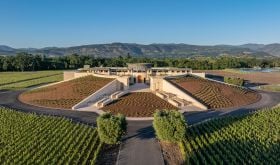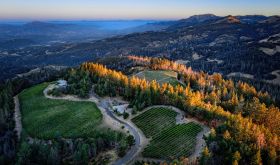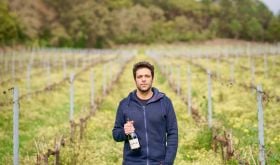
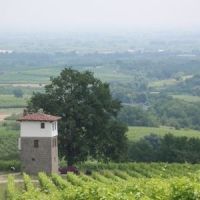
Kir-Yianni (profiled here) have estates in Naoussa, pictured left, and in Amyndeon in northern Greece. They sent the following report on the 2008 vintage, describing it as 'the vintage with the shortest (and fastest) growing season in the last 25 years'.
June was quite dry and as a result grapes remained relatively small and healthy.
July was quite rainy and pumped up berry size a bit right before and during veraison.
August, the month of maturity, was particularly dry. Not a single drop of rain fell, a phenomenon that is very rare for Naoussa. Average temperature was very high despite the absence of any heat waves; in particular, it was 2 °C higher than the average of the period 1980-2007. Hence ripening raced through the month, even though growth seemed to have proceeded regularly up to then. Most of the varieties were harvested more early than usual and gave lower yields as a result of dehydration. The vineyard blocks that suffered the most were the dry farmed ones, the heavily trimmed ones, the ones on southwest-facing slopes, and the ones that were thinned early. During the first fortnight of September we noticed above average daytime and nighttime temperatures. The first autumn falls were poor (a mere 10mm) as temperatures began to drop back to normal figures for this month. Heavy rainfall and winter-like weather conditions followed towards the end of the month.
A note from our vineyard manager
This year we irrigated 2-5 times depending on the vineyard block with medium water quantities as opposed to the 1-2 times usually applied. Syrah's ripening was very peculiar because we harvested it before Merlot on August 25, unlike every other vintage up to this year when Syrah usually followed Merlot's harvest by 15-30 days. We picked Merlot three days later, while the harvest of Xinomavro started on September 10 – about two weeks earlier than normal and the earliest ever remembered. In fact, Xinomavro's veraison shrank to 36 days!
The high nighttime temperatures in August raised sugar content for Xinomavro at a much faster pace than phenolic concentration and ripeness in some of the vineyard blocks. The new Xinomavro clones (V3 and V6) showed a better match of growth between sugars and phenolics. The vineyard blocks with the new clones were harvested first giving exceptionally good quality. Harvest was interrupted by rain for a couple of days and as a result the oldest vineyard blocks were picked at low temperatures under overcast skies. This time around we went to great lengths with our selective picking: just like every year we picked the end-of-row vines separately to minimize the adverse impact of high vigor in the core batch. We even picked the small-berried bunches separately. Therefore, we ended up with three batches from each vineyard block: the small berries from the core, the large berries from the core, and the end-of-the row berries.
We're currently undergoing different wine processing to handle appropriately the lower phenolic ripeness in the last two batches. Although it is too early to predict, the 2008 vintage will most probably be superior to the 2007 one for the French varieties, while for Xinomavro, 2008 will be similar to 2005, better than 2006, but worse than 2007.
A note from our winemaker
We tried as always to highlight the differentiation in aromas and phenolics that naturally stems from the diverse terroir of the Naoussa vineyards. We irrigated more generously the more aromatic vineyard blocks of Merlot, Syrah, and Xinomavro. Likewise vinification was highly pronounced leading to early pre-blends of all our top labels: Kir-Yianni Estate (Red), Diaporos, Ramnista, and Dyo Elies.
Due to the peculiar ripening of Syrah, this year is marked by a most interesting novelty: co-fermentation of Syrah and Merlot in the proportions of the Dyo Elies blend. A protracted maceration of uncrushed berries at low temperature and a gentle use of pigeage. The same approach of co-fermentation between Merlot and Xinomavro was adopted for one batch of the Kir-Yianni Estate pre-blend but at dominant proportions in favour of Merlot. We've yet to discover the result of this innovation that hopes to capture the most of Merlot's fatty roundness with Xinomavro's hints of sun-dried tomato.
As regards Xinomavro, we can distinguish the vineyard blocks harvested under hot and sunny conditions from those harvested under cold and cloudy conditions. The former consisted mainly of the young vines, while the latter of the old vines. The young vineyard blocks were grouped this year not according to clone, but according to soil type. The results were spectacular. The differences in aroma and mouth feel were impressive. Apart from their special, terroir-driven characteristics, all young Xinomavro clones have exceptionally high color intensity and higher pH compared with the average Xinomavro.
The old vineyard blocks were also grouped according to soil type and followed appropriate fermentation protocols. This year's novelty for the old vines is the highly selective crush that began in the vineyard as discussed in detail by our vineyard manager. Since there were no clonal selection procedures, when the old vineyards were planted, lesser and blessed clones are mixed within each vineyard block. The three batches of grapes were even further selected on our conveyor belt that this time ran at only 1.000kg per hour – an unusually low rate that was necessary due to the problematic harvest conditions of the second wave. Finally, the use of the pneumatic pigeage system gave even better results this year. Last year, it was used only for some of the grapes of inferior quality that came in. This once again confirms the principle that the quality of dry red wines is affected foremost by the quality of the grapes rather than any winemaking equipment.
ΑMYNDEON
General comments
Weather conditions in Amyndeon were similar to those in Naoussa. Vegetative and fruit growth followed similar patterns to those of Naoussa. The drip-irrigated white (Chardonnay, Sauvignon Blanc and Gewurztraminer) and early red (Merlot and Syrah) varieties produced an excellent crop. The late ripeners like Roditis and Xinomavro matured under adverse conditions because the weather after mid-September became cold and rainy lasting all the way till the end of harvest.
A note from our vineyard manager
Our vineyards at Samaropetra were irrigated 4-6 times depending on the variety with very small amounts of water just enough to avoid excessive water stress and facilitate normal ripening. The coolness of the Amyndeon plateau (700m) had a positive effect on ripening especially during this hot and dry August of 2008. As a result aromas were maintained fresh and intense much like in 2007. Our contract-based vineyards of Xinomavro and Roditis had a very good growing season up until the middle of September. The rains that ensued led to a drop of concentration in the berries. However, Roditis managed to reach sufficient sugar levels. As for Xinomavro, due to the low phenolic ripeness most of the grape juice was used for the production of rosé, rather than red wine.
A note from our winemaker
The intense expression of the varietal character for all French grape varieties with the distinctive aromas tied to the Samaropetra terroir is once again a mark for the 2008 vintage.
From a winemaking point of view, nothing changed in our standard protocols for the Tesseris Limnes blend. The only exceptions were on the one hand the longer cold soak time and the higher turbidity during fermentation for Gewurztraminer and on the other hand the absence of cold soak for Chardonnay and a slower press program.
Roditis was for the most part fully ripe from an aromatic point of view. Acidity levels were already comfortably low, so no need for any further drop arose. About 20% of the total quantity received was not cold soaked prior to the press. As a result the 2008 Samaropetra blend will contain roughly 40% of Roditis that was pressed straight after destemmer Despite the relatively unfavorable crush, our Xinomavro blends shall come out very well. The 2008 Akakies shows a delightful aromatic complexity thanks to the long periods of cold soaking (up to 48 hours). The 2008 Paraga will contain significantly lower proportion of Xinomavro compared to Merlot and Syrah which are distinguished this year by a very good aromatic and color intensity.
ANGELOS IATRIDES, ALPHA ESTATE
 The post harvest rainfalls during the 2007-2008 winter season were at normal levels, thus vines easily created their supplies for the coming winter. On the contrary, low rainfalls prior to the growing season resulted in low levels to the immediate ground water supplies.
The combination of the above conditions with relatively high season temperatures brought the juices two weeks earlier, compared with the previous year.
Relatively warm and dry, May increased our belief for a premature season and played an important role in a homogeneous flowering. After that, the presence of optimum ripening conditions with almost no rainfall and mild temperatures laid the base for an excellent season, actually even better than the previous one of 2007.
But then August made its presence felt, with climate conditions perfect for optimal maturity. Absolute zero rainfall, temperatures ranging from 15 to 30° C and water stress present at specific and naturally controlled intervals.
It is important to mention that even though dry conditions were present during all the growing period, yields were at last year's levels due to the vines being fresh, because of last year's low production.
The foundations have been laid for the year of the century. Never until now in my professional life have I used such a characterisation for a harvest, but it is proven beyond any doubt that management and control of water supplies, in combination with the climatic variables of a specific area, are critical for successful vinification. Our belief that climate change and its consequences for viticulture will determine qualitative management criteria for vinegrowing is confirmed.