
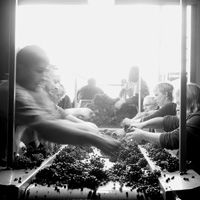
Pink champagne, once dismissed as a frivolous irrelevance, is now being taken seriously. So seriously that it is creating major headaches for producers in France's Champagne region thanks to a current shortage of one of its crucial ingredients. This year's harvest in Champagne, just drawing to a close, may have been the earliest in living memory, accelerated by the unusually warm spring and early summer, as in the rest of Europe. But the weather in July and early August was grey and humid, which prejudiced the health and quality of Pinot Noir and Pinot Meunier, the two dark-skinned grapes that still constitute the majority of vines planted in Champagne, being more susceptible to rot than the light-skinned Champagne grape Chardonnay. (Our image shows the team at the excellent grower Larmandier-Bernier hand-sorting Pinot grapes from this year's harvest.)
Pinot Noir and Pinot Meunier may have dark skins but their juice is pale, pretty much the same colour as Chardonnay juice. So to make 'white' champagne, producers have to press the dark-skinned grapes particularly carefully so as to leach as little colour as possible from the skins into the still wines that are blended to form the assemblage that is the basis for champagne making. For decades, winemaking in Champagne has been focused on minimising the visible contribution of these dark-skinned grapes and maximising their contribution to flavour, aroma and texture in white champagnes.
But this century, pink champagne sales have taken off. The UK, for example, imported twice as much of it in 2007 as in 2000, and apparently sales of rosé champagne spike in the Caribbean at Christmas and in the south of Spain in the summer as these locales are invaded by sybaritic Brits. On a worldwide basis, rosé now constitutes 8.5% of all champagne shipments, far more than it used to. For some houses such as Bruno Paillard, rosé represents more than one bottle in every five sold – and Laurent Perrier are so coy about the importance of their popular rosé that they decline to say what proportion of sales it represents. Even a house as traditional as Bollinger introduced a non-vintage rosé for the first time ever in 2008.
To make a pink or red wine, you of course need pigment from dark-skinned grapes. All reds are made by prolonged contact with dark grape skins. Most still rosés are made by very brief maceration of dark grape skins with the juice. Some pink champagnes are too. But most rosé champagne, exceptionally, is made by adding on average about 15% of still red wine to the (otherwise white) assemblage. Since well over 300 million bottles are filled with champagne each year, as much as three million bottles' worth of still red wine are now needed to provide the colour for rosé champagnes from each grape harvest.
Not only is demand at record levels, however – rosé seems to be the one champagne style that has proved recession-proof – but this has been the second summer in a row when both quality and quantity of red wine grapes in Champagne have been disappointing. So one of the chief current preoccupations of chefs de cave responsible for making rosé champagne is getting their hands on enough still red wine to make sufficient rosé to satisfy demand. The Champenois have relied far more than any other wine producers on creating demand by marketing – but the combination of unexpectedly poor summers, even in this era of global warming, which has been threatening the acid levels so prized by champagne producers, and a rosé craze apparently outside their control, has put them under pressure from entirely external factors.
Because making good-quality still red wine is so very different from making sparkling white wine, it requires completely different equipment and techniques. Big houses and those with a reputation for their rosé such Veuve Clicquot, Billecart Salmon, Bruno Paillard and Laurent Perrier (who, unusually, produce their rosé by the saignée method of 'bleeding' colour from dark-skinned grapes) produce their own red wine and have been deliberately acquiring vineyards that will supply suitable red wine for their needs. But many producers buy in still red wine from specialists in producing it such as the Union Auboise, the co-op in the southern part of Champagne where Pinot Noir dominates.
Fortunately, there is a fashion for paler rather than darker pink champagnes, so producers may need less and less red wine for their rosé blends – not least from the warmer vintages that have proliferated (although 2010 and 2011 were exceptions to this) and that naturally produce deeper-coloured, more tannic red wines. And some producers have apparently installed special thermovinification equipment designed to produce deeply coloured wines by fermenting at relatively high temperatures. (The Champagne region is so far north and harvests have traditionally been in late September or early October so that fermentations are usually naturally very cool – cooling equipment has generally been superfluous here.)
But given all the effort that the Champenois are putting into making these rosé wines, what exactly is the point of them? Because of demand for rosé, red wine grapes in prime spots have commanded a premium, so pink champagnes, even basic non-vintage blends, have been selling for considerably more than their white counterparts. What do we consumers get in return? Not much, in many cases in my view. My tastings suggest that a huge proportion of rosé champagne is a fairly cynical product that does not have any special positive attributes but merely ticks the visual box (sometimes only just) of being pink. In fact I would go so far as to say that the average quality of pink champagne is lower than that of the average white champagne, despite it being more expensive.
I asked David Hesketh, the Master of Wine in charge of selling so much Laurent Perrier rosé champagne in the UK that in 2007 it had to be put on allocation, whether he thought most people could tell a rosé champagne from a white one if they were wearing a blindfold. 'No, I don't think they could. Those who do it [make rosé champagne] well and get an element of red fruit profile in it, then their wines are noticeably different, but with many other rosés you might be hard pressed.'
In the world of champagne, image has always been more important than reality.
SOME RECOMMENDED ROSÉS
These are rosé champagnes that I think are worth buying, with average worldwide prices according to wine-searcher.com. There are few bargains, alas.
Dom Pérignon 1990 (£391), 1996 (£274), 2000 (£225)
Krug (£208)
Pommery, Cuvée Louise 1999 (£167)
Roses de Jeanne, Le Creux d'Enfer Rosé de Saignée 2004 (2006 is £121.50 at The Sampler)
Bollinger, La Grande Année 1999 (£99), 2002 (£112)
Roederer NV (£47)
Bollinger NV (£46)
Jacquart, Brut Mosaïque 2000 (£40)
Veuve Clicquot NV (£40)
Georges Gardet 2002 (£39)
Agrapart, Les Demoiselles NV (£34)
Lanson NV (£32)
Rosé champagne – the missing ingredient
• 4 分で読めます
This is a longer version of an article also published in the Financial Times.


購読プラン
スタンダード会員
$135
/年間
ワイン愛好家向け
- 296,465件のワインレビュー および 16,124本の記事 読み放題
- The Oxford Companion to Wine および 世界のワイン図鑑 (The World Atlas of Wine)
- askJancisへのアクセス(AIワインアシスタント)


プロフェッショナル
$299
/年間
ワイン業界関係者(個人)向け
- 296,465件のワインレビュー および 16,124本の記事 読み放題
- The Oxford Companion to Wine および 世界のワイン図鑑 (The World Atlas of Wine)
- askJancisへのアクセス(AIワインアシスタント)
- 最新のワイン・レビュー と記事に先行アクセス(一般公開の48時間前より)
- 最大25件のワインレビューおよびスコアを商業利用可能(マーケティング用)
ビジネスプラン
$399
/年間
法人購読
「プロフェッショナル」プランの内容に加えて
- 最大250件のワインレビューおよびスコアを商業利用可能(マーケティング用)
- レビュー依頼用のワインを提出可能
- 従業員向けにメンバーシップを提供し、一元的に管理可能
- APIアクセス(※別途料金)
More 無料で読める記事

無料で読める記事
この記事はAIによる翻訳を日本語話者によって検証・編集したものです。(監修:チャーリー・ギーガン、写真:ジェイソン・ロウ)...

無料で読める記事
20世紀のワイン界のアイコンたちが関わった初の大西洋横断ジョイント・ベンチャー、オーパス・ワン。この記事の別バージョンは『フィナンシャル...

無料で読める記事
速報!オールド・ヴァイン・レジストリが記録を更新し、障壁を打ち破り、新たな地平を切り開いている。そして今、オールド・ヴァイン...

無料で読める記事
この記事の別バージョンはフィナンシャル・タイムズにも掲載されている。 世界最高のシャルドネとは?も参照のこと。写真上、左から右へ:ロナン...
More from JancisRobinson.com

テイスティング記事
Proof that South Africa remains one of the most rewarding countries for wine. Above, Chris Keets (left) of Weather Report...

テイスティング記事
歴史あるブドウ畑、高い標高、火山性土壌、そしてオーガニック栽培の組み合わせが、この知名度の低いAVAを際立たせている。写真上は、 ムーン...

テイスティング記事
熱波に見舞われた年に生まれた、魅惑的にフレッシュで親しみやすいワイン。ソッティマーノは、写真上のコッタ・クリュから...
テイスティング記事
この記事はAIによる翻訳を日本語話者によって検証・編集したものです。(監修:Yuri Shiraishi)...
テイスティング記事
暑さの中でもリフレッシュできる25の方法。 先週、ヨーロッパは6月としては記録的な熱波に見舞われた。今週は...

今週のワイン
元化学者の正確さとブドウの樹の囁きを聞く者の魂で造られたヴィーニョ・ヴェルデの白ワイン。23ドル~、22ポンド~。写真上はラモスと...
テイスティング記事
ヴァーティカル・テイスティングで、ジャンシスがカリフォルニアを象徴する赤ワインの画期的な始まりを振り返る。ロンドンの67パル...

Don't quote me
ブドウの樹に日陰を提供し、ワイン樽の材料となる森のテロワールは、ブドウ畑やワインと相互につながっている。写真上は...