I feel rather ashamed of my recent trip to inspect vineyards in Russia. Firstly, and most unusually, I went at the invitation of some wineries there. I usually insist on paying my own way but my weekly employers at the Financial Times had no qualms about my being a guest in this, virtually uncharted, corner of the wine world where local knowledge is particularly useful.
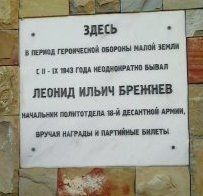
Secondly, I got into an unseemly tussle with Julia as to who should accept this invitation from Fanagoria, Sauk Dere and Myskhako wineries. (This plaque commemorates the time Leonid Brezhnev spent in a bunker at this last winery during the second world war.) Both of us are keen travellers and were equally intrigued by the prospect of being the first wine writer based in the west to take a look at post-Soviet viticulture on the Black Sea coast. I am afraid to say that I pulled rank, and argued that it would be a shame if FT readers were robbed of the chance to read about this exotic outpost of the vine.
In the event, what I discovered is that today Russian wine production is remarkably like wine production everywhere else. Two wineries with statues of Lenin aside – and the fact that all the women look like either beauty queens or white-coated hospital matrons – what I saw was almost disappointingly familiar. I flew in to the main city Krasnodar, where there has clearly been considerable recent investment and, although the Ancient Greeks who colonised this part of the world viewed it as the gateway to Asia, it looked just like any prosperous European city to me, complete with ubiquitous ads for IKEA. As for the Russian countryside, I had not seen anywhere more rural than the Moscow airport corridor since driving from Odessa in the Ukraine to what was then Leningrad in the early 1970s and could hardly believe what must have been a transformation in this region, known as Kuban after the river running through it.
The big transformation in Russian wine production has been in the infrastructure, with new winery equipment and even whole new wineries being installed at a lick. In the old Soviet Union, grapes were grown from Moldova to Tajikistan and transformed into wine with maximum efficiency but minimum attention to quality. Half-made wine, stuffed full of preservative chemicals, was transported in bulk to unglamorous bottling plants near the major cities, particularly in Russia. Highly respectable academic bodies were devoted to the study of wine-making and, especially, vine-growing, but few connections were made between the two activities. Then came Gorbachev and his anti-alcohol putsch, which left vast tracts of eastern European vineyard surplus to requirements, and vineyards even in Russia's favoured Black Sea coast region suffered considerable neglect.
Much of Russia, like Ukraine, is far too cold to ripen grapes successfully. And in Russia's wine districts north and east of Kuban – Daghestan, Stavropol and Rostov-on-Don – vines have routinely to be banked up in winter to keep them alive. Even in Kuban, Russia's balmiest wine region, a substantial proportion of vines is lost in winters as cold as 2006 and 2002 – so much so that growers are experimenting with vine varieties specially bred to incorporate cold-resistant genes from Mongolian vines. The more northerly Russian wine regions may have their own indigenous varieties but in the resurgent Kuban region the vast majority of vines being planted carry such international names as Cabernet, Chardonnay, Merlot and Sauvignon Blanc.
The local government has long been particularly wine-friendly and now there are state subsidies to instil order and trellising into old, unkempt vineyards and to plant new ones. It is official state policy apparently to restore the total area of Russian vineyard to its pre-Gorbachev 1984 level of more than 400,000 ha, although the national total is still only 65,000 ha despite some determined planting recently. (See Russian vineyard & cellar.)
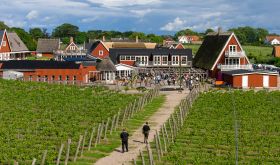
Fanagoria, for example, which claims to be Russia's biggest producer of estate-bottled wines, has about 2,300 ha of vineyard, of which almost two-thirds are very new, very neat, mechanisable plantings in the fertile black soils of the Taman peninsula. The winery takes its name from the ancient Greek colony one can so easily imagine on this spit of land between the Black and Asov seas with its views of the Crimea just three miles across the water. Every summer the mounds over the ancient settlement are uncovered and more gems from successive incomers are unearthed. The local archaeological museum is stuffed with Ottoman, Genoan, Slavonic, Khazar, Byzantine, early Christian, Roman and ancient Greek leftovers from the spoils sent to the Hermitage in St Petersburg.
The museum's curator claims that viticulture pre-dated the Ancient Greeks in this part of the world. What is certain is that it died out soon after the Greeks left and was not revived until the 19th century, firstly in the Crimea and then on Russia's Black Sea coast. Abrau Durso is Russia's oldest winery in continuous operation, catering to Russians' longstanding love of sparkling wine. Sweet red wine is another wine style traditionally prized by Russian consumers, who were long taught to disdain native products in favour of bottles labelled Georgia (although one major problem with the Russian wine market continues to be the lack of regulation).
The Kremlin's sudden ban on wine imported from Moldova and Georgia in 2006 has provided a market opportunity for Russian wine, although it has to labour against the prevailing view that foreign means fancy. Fanagoria admit that they put the word 'export' in English on their wine labels because it adds value in Russian eyes. Even official figures acknowledge that 70% of the wine labelled as Russian is made up of bulk imports of cheap wine from the likes of Spain, Ukraine and Argentina. Wine made from grapes grown in Russia accounts for just 20% of all wine sold in Russia. Nevertheless, sales of truly Russian wine are growing and have encouraged a recent influx of investors, and consultants such as London-based John Worontschak, who works at all three of my host wineries, in Kuban.
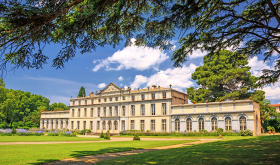
I passed a beautifully maintained new 500-ha vineyard said to have a Slovakian connection on my way to Myskhako winery on the outskirts of the port of Novorossiysk, 'New Russia', through which the bulk imports arrive and through which such Russian wine as has been exported passes. Here I met a couple of young Swiss winemakers pressing grapes grown on a local Swiss-owned vineyard. Château Le Grand Vostock is a substantial, originally Franco-Russian, project aimed at encouraging wine tourism in Kuban. A more recent enterprise, the spruce, white-walled Château Tamagne, is a 2007 creation on the Taman peninsula, financed by oligarchs from the Urals, that would not look completely out of place in the Napa Valley. At both Myskhako and Sauk Dere, the wineries are being thoroughly remodelled, and vineyards are being planted or replanted furiously, with high hopes of attracting visitors.
Peter and Yevgeni Romanishin, director general and sales director of Fanagoria, were just off to visit the Munich beer festival when I met them, in what may have proved a fruitless search for ideas for running a wine festival. Yevgeni had just returned from visiting a potential customer in China. These brothers in their thirties constituted the most cosmopolitan management team I met, but even they admit that exports are likely to remain a minority concern for a while. I tasted some promising Sauvignon Blanc and Pinot Noir from the cooler vineyards of Fanagoria, and some convincing Aligoté from their much older vines. Myskhako, in warmer, drier soils to the south, can clearly do good things with Cabernet and Merlot, as can Château Le Grand Vostock, to judge from their Chêne Royale 2007.
But non-Russians might be more titillated by less familiar varietals such as the crisp white Rkatsiteli and fiery red Saperavi that the Russians have borrowed from Georgia, and curiosities such as Tsimlansky Black, from the banks of the Don, that seems to be able to make smoky, dusty reds with real character. But without wine laws, the Russian wine scene is likely to continue to be as undisciplined as my preconceptions.
See also my tasting notes on Russian, and Soviet, wines.