Last weekend's MW Symposium in Florence attracted 450 attendees, of whom about 120 were those who had managed to gain the two precious initials after their names and more than 60 were those who wished to – despite the proximity of this year's exams. For them there was a host of technical detail from cutting edge wine scientists around the world, as well as some lighter, softer topics such as top sommelier Gérard Basset interviewed by Debra Meiberg MW.
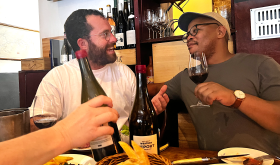
As at the Bordeaux symposium four years ago, some of the most entertaining contributions were from Indians. In Bordeaux it was the sommelier-turned-wine-consultant (the way they all do) Magandeep Singh who gave a particularly vibrant and amusing presentation, on wine in India. This time it was Rajeev Samant (above left), the founder and CEO of Sula, India's most successful wine producer, who made one of the most heartfelt observations from the floor after both wine climate scientist Professor Greg Jones and our very own Wine Grapes specialist Dr José Vouillamoz had lectured us all on how the wine map is changing and how we might better match vine varieties to changing conditions. 'In India we have no rules and no traditions', Samant admitted. 'And now I feel so bad not to have listened to a session like this 10 years ago. We've tried Merlot and Cabernet Sauvignon and they have both been abject failures. Tempranillo has admittedly fared a little better. But I now realise we should work from scratch with scientists.'
Later from the platform of the semi-subterranean auditorium of the Palazzo Congressi in Florence, Samant also injected real life into a session called 'Beyond success: creating a strategy for sustained growth' (out of which one senior MW stomped in search of culture muttering, 'growth? I'm not interested in growth'). India's population is due to overtake that of China, so I suppose we should all be interested in what is happening to wine there. Samant is optimistic that an EU free-trade agreement to be signed within the next two years will reduce duties on mid to upmarket imported wines, which should help wine exporters to India considerably, and should help to grow the wine market there.
He also reminded us that Modi had been elected prime minister of India that very day and that all of India's businessmen were hoping now to operate in a climate with 'no corruption nor sycophancy, but more growth'. He outlined a frighteningly complex business environment in which those producing wine in India's three main wine regions (generally producing two harvests a year) had to deal with archaic and different rules to sell in each of the 32 states. Each requires a slightly different label, and the managing director of the local importer can be sent to jail for a single bottle with the wrong label. Taxes vary so much that a bottle of Sula can be priced between €7 and €20 depending on the state. Different distributors are required not just for each province, but for each city – and they all insist on exclusivity!
Despite all these handicaps to trade, wine consumption in India has been steadily increasing by 'about 25% in good years' and overall has increased tenfold in the last 15 years. Samant pointed out that in his grandmother's generation, only about 0.05% of the female population had ever tasted an alcoholic drink, whereas in modern India, the real sales growth for wine is coming from young urban professional women. (Talking of which, the statistic from my talk about communication and reaching consumers of tomorrow that seemed to shock everyone was that only 15% of Purple Pagers are women! Please, encourage the female wine enthusiasts of your acquaintance to make our acquaintance…But I digress.)
After the same session, it took Sonal Holland (right), a powerhouse of a young Indian MW student, to ask the single most memorable question from the floor of the entire symposium. Christian Seely, AXA's amiable wine chief, had been outlining to us just exactly by how much average prices for red bordeaux had risen between vintages 1986 and 2012 (as though we hadn't noticed?): +703% for the first growths, +340% for the better seconds, +180% for the thirds, and just +24% for generic AC Bordeaux. That's all very well, she said, before going on to tell us how she decided to invest in 2009s, making a sizeable investment in first growths and the like. 'Since then', she added reproachfully, 'my investment has devalued by about 30%. Admittedly the rupee has devalued a bit which has helped. But now I don't know whether to hold or sell. There's lots of negative reporting now. Please, Mr Seely, give me your personal advice.' At this point there was a groundswell of sympathetic slow clapping in the auditorium and many a rueful sigh.
Seely temporarily lost his usual composure. 'Are you sure you don't want to talk about English sparkling wine?', he prevaricated, before managing to come up with a response that was not 100% waffle (a rarity from a Bordeaux mouthpiece) although did not constitute much firm advice on her future strategy. 'I also invested in '09s (for myself). Prices are fed by market demand, and the overall trend in the long term is up. One thing I believe very strongly is that investment in Bordeaux should be done property by property. You have to look at the history of each property's pricing policies. Look at the change in value of their wines after release prices to minimise your risk.
'What Bordeaux is inevitably trying to work out as the years go by is, what is the limit on pricing given the quality of the '09s. But it's a fact that in some cases people pushed their en primeur price a little too high in 2009 encouraged by the demand. Also in '05. But it can happen in the other direction. For example '08 en primeur was one of the best investments ever. The same is true of the '04s.'
Composure regained, although Robin Tedder MW of New South Wales attacked again: 'Seely, looking at your graphs, you do sound like a mutual bond salesman', he observed, before moving on to what was literally a multi-million-euro question: 'There are 35,000 vine growers in Italy alone and many, many more throughout the EU. What would happen if EU subsidies were removed?'
It was up to Dr Rowald Hepp to respond on behalf of Europe: 'At Schloss Vollrads we don't accept subsidies, but abandoning them entirely would bring a whole new dynamic to Europe in general. It would clean and rinse the system.'
Worth thinking about, as was much that was said in Florence.