See also a detailed report on the 2005 vintage in Germany and my first set of nearly 200 tasting notes.
As it is throughout France – though not in Italy – the 2005 vintage is exceptional in Germany (see my full report next week). But perhaps just as exciting are the dramatic changes to be seen in the sort of German wines being produced today.
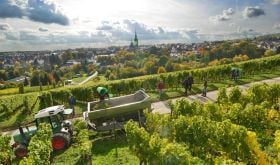
The effects of global warming on wine are more obvious than anywhere else in the recent evolution of wine styles in Germany, mainland Europe's most northerly major wine producing country. (Thanks to global warming, Belgium, the Netherlands and Denmark are all now growing vines, but on nothing like the scale of Europe's fourth biggest wine producer.) Gone are the days of thin, tart German wines made from hard, green grapes. Even German vine growers are now having to get to grips with record ripeness and unaccustomedly low acidity. As Erni Loosen, once regarded as the enfant terrible of the Mosel but now almost an old boy alongside the swarm of young turks recently arrived on the scene, put it last week, "We had to work like idiots to keep our Oechsle [sugar] levels below 90 for our Kabinetts im '05 by sorting out all the botrytised [extra-concentrated] grapes. Our fathers had to cope with the problem of underripeness. Today, we are more likely to be worried about grapes being too ripe."
Certainly the whole structure of German Riesling, the country's signature grape, has been changing, playing into the hands of the majority of Germans themselves who have been taught to admire only dry, or trocken, wines. All that extra sunshine has been translated into extra stuffing in the trocken Rieslings that tasted so unappealingly meagre a decade or two ago. Meanwhile average alcohol levels have risen as a much higher proportion of the sugar in German grapes fermented out to alcohol and it is now possible to find even German wines with more than 14 per cent alcohol – something that the more thoughtful producers are trying to curb, and something that would have been unthinkable to our grandparents used to German wines with just seven or eight per cent alcohol.
Lovers of classical fruity low-alcohol Riesling, of whom I am decidedly one, need not fear that this style of wine – uniquely revitalising and found nowhere else on the planet – will disappear overnight. But even its most famous exponent, Egon Müller of the particularly cool Saar tributary of the Mosel, admits, "We have to face the fact of global warming. We can have high Oechsle now, as happened in 2003, with the flavour profile of only a Kabinett, because if the grapes ripen quickly then the sugar content increases faster than the flavour develops." This of course is a phenomenon apparent in other European wines produced by the heatwave summer of 2003 but it is a signal that even the Saar is not immune to climate change.
Egon Müller's neighbouring estate Van Volxem has since the 2000 vintage been owned and run by Roman Niewodniczanski, a half-Polish pony-tailed beanpole who is using his family's brewing fortune to impose an entirely new or, he would argue, actually extremely traditional regime in the estate's vineyards and cellars. The result is a range of "harmonic dry" Saar wines so ripe they are almost eerily low in acidity – almost a mirror image of the Egon Müller style. Even in 2003, says Niewodniczanski, he was able to pick as late as November. "I chose to buy a winery in the Saar precisely because of global warming. Even in 2003, my best vintage yet, the wines are no more than 12.5 per cent alcohol." (Most of Müller's are about eight per cent.)
Niewodniczanski, who claims to be guided by such wines as Henri Jayer's burgundies and "the sort of wines made in Germany a century ago when our wines were worth three times as much as top red bordeaux" is just one of the more memorable, and certainly the tallest, of the new band of young German producers who "follow the recovery of hand-crafted wine production", as he puts it.
At the other end of several scales from Niewodniczanski – financial as well as meteorological, one suspects – is Hanspeter Ziereisen of Baden in southern Germany. A carpenter and asparagus grower, he just happens to have a plot of steep, dry limestone from which he has coaxed some quite remarkable Syrah – a grape variety previously thought impossible to ripen in Germany. The 2004 which I tasted is only his second vintage so this may be a young-vine phenomenon, but there could hardly be a less obviously Germanic German wine. Ziereisen says he prefers the phrase "primitive made" to "hand made" and his tiny production sells out on release within Germany.
Germany is now well and truly a red wine producing country even if the most usual grape is Pinot Noir, or Spätburgunder. In fact a host of Pinots, Blanc and Gris too, are now ripened fully in southern Germany and often subjected to (still occasionally over-enthusiastic) oak treatment. But most of these wines are sold within Germany where demand is so high that they too rarely seem good value in more competitive markets abroad. Germany's top quality Rieslings of all but the very highest sweetness levels, on the other hand, tend to compare favourably with top quality white burgundy, even though prices for the drought-shrunk 2005 vintage have risen.
The essence of the primitive wine movement, the opposite pole to Germany's industrial-scale producers of the likes of Liebfraumilch who are finding life increasingly tough, includes reducing yields dramatically to help ripen the grapes fully, picking all grapes by hand no matter how steep the slope, a minimum of physical and chemical treatments in the vineyard and cellar, and serious attempts to communicate the differences between different vineyards in the bottle. One of the most tasteable changes is the switch by an increasing number of producers from using specially selected, cultured yeasts to relying on whatever yeasts happen to be in the atmosphere. In my tastings it was quite noticeable which wines had the bright, tropical fruit flavours and bouncy fruit associated with cultured yeasts and the earthier, less obvious aromas backed up by greater weight on the palate that result in arguably more complex wines when these 'wild' yeasts manage to do the job of fermenting Germany's increasingly sugar-rich musts successfully.
Thanks to the younger generation, the whole German wine landscape has changed over the last decade so that the once-famous Rheingau, for instance, is a much less dynamic region than Pfalz and, particularly, Rheinhessen – once dismissed as good for little other than Liebfraumilch ingredients and a single row of famous vineyards right on the Rhine, but now a hotbed of winemaking ambition in villages until recently as obscure as Westhofen, Dittelsheim and Siefersheim.
Even Württemberg, whose wines were once dismissed as strictly local mouthwash, is making quite decent Sauvignon Blanc and Frühburgunder, an interesting small-berried, early-ripening mutation of Pinot Noir.
Next week – a detailed report on the 2005 vintage in Germany. See also my first set of nearly 200 tasting notes.