
On Monday we published a list of the recipients of the Gérard Basset Foundation diversity grants and scholarships. I found it personally rewarding to read the list of recipients as several of them involve people whose work I have admired, or initiatives I have advised or mentored.
In my previous life as an academic, I worked with a few multinational and multidisciplinary research groups addressing racial disparities in healthcare, the humanities and more broadly in cultural understanding. More recently, I’ve given talks and worked with groups to explore how we can better address the wine industry’s problem of a lack of diversity.
In the last two years especially we’ve seen an enormous increase in funding for WSET scholarships and some supporting studies through the Court of Master Sommeliers and Institute of Masters of Wine programmes. There has also been a slight increase in funding or partnerships for students interested in wine at Historically Black Colleges and Universities here in the United States, and in opening up viticulture and oenology programmes worldwide.
In the list of Gérard Basset Foundation recipients I was especially encouraged to see Wheeling Forward included. It’s important we remember diversity is not just a code word for racial differences. Genuine diversity includes consideration of other sorts of differing types of human experience: gender, sexual orientation, religion, language, financial means and disability, among others. Wheeling Forward does important work advocating and providing resources, support and education for people with physical disabilities.
The wine industry will surely benefit by working to make the wine world more diverse. Studies have repeatedly shown the most successful businesses are those with the greatest diversity at decision-making level. With the various economic challenges being faced globally, wine businesses would be smart to strengthen their ability to succeed on multiple levels.
There is a need to create not just opportunities for traditional wine education but to foster equity within the world of wine. There can’t be diversity at the decision-making level of the industry without a more diverse range of candidates being hired, retained and promoted. To get there, there’s a need to be willing to invest in ongoing solutions.
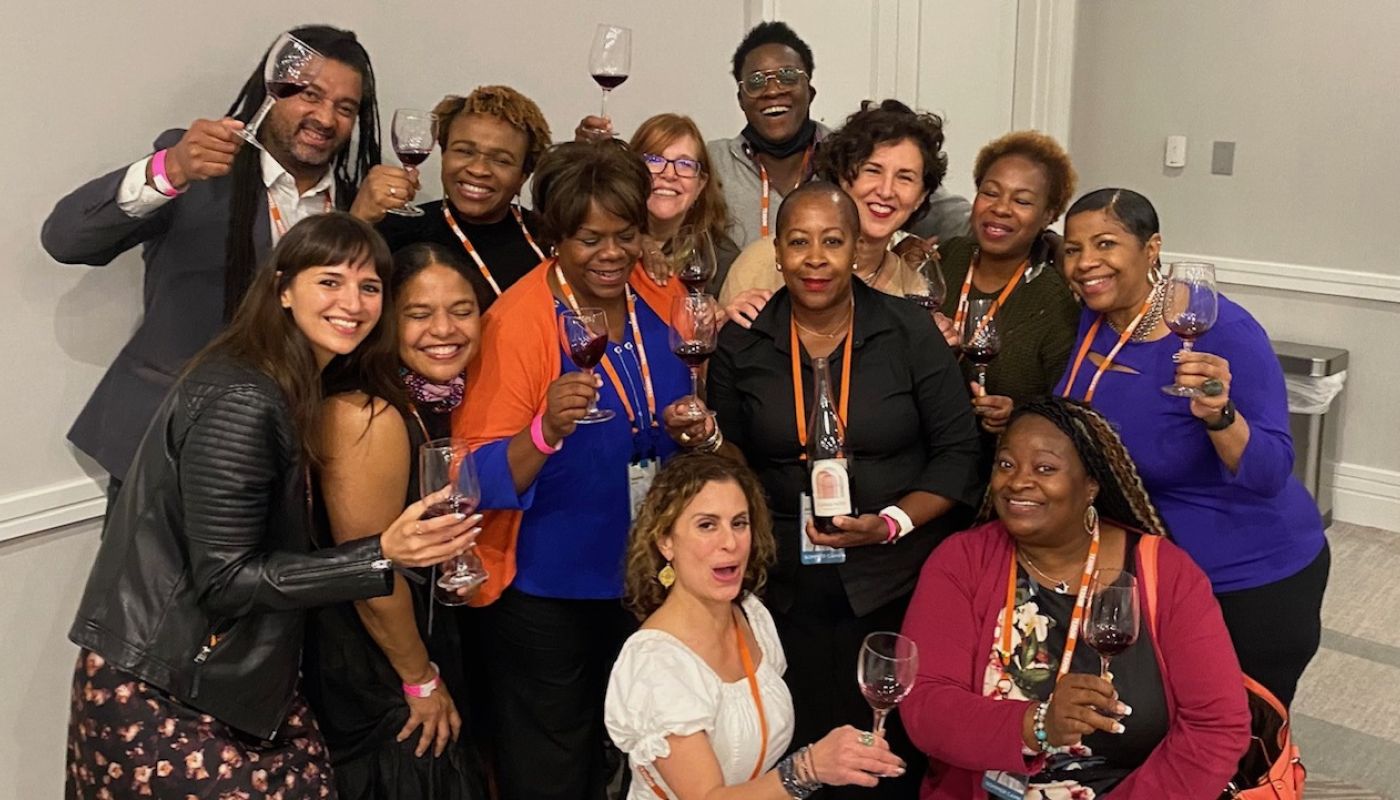
The picture at the top of this article of the speakers and sommeliers at Texsom last November in Dallas is virtually a who’s who of many in the current diversity and change community in wine in the US. This particular conference is focused on wine education yet in 2021 did an excellent job of ensuring it addressed diversity and advocacy via the invitees, the schedule and the seminar topics. There are wine and hospitality conferences focused on advocacy and diversity such as Resistance Served from Radical XChange, Lift Collective and Bâtonnage Forum. Texsom was unique in that it demonstrated how to bring these considerations into a mainstream wine programme. Let us hope this example is more widely followed.
Starting the conversation
It can help to remember that wine is not the only industry struggling with diversity issues. Those of us not too far from Silicon Valley are deeply aware of how the tech industry has stumbled repeatedly in solving their diversity problem. Hollywood and the global film and entertainment industry has even more publicly gone through repeated missteps, not just on racial issues but also gender. And although disability issues tend to attract less public attention, Hollywood has been grappling with them as well.
Here in California two years ago I helped Maryam Ahmed co-found the Diversity in Wine Leadership Forum, which brings together leaders of diversity initiatives in the wine industry to encourage collaboration and joint problem-solving. The Forum also serves as a centralised resource for those looking to support these initiatives. The Forum is now run by Ahmed of Maryam + Company, which provides community activation, project management and programme development for businesses in food and wine. She is based in California but works with companies and organisations all over the United States.
An advisor to the Forum is Dr Akilah Cadet, owner of Change Cadet, a service that offers diversity consulting, strategic planning, executive coaching and crisis recovery to an impressive array of businesses large and small. Change Cadet partnered last year with the Diversity in Wine Leadership Forum to form a series called Do the Work, which provides training specifically designed for members of the wine industry on learning how to navigate the dynamics that drive diversity issues and our own place in them. The series was designed both to be affordable and to help people newer to these issues become more comfortable dealing with any discomfort. People in wine from the UK, Europe, Canada, Brazil and the United States joined the three-part series. A repeat of the series begins in April.
These sorts of training are especially relevant now. Over the last two years most people have some level of understanding of diversity. Even people who don’t recognise the need to change things are aware that it’s a common conversation around the world today. Ahmed points out that most businesses – and in wine a lot of regional groups – want to address diversity in a strategic way, but many people and groups are still unsure of how. See my detailed guide to how to take the next steps for those in the wine industry.
These involve new approaches to recruitment, retention and promotion of staff and, perhaps of wider interest, education. The diversity scholarships that have been made available recently have largely focused on traditional certifications such as WSET, Master of Wine and Master Sommelier. These can be valuable, and it is important to support these sorts of studies. But we need to be careful not to treat such scholarships as the primary solution to the diversity problem in wine. Directing our attention primarily to traditional education comes with its own set of problems.
By focusing on education, we treat the problem of diversity as one based in the candidates themselves and miss that the problem is largely in the way the wine world itself operates. When we assume education must take a traditional classroom and certification model, we miss an even older tradition of education based in learning by doing, on-the-job training, and community-based mentoring. This is part of what makes both the Two-Eighty Project and The Hue Society such important groups for the Gérard Basset Foundation to support.
The Two-Eighty Project has created a powerful programme for learning-by-doing where attendees meet with some of California’s most influential figures in viticulture to hear directly about the challenges of operating a vineyard. They also work with a vineyard that has been planted as part of a community project with neighbourhood members also invited to help foster the vines. And that connects to the work The Hue Society is doing. The Hue Society has built its own wine community designed to centre the experiences of Black and Indigenous people and people of colour. Members learn about wine through sharing experiences and knowledge with each other in monthly tastings, as well as more spontaneous social events that naturally develop over time. It’s a more organic form of learning and mentoring based on community-building.
When it is assumed that the best candidates for wine-related roles must have traditional certifications or degrees, an enormous pool of worthwhile people are overlooked. Some of this may well result from our unconscious biases.
Unconscious biases are assumptions of differing sorts all of us have simply from how we were raised. The challenge of unconscious biases is that unless we’ve worked on them, we don’t even notice we have them, yet they inform how we interact with each other and how we make decisions. Some of these unconscious biases take the form of harmful stereotypes we need to unlearn. Many of the diversity issues in wine come down to our implicit biases limiting who we include in wine and how. In unconscious bias education, people can learn over time to undo some of them. But even for those biases a person might not be able to erase, people can still learn to do things differently. (My longer article addresses ways to do this in the section ‘Rethinking recruitment’.)
Many of us are still resistant to addressing diversity issues. There is still a fear of making missteps, but Ahmed and Dr Cadet point out that learning from missteps is all part of making progress.
We all have weaknesses, areas where we lack knowledge, and simple habits of behaviour or expression that we haven’t yet noticed it’s time to rethink.
Personally, I’ve been recognising my need to move away from the ableist language I’ve used without thinking about it. As small as these slips may seem, the casual repetition of them throughout our society (inadvertently or not) has a dehumanising effect that builds up over time. So, I am working on noticing when I use phrases such as ‘that is dumb’, ‘falls on deaf ears’ or ‘they have a blind spot’. When I realise I’ve used them I simply apologise, restate my comment in a more intentional way, and then we move on. For many of us these expressions also include harmful stereotypes we need to work to change as well. The point is, we all make missteps. If we recognise that, we can also learn in good faith to be more careful and change those habits over time.
We also need to recognise that the wine world will only become more diverse with time and commitment. Many of the solutions will need repeated attempts but I feel strongly that we shouldn’t let discouragement get in the way of real and worthwhile progress.
The longer version of this article offers next steps for those working in the wine industry, including recommendations on hiring practices, retention and advancement of employees, rethinking cancel culture and what individuals can do themselves.













