As I walked the alleys of a major London wine show, looking for the producer’s wines that I wanted to taste, I held the hand of my two-year-old daughter.
Finally spotting the wines in the line-up, I started to swirl, sniff and taste. My daughter asked to do the same, and I handed her the glass so that she could dip the tip of her little finger in the liquid. A gentleman standing behind me raised his voice and asked: ‘Excuse me, Miss, are you French?’ ‘Yes, sir, but how on earth did you know?’ ‘French people are the only ones that will let a two-year-old drink’, he replied.
‘Well’, I said, ‘she is not drinking. She is tasting.’
This was one of the fundamental lessons my dad taught me when I was growing up in the vineyards. Back in the 1990s, both my parents drank wine every day, and there was always a bottle on the table at every meal but breakfast (don’t laugh, this habit wasn’t far gone …). Both of them agreed not to continue my grandparents’ tradition of cutting wine with water for kids and would let my brother and me experience the full strength of wine when we asked to taste it. We had the same policy for everything at home: the minute I wondered how something might taste (the cat’s food, for example), a parent would reply, ‘Well, why don’t you try it?’
There is a strong belief in my family that if alcohol is not something that kids see as forbidden, then they will be less likely to abuse it as grown-ups.
A few months after the London wine show incident, my father passed away from cancer. He was only 60 years old. See, my dad was a smoker and had been part of that generation of farmers who sprayed pesticides bare chested, because we didn’t know any better at the time. But he was also an alcoholic and had gone into rehab several times through my high-school and university years.
So clearly, knowing the difference between tasting and drinking isn’t necessarily enough to protect against excess consumption and harmful drinking habits.
I realised then that although I had been born into a winemaking family and been a wine student all my life – through university, the WSET and the Master of Wine programme – and had been working in the wine trade for the best part of two decades, I had never been taught about the effect of alcohol on the human body.
So I started to learn about wine, health and moderation. And it struck me that, if we want to have a long, positive relationship with wine (especially those of us in the wine business), we have to question our own intake, and understand what moderation looks like for ourselves.
What is moderation anyway?
For the last decade, the wine trade has fully embraced the importance of moderation and studies show that people understand what drinking in moderation means: do not drink and drive, do not drink when pregnant and do not get wasted.
Wine in Moderation, a programme launched in 2008 by the European wine sector to demonstrate social responsibility, defines moderation as ‘the level considered to be low risk’, but no universal drinking guidelines exist.
The International Alliance for Responsible Drinking, a non-profit organisation made up of a number of the world’s largest wine, beer and spirits companies, has compiled a table of international drinking guidelines, where it’s easy to see how much these guidelines differ. In France for example, moderation is defined as up to 20 g of pure alcohol a day (two drinks a day for both men and women) but no more than 100 g a week, or five drinks, while the US guidelines allow up to 28 g per day for men, 14 g for women, with limits set per 2 hours.
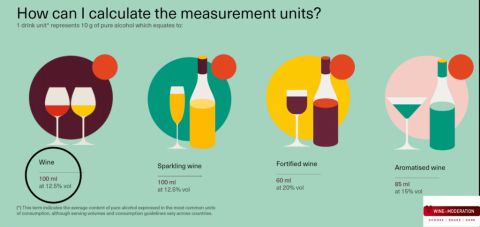
The definition of ‘standard drink’ also changes depending on where in the world you are. Wine in Moderation defines a standard drink as 100 ml of 12.5% wine. But while a 100-ml pour is standard in Germany, the standard in France is 125 ml and 175 ml in the UK – but pubs and bars often propose a 250-ml pour, regardless of the wine’s ABV.
If I ordered a 250-ml glass of a 14% red at my local restaurant, I would ingest the equivalent of 28 g alcohol in just one glass and, as a woman, I would be over the limit of moderation according to most guidelines.
Moderate drinking, maximum pleasure
As you see, moderate drinking means less alcohol intake than most people think.
But the good news is, according to Pierre Chandon, a professor of marketing at INSEAD, favouring moderate portions is optimal not just in terms of health and calorie intake, but also from a pleasure perspective.
‘Hunger, satiation and value for money are driving us to choose bigger and bigger portions without realizing how big they’ve become’, he said in a recent Areni podcast. ‘But we forget something very important, which is that the key pleasure in food and beverage does not increase with quantity.’
In his recent research, he demonstrates how the pleasure we get is not the sum of the pleasure from each sip, but the average, so the last gulp of wine – or the last spoon of chocolate mousse – doesn’t add a little bit of pleasure. It actually subtracts from the average.
‘People tend to forget that sensory pleasure peaks during the first few bites and diminishes with each subsequent bite’, says Chandon. ‘More importantly, it is the last bite that determines the overall enjoyment of the food. Because pleasure in food is influenced by the average (not the sum) of the pleasure experienced in each bite, the last bite of a large portion yields less eating enjoyment. Hence, people tend to consume portions that are too large from a pleasure standpoint.’
Michelin-star restaurants have understood this concept very well: by serving a series of small portions, they maximise their customers’ pleasure.
Moderation can sometimes be seen as a killjoy, an effort that precludes you from having fun. Chandon has demonstrated that in many cases, moderation is actually the reverse: it allows us to maximise the pleasure we take from a glass of wine.
Know yourself
If there’s no universal definition of moderation, then we need to define it for ourselves. I thought back to a conversation I had with Professor David Nutt, author of Drink? The New Science of Alcohol and Health (2020), which provoked me to question myself as a drinker. Of course, I am a wine taster, but what kind of drinker am I? What kind of drinker do I want to be? Nutt lays out two requirements to answer this question:
1 Know your history
Genetics influences a lot. Young men with a family history of alcoholism have a high risk of becoming dependent. ‘Another very interesting question to answer’, Nutt said in our podcast, ‘is “What stage of your life are you in?” Because some people never stop drinking like a twenty-something.’
Although I am not a young man, I have a direct history of alcoholism and mental health issues. Being a mother of two young kids, I am constantly overtired, which also puts me in a vulnerable position. I need to be conscious of all these factors.
2 Know your motivations
Nutt described four main motivations for drinking alcohol, and I have added two more:
- social: drinking to celebrate and have fun
- conformity: drinking to fit in
- enhancement: drinking because it’s exciting; wanting the effect of alcohol
- coping: drinking to forget worries
- pleasure: drinking to enjoy the taste of wine
- work: drinking on a work-related occasion out of a feeling of obligation (this is particularly relevant for people in the wine trade).
My motivation for drinking can oscillate between all of the above, but as I have grown older, I have become very comfortable refusing a glass of wine during a work event, although it took me a while to develop the confidence to say ‘no’ in such instances. I also recognise that if pleasure is my main motivation, then moderation is the only option, as excess drinking will return opposite results. Given my history, I am also extremely cautious regarding the coping motivation. I allow myself to ‘want’ a glass of wine, but I am painfully aware that if I found myself in a situation where I ‘need’ a drink too often in my week, then I need to address the issues at the source, and not use alcohol to cope.
Building a drinking strategy
Knowing my history and motivations allowed me to establish a drinking strategy. Here are its key elements.
- Always bring my water bottle and spittoon to tastings and wine events. Although event organisers are much more thoughtful today than when I started working in wine, there are still times when spittoons are way too rare, and the water jugs are not refilled often enough.
- Always go for the 125-ml option in a wine list, and request it if it’s not available on the menu.
- Pace myself at cocktails. Never allow the waiter’s ‘automatic refill’, as it is otherwise very difficult to keep track of my intake.
- Always feel free to say ‘no’ and remember that ‘no’ is a complete answer; no explanation is needed.
Building a healthier industry
Rebecca Hopkins is an Australian wine professional living and working in the US. Concerned about wine professionals who were struggling to balance their work-related food and wine consumption with their health, she founded A Balanced Glass, a web forum dedicated to the health and wellbeing of wine professionals.
‘It’s important that we do this because we want to create a thriving workforce’, says Hopkins. ‘We are losing talent to other industries because we are not creating environments that are inclusive, that are safe, that are informed, transparent, and really encouraging high performance. We also need to create an environment where people feel taken care of and safe in order to perform at their highest potential level.’
The first advice I was given by female colleagues in this industry was to always drink less than the men in the room. ‘You can’t afford to lose control’, they’d explained.
And while the trade has made a lot of progress encouraging moderation, physical and verbal harassment still happens quite frequently at the end of a boozy work event – or at the end of a long service – and this is a key reason why women are leaving the trade.
If we were to encourage and respect moderate drinking as much within the trade as we do outside of it, the industry would be a more welcoming place. And so we should take our own drinking strategies and turn them around, remembering to:
- abstain from publishing or endorsing content promoting being drunk as something fun
- have plenty of water and spittoons at events – even at meals
- serve wine and drinks in the recommended 125-ml serving sizes – we know from research that people do not miss the larger sizes
- don’t top up wine glasses without the drinker’s express permission
- stop using expressions like ‘nobody ever got drunk with Petrus’; if moderation is a conscious behavioural choice, then it has nothing to do with the bottle’s price tag, even within fine-wine circles
- don’t get wasted
- be aware that harassment is still frequent and support your female colleagues if witnessing uncomfortable situations
- never, ever pressure people to drink, and remember that ‘no’ is a complete answer.
While the conversations around alcohol and health continue to be debated by governments and researchers, we each have no other options but to define our own limitations. And that starts by questioning our own knowledge of moderation and our own behaviours.
Images courtesy Wine in Moderation.
This essay was first published as What is moderation anyway on AreniGlobal.com and has been adapted and expanded for JancisRobinson.com. For more resources on wine and health, see our collection of features, and for some non-alcoholic options for the holidays, see today's NOLOs – a festive guide.
















