
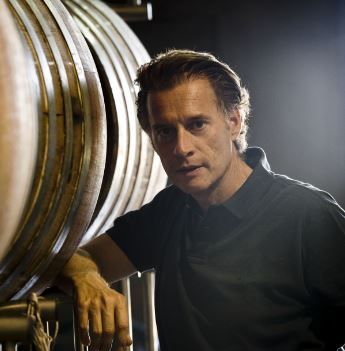
In my little puddle of vinous life I am becoming aware of the most massive U-turn on the part of an increasing number of thoughtful wine producers. Interestingly, this is nothing to do with marketing but sheer disaffection with the wines they made in the past.
Take Alberto Antonini (pictured, in superseded setting), a respected 55-year-old consultant winemaker with professional qualifications from Bordeaux and Davis in California. He has made wine in California, Argentina, Chile, Spain, South Africa, Canada, Romania, Armenia, Uruguay, Australia and his native Italy. He admits, 'When I think of what I was saying 20 years ago, it seems like a different planet.' Although trained to make use of all the latest technical advances in winemaking, he has completely revised his views on, for example, suitable ripeness levels of grapes. 'When you get over-ripeness you cover the local character, just like over-extraction [macerating the grape must so long that the fruit is submerged by tough tannins]. Similarly, the use of synthetic products doesn't help you display Nature. The products that you're taught to use such as selected yeast, enzymes, various other additives, I have slowly got rid of all of them.' He was talking specifically in this instance about his work in Argentina with Altos Las Hormigas, which he co-owns, and was presenting his wines and thoughts in the company of fellow believers Sebastian Zuccardi and Gabriel Bloise of Chakana, all of them guided by soil expert Pedro Parra. They are all delightedly getting to grips with how very different the wines made from different areas of the high Uco Valley in the Andes can be.
'I grew up being told that the New World had no terroir,' laughed Antonini, 'but it's amazing how you realise terroir is everywhere. In just five hectares [12 acres] of Altamira you can find soils that can give you wines worth between $5 and $200 [a bottle]. We really want to focus on the purity of local flavours and express terroir in our wines.' Zuccardi, Bloise and Parra were like excited nodding dogs beside him. They are hard at work, in a project led by Laura Catena of the eponymous Argentine wine company, shaping a credible and detailed appellation system for Argentina's wine province Mendoza.
The same revisionist views can be heard throughout the winemaking world. Eben Sadie has been viewed as the leader of South Africa's next generation of winemakers ever since he went on his own to found Sadie Family Wines in 1999. We met up earlier this year while he was partying his way around London and he could hardly wait to recant re the wines he was making a decade ago. 'My 2004 tastes so much better now than when it was released. I honestly don't know how people sold them when they were young; they were so hard in youth and then went into lockdown in middle age. South African wines are now definitely fresher, which is good because our wines were too ripe. Mind you, I would have protested if you'd told me that in 2004. In South Africa we now have this big, shared notion: everyone is going for freshness and acidity. Quite a contrast from the early 2000s when everyone was trying so hard to get high scores on the 100-point scale. But I was young then.'
And it is not just relative newcomers who are changing their tune. Last week I tasted the latest releases from Moss Wood, founded in Western Australia's Margaret River in the 1970s with Keith and Clare Mugford, who have been running it since 1984. They too volunteered a sea change in the way they make their whites. They used to make the region's characteristic blend of Sémillon and Sauvignon Blanc in oak in what Keith Mugford describes, referring to the famous dry white bordeaux, as 'Domaine de Chevalier style', but the wine sees no oak now. Similarly with their Chardonnay, they used to stir the lees feverishly, believing they were copying best burgundian practice. But when they asked a panel of respected palates to assess all vintages of their Chardonnay to establish which were classic Moss Wood, 'everyone agreed that the great years stood out and had nothing to do with the winemaking. The more you fiddle around with winemaking techniques, the more you will minimise the vineyard's individual stamp', declares Keith Mugford.
Nor is this phenomenon by any means restricted to the New World. Someone as far-sighted as Gérard Gauby of Roussillon was revising his conception of ripeness and balance in wines as long ago as the late 1990s. I recently came across a fascinating pair of wines from the Spanish region of Valencia, made by Celler del Roure, about 50 km inland on about the same latitude as Ibiza. The owner Pablo Calatayud and his appropriately named winemaker Javier Revert did very well commercially when exporting dramatically styled reds and whites to the US but found themselves frustrated by the way that oak ageing, while endowing the wines with useful structure, robbed them of their freshness, elegance and local character. Over the last five years they have been experimenting with a reversion to tinajas, the large clay jars once used for winemaking in this part of the world. The results are delicious: chock full of personality but accessible and expressive rather than overlaid with oak flavour.
For both Sadie and Antonini, their past sins are inextricably bound up with the use of too high a proportion of brand new small barrels. According to Antonini, 'too much small new oak covers the true character of the wine'. He is even abandoning the neutral, easy-to-clean stainless steel that has been the preferred alternative to wood for many winemakers and is slowly replacing it with concrete 'because it's more alive. Natural yeasts like concrete more than stainless steel, which is a dead material. Small barrels probably work very well for the red bordeaux recipe but the big problem around the world has been that everyone has been using the same recipe.'
Sadie mused to me, 'I do wonder how my wines would have been with only half the new wood I used in the past.' I have written before – see Oak as shoulder pad – about the extent to which winemakers all over the world are using fewer new barrels, and larger sizes. I do hope the coopers, who did so well in the late 20th century, are now diversifying into clay and concrete.
SOME FAVOURITES
Moss Wood Chardonnay 2012 Margaret River
An elegant answer to white burgundy informed by the Indian Ocean.
£24.95 Jeroboams
Altos Las Hormigas Malbecs 2012 Uco Valley
Any wines from this vintage and this producer are exciting and already available at $20-30 in the US. They should be on sale in the UK at around £20 later this year.
Celler del Roure, Parotet 2012 Valencia
Made mainly from the local Mando (aka Mandón) grape aged in clay jars.
£20 Tivoli Wines
Sadie Family Wines, Columella 2010 Swartland
The trailblazing red based on old vines took a new, fresher direction from the 2008 vintage.
About £48 Uncorked, Swig, Hedonism, Handford Wines













