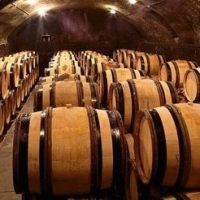
Twenty years ago wine producers around the world measured their success by the number of new oak barrels they had in their cellars – preferably made from French oak, bought at vast expense from the world's most experienced coopers (French ones) with the same capacity as those traditionally used in Bordeaux and Burgundy, 225 and 228 litres respectively – the size that a strong man can turn on its side and roll along with relative ease.
An oaky taste, something a bit toasty and dense that overlaid the fruit, was hugely fashionable for a while – especially in the Chardonnays and Cabernets that proliferated then in virtually every wine region that could successfully ripen them, as those who remember Rosemount or Kendall Jackson Chardonnay can attest. There was also a sort of exhibitionistic element in producers' being able to show off just how much money they had invested in France's supremely well-conserved oak forests. (Today, a new top-quality barrel can easily cost 600 euros.)
But fashions and therefore tastes change. Now I find that for even the least sophisticated taster, 'oaky' is a term of distaste, and even some of the smartest, most ambitious wines may be rejected by neophytes because there remains a trace of the oak barrel lodgings to which these wines were treated in their youth to give them the potential to age – although the wines are designed to be drunk long after any perceptible trace of oak has been subsumed.
Skilled winemakers are keen to put suitable wines into oak for a year or two before bottling to expose them to the very slow oxidation that helps clarify and stabilise them instead of subjecting them to more brutal chemical or physical alternatives. Oak also encourages a sort of complex marriage brokering between the wines' many constituent parts. Wines tend to come out of barrels more complex than when they went into them.
Partly in response to the change in consumer tastes, an increasing proportion of winemakers are eschewing the traditional small barrel size, often called a barrique, in favour of bigger barrels in which the proportion of wine in direct contact with wood is reduced. This is particularly marked in places such as Italy's top wine regions Piemonte and Tuscany, where, before the advent of the barrique and a widespread but temporary belief that it would somehow confer French magic on their wines, large old oak casks were the norm.
The influential Italian wine writer, the late Luigi Veronelli, was so enthused on a trip to California in the 1980s by what barriques did to wine that he convinced many of Italy's top wine producers of their virtues. This led to a wave of concentrated, oaky Italian reds, and whites, but there is now a distinct return to larger oak casks. On a recent short visit to Tuscany I was given samples of the same wine based on the local Sangiovese grapes aged in different sizes of oak and it was notable how much more refined and precise the wine aged in 500-litre casks was – refinement and precision being 21st-century virtues. Think of oakiness as shoulder pads.
But larger casks are also invading the classic French wine regions which have traditionally used the classic smaller barrels to the exclusion of all else. In Burgundy last week, Grégory Patriat, perhaps the region's most lavishly funded young winemaker in Burgundy in his capacity as powerful négociant Jean-Claude Boisset's 'viticulteur-winemaker' for his own domaine wines, could hardly contain his enthusiasm for what 500-litre barrels do for his fine white wines. 'They give more purity, more tension, make the wine more crystalline, give it more minerality.' (Minerality is a very early-21st-century virtue.)
He doesn't use 500-litre barrels for his reds, arguing that they don't soften red wines' tannins as effectively as the traditional Burgundian 228-litre pièce, 'but since 2007 we have rediscovered our whites thanks to 500-litre barrels – and they're cheaper!' He hastened to point out that this lower cost of oak per litre of wine is a decidedly secondary consideration. There is, however, the extremely practical fact that, although the larger barrels are physically more difficult to handle, they take up much less space than the same volume of wine stored in traditional smaller casks, provided of course that your cellar is not so cramped that you cannot even get a larger size through the door (a consideration in many small, family-owned caves in Burgundy).
Celebrated French wine writer Jacques Dupont overheard this conversation and volunteered that in the Champagne region, to which he was returning that night, a similar phenomenon is already evident. Oak ageing of the base wines for champagne has been increasingly fashionable, but many producers wishing to reduce obvious oakiness are introducing larger casks, and – a hugely significant qualitative, and economic, factor – re-using them more often.
Again in the shoulder pads era, the percentage of new barrels used – preferably 100% – was considered a measure of quality. Today, it is no longer regarded as shameful, in fact in some quarters such as at the pre-eminent Bolgheri winery Sassicaia it is positively relished, to admit to re-using a certain proportion of their barriques once, or even twice. Used barrels tend to move down the ranks. In Bordeaux, for example, a barrel used for first-growth Château Lafite in its first year may be used for the second wine Carruades de Lafite in its second year and then shipped down to their property in the Languedoc Château d'Aussières for its third and fourth years, possibly having its interior shaved while there to expose the wine to a bit more new oak.
Less obvious oakiness is by no means restricted to Europe. Australia has long had a tradition of using 300-litre hogsheads and larger puncheons to mature its full-throttle reds, and reduced oak flavour has played a major part in perhaps the biggest and fastest stylistic turnaround the wine world has ever seen, Australian Chardonnay's recent rapid weight loss. Even in California, where oak tolerance can seem endemic, barrel salesman and Purple pager Mel Knox, who sells the hugely reputable Taransaud and François Frères barrels to some of the least cash-strapped wine producers in the world, reports that he sold 200 500-litre barrels last year and perhaps 10 of the 600-litre demi-muids commonly used in the Rhône Valley. It would seem that even in California some winemakers are now demanding sizes larger than the barrique, on which the modern California wine industry was founded.
A lower cooperage bill seems in tune with the current era of austerity, but the tonneliers are not doing too badly. The latest toys for fashion-conscious winemakers are an array of fine wooden fermentation vats to be used, just once a year, before the wine goes into whichever barrels are chosen for it.