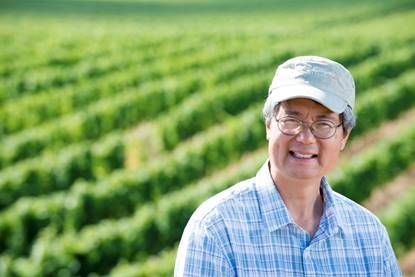
Number 34 in our series of entries to our wine writing competition comes from Mark Chien.
Age 59, male, currently program coordinator (2 years) for the Oregon Wine Research Institute at Oregon State University. Previously viticulture extension educator at The Pennsylvania State University (15 years), and wine grower on Long Island, NY (3 years) and the Willamette Valley (16 years).
THE WONDER OF EMERGING WINE REGIONS
Wine has been around for a long time, about 9,000 years according to the research and discoveries by archeo-chemist Dr Patrick McGovern at the University of Pennsylvania. For wine lovers this may be the most exciting time to drink wine ever. Old heritage varieties are being re-introduced from tiny regions all around the Old World of wine, especially in Italy and Greece, but also places like Croatia and Serbia, where wine industries are re-emerging from the ashes of war.
But I think the most exciting development of all is the appearance of new frontiers of wine in the New World. Let’s face it, modern wine in North America has really only existed for 50-60 years, from Napa to Niagara. Wine from Long Island, Virginia, Vermont, Missouri, Texas, Nova Scotia, Ontario, British Columbia and other previously unheard of viticultural areas are all making significant regional quality statements and creating a sensation of new flavours and styles of wines using grape varieties that would shock and confuse Old World adherents. And traditional varieties like Pinot Blanc and Mencía can create delicious and exciting variants in a place like Oregon.
As a wine consumer nothing gets me more excited than a fine wine from the Old World. As a viticulturist, there is nothing quite like the process of discovery of a new wine region.
A recent visit to the Wine Islands, north of Vancouver, reminded me just how exciting it can be to plant the flag of new varieties in a previously unknown wine region.
The process usually begins with a single individual or couple with a vision of wine in a new place. It could be David and Diana Lett imagining Pinot Noir in the Willamette Valley, or the attraction of the maritime climate of the North Fork of Long Island to Alex and Louisa Hargrave. Someone, for some reason, thinks wine can be grown in this place.
In the Wine Islands, a very cool wine region at a 49 oN latitude (same as the Mosel), innovative wine grower Paul Troop understood viticulture conditions and requirements enough to know that classic European varieties would struggle to ripen and that hybrids might be better suited to the climate of the Wine Islands. Through the provincial government plant-importation centre at Sannichton he brought the Swiss Blattner varieties to this small, emerging wine region.
When I was visiting the area in 2011 with Kevin Ker, a top viticulture consultant from Ontario, these new varieties were just beginning to make wine, and they showed promise. Wine consumers do not realise, nor do they need to understand, how much effort goes into the process of discovery a new wine region. John Gladstones’ outstanding book Viticulture and Environment explains the essential elements of a new area that must be found, analysed, understood, and tested again and again before fine wines can emerge. It is an enormously complicated and intensive process that takes great patience and perseverance to understand the fine details of terroir, one that can only be achieved by careful analysis, guessing, planting and then tasting the wines, and replanting until it’s done right. Those who appreciate cult Napa Cabernets may not remember that Yountville used to be most widely planted with Riesling in the 1970s and 80s, and only the phylloxera disaster allowed vineyards to be properly designed and replanted with more appropriate varieties and rootstocks.
In the Old World, and even in New World wine areas, the process is relatively simple, if not formulaic: you pretty much look over the fence to see what your neighbour’s vines are doing and which varieties, clones, and rootstocks have proven successful over time, both viticulturally and commercially (there is often a tension between these two wine imperatives). Vineyards also need to be sited and designed properly if they are to produce the highest quality fruit, which means considering the most favourable soils, elevation (absolute and local), aspect, slope, water availability, presence of diseases and pests, trellis system, vine spacing, fruit wire height – the list goes on and on. All of these decisions must be made before the first vine is planted, then you wait three to five years for the vines to produce a crop, then make wine for a few years to determine if you made the right decisions. In the Old World this has been a centuries-long process. Napa figured it out in 50-60 years, and Oregon in 40 or so, along with other New World wine regions. Now, the Wine Islands, along with many other new regions such as the Mid-Atlantic, Texas, the northern tier with their cold hardy hybrid varieties developed by the University of Minnesota, Nova Scotia and others are all following this well-worn path.
The Willamette Valley in Oregon only had to prove that Pinot Noir could grow successfully here, and a recent declaration by Eric Asimov, wine writer for The New York Times, that Oregon Pinot Noir is next only to Burgundy in quality seems to validate the grape in this place. But what of the Wine Islands? It must endure not only the discovery process but also consumer bias against hybrid wines. Needless to say, in blind tastings it would be easy to prove that hybrid wines compete favourably with their vinifera cousins, but that’s not how consumers, or the wine media, evaluate the wines they buy and consume.
Cold hardy hybrids like Marquette, La Crescent, and Frontenac have opened vast new areas to wine that were previously thought to be inhospitable to vines due to freezing winter temperatures. Growers had to decide how to train and cultivate these new varieties, and winemakers have worked mightily with enology researchers to tame the often overbearing acidity, particularly in red wines. But in a blind tasting in northern Vermont of Marquette (Pinot Noir is a significant part of its lineage) wines against Pinots from the Russian River, Willamette Valley, and Cote de Beaune, the Vermont wines were definitely in the same class, with a discernable and common thread in fruit quality and character between them. Wines from North Dakota, Wisconsin, and Minnesota? You bet! And growers don’t have to bury the vines to keep them alive. That’s progress!
If you make a fine wine will anyone care? The global wine market is overflowing with delicious wine. On Long Island, nascent vintners believed just because New York City was on the horizon that there would be an endless market for their wines. It took 20-30 years to produce great wines, and another dozen or so to get somms and retailers in the city to realize that fine wines were being grown in their backyard. Long Island is still seeking to define its wine identity.
It's the same story in the Finger Lakes, now widely recognised as one of the few great places to grow definition Riesling. The discovery process is still very much ongoing there, and I believe that they are only halfway to their very best wines. Once the best sites are found and the necessary vineyard practices applied to them, only then can the finest wines be made.
Virginia has its own peculiar identity challenges. For the past decade fine wines have been made at Barboursville, Linden, RdV, Glen Manor, Boxwood and others, but the state is defined by its 'wine entertainment' businesses, where the focus is on events, and not on producing the best possible wines. This has impeded the recognition process. Yet, nowhere has such prodigious effort been exerted to understand vineyard site quality and characteristics in the pursuit of great red wine – not cult Napa Cabernet or first-growth bordeaux, but a distinctly Virginia wine.
In almost 40 years of growing wine grapes and extension education and research I have learned that most of viticulture in great vineyards is the same around the world, but the key to great wine is the small portion of knowledge and site characteristics that is both unique and local. These are the essentials of the discovery process.
I once tasted a blend of Concord and Cabernet Franc from a wine grower along Lake Erie in north-west Pennsylvania that, even with 20 years of Pinot Noir experience in Oregon, I identified as Pinot Noir. Grapes are malleable and magical in their potential for originality and to surprise.
During our 20-year first tour of Oregon we would go to Vancouver once or twice a year and always try Okanagan wines in the restaurants. They weren’t always easy to find. Over time they became more available and notably better in quality. It was a fascinating exercise to follow along as a new wine region gained in quality and confidence. Because we were not immersed in the process and tasted wine on a regular but infrequent basis, we were able to readily discern the quality improvements. Now fine wine is firmly established around the lake.
So many emerging wine regions like the Wine Islands are waiting to be discovered, even by wine lovers in their backyard. Of course, high-quality wines are the key to success everywhere; there is simply too much inexpensive, delicious wines readily available. Vintners in new regions should expect, and deserve, attention from wine consumers and sellers just because they are local and part of the farm-to-table culinary culture. Yet in the end, in almost all cases that I have experienced, new wine regions end up figuring out their terroir and offering something distinctive, unique, and delicious to those who are curious and adventurous enough to try their wines.
This is the thrill of wine: drinking something old and familiar, but also something exciting, new, and different.