This pair of articles, the seventh in our series of published entries in our wine writing competition, comes from Kamal Farmer, who describes himself thus:
Sex: Male
Occupation: IT infrastructure specialist
Location: Melbourne, Australia
The best wine advice I ever received was 'taste more, taste often' – a phrase that I’ve embraced wholeheartedly, even when it sometimes means picking up a glass that smells of vinegar and gym socks and giving it a go. While I’m not in the wine industry, I attend just about every wine tasting event in Melbourne (and there are many) – again, tasting more wine, more often. Over the last 12 months I would have tasted in excess of 2,000 wines. Some good, some bad – but it’s all been a fantastic learning experience just the same. I’m the organiser of a friendly wine-tasting group in Melbourne that meets every three weeks, tasting everything blind in order to improve our palates. And it’s not often you get to chat about wine for three hours straight with like-minded people. It’s a lot of fun. My wife Lucy also enjoys the odd glass of wine and has thankfully indulged me with our last six holidays to Australia’s various wine regions. Living 20 minutes from the Yarra Valley doesn’t hurt either.
My writing style is entirely reflective of my personality, so I hope you enjoy it. References for any statistical facts or figures can be supplied in your preferred format.
Wine, Australia and the Olympics
As a relatively young nation, Australia may not have the rich wine history of many European countries; though when it comes to innovation, I think Australia can stand proud.
As I type this, I’m using what is arguably Australia’s greatest invention to date – Wi-Fi. Developed by the Australian Government agency, the CSIRO, Wi-Fi has changed our lives forever and modernised many aspects of the wine industry. Many vineyards are now equipped with wireless sensors scattered across their sites, collecting data about soil and air quality, recognising when there is too much or too little water, and more. Ultimately this equates to more efficient growing practices, improving the health of vines, and often a reduction in operating costs.
It doesn’t stop there. Fermentation vessels can be Wi-Fi-enabled to alert a winemaker via email, phone call or text message to the minutest of irregular changes occurring inside the tank. The now more informed winemaker can head off any unexpected fluctuations before any real damage is done.
Have you ever thought about Wi-Fi-enabling your bottle of wine? Me neither. However, the recent start-up Kuvée has done just that – creating a system where you can browse and buy wine directly from the integrated LCD screen on the bottle. Their only fault appears to be that they’re not Australian. (We’ll forgive them this one transgression.)
Australia's greatest contribution to wine innovation may be less well-known, but no less important. The wine bag in a box, also known as Château Cardboard in some circles, was conceived and developed in 1965 by Thomas Angove of Angove's winery in McLaren Vale, South Australia. When I was growing up in the working-class Western suburbs of Melbourne in the 1980s, bottled wine was almost unheard of. While you could argue that boxed wine’s popularity in Australia was born from the value it provided (more wine for less money), equally important was the alignment of the palate of many drinkers to the easy-drinking, off-dry style that many boxed wines offered.
As a child, I was thrilled that my parents bought boxed wine. After all, I was the one who got to play with the inflated faux-balloon silver bag after everyone had had their fill. Oh, for simpler times! What’s more, this bag was incredibly strong; withstanding the rough and tumble of my childhood antics, and doubling as a pillow when a party-goer had consumed just a little too much (or so I’ve heard).
The industrial design required to both protect the wine and resist the forces of a small child is more than meets the eye. Curtailing the perils of exposure to oxygen in bagged wine packaging required some out-of-the-box thinking, if you’ll pardon the pun.
The original design by Thomas Angove for the 'wine bag in a box' was just that – open the box, snip off the corner of the bag and pour out your crimson prize. Purchasers who didn’t consume the entire contents of the bag in one sitting were encouraged to reseal their bag of wine with a rubber band or paperclip (though I imagine as much wine was consumed as was spilled on the dining table). Sadly, without a method to halt the intake of air into the bag, oxidation would quickly set in. It wasn’t until Australian icon Penfolds welded a tap to a collapsible metallised bag in 1967 that things really got moving.
The tap prevented the ingress of air as wine was drawn from the bag (the bag collapsing as the volume of wine reduced) – the metalised bag itself also now providing the correct barrier protection against oxygen leeching in from the surrounding atmosphere.
As far as preserving wine from a previously opened container goes, boxed wine has done a mighty fine job in its over 50-year history.
But despite all of the positives the wine bag in a box offers, boxed wine has become synonymous with low-quality, mass-produced wine. Australia even has a colloquialism for this type of wine, 'goon', with the inner bladder of the box known as a 'goon bag'. The irony of many Australians (some of convict ancestry) using the word 'goon' is not lost on me.
Amazingly, recent statistics show that goon bags – sorry, boxed-wine – still account for nearly 40% of all white wine sold in Australia – no doubt to the chagrin of us more serious wine drinkers. And while that number has fallen (as the emerging lower-middle-class switch to increasingly affordable bottled wine) boxed wine’s poor reputation endures.
Though the link to wine may not be obvious, Australia was also the home of another great invention: the rotary clothes line known as the Hills hoist. The beguiling rotational motion of the Hills hoist was another fond memory of childhood summer days as I helped to hang out the washing. I imagine that as a five year old that my 'helping' amounted to much the same effect as a paperclip had on preserving an opened bag of wine. It wasn’t until I was in my twenties that I learned of yet another example of Australian ingenuity in the form of a drinking game using the Hills hoist.
A pioneering (presumably young) Aussie thought to combine the freely rotating nature of the Hills hoist clothes line with a goon bag (just the inner bag, no box) – and as simple as it sounds, 'goon of fortune' had arrived. With a nod to spin-the-bottle and the beloved TV game show Wheel of Fortune, participants would stand around a Hills hoist clothes line, with a full goon bag attached to one arm. The clothes line is spun, with the hanging bag eventually coming to a stop closest to one lucky contestant. The 'winner' of the spin was obliged to drink straight from the bag (while it was still attached to the clothes line, no less). The spinning and drinking is repeated over and over until a winner is determined by (literally) the last-man standing. Throw a shrimp on the barbie while playing and you’ve nailed the all-Aussie backyard trifecta.
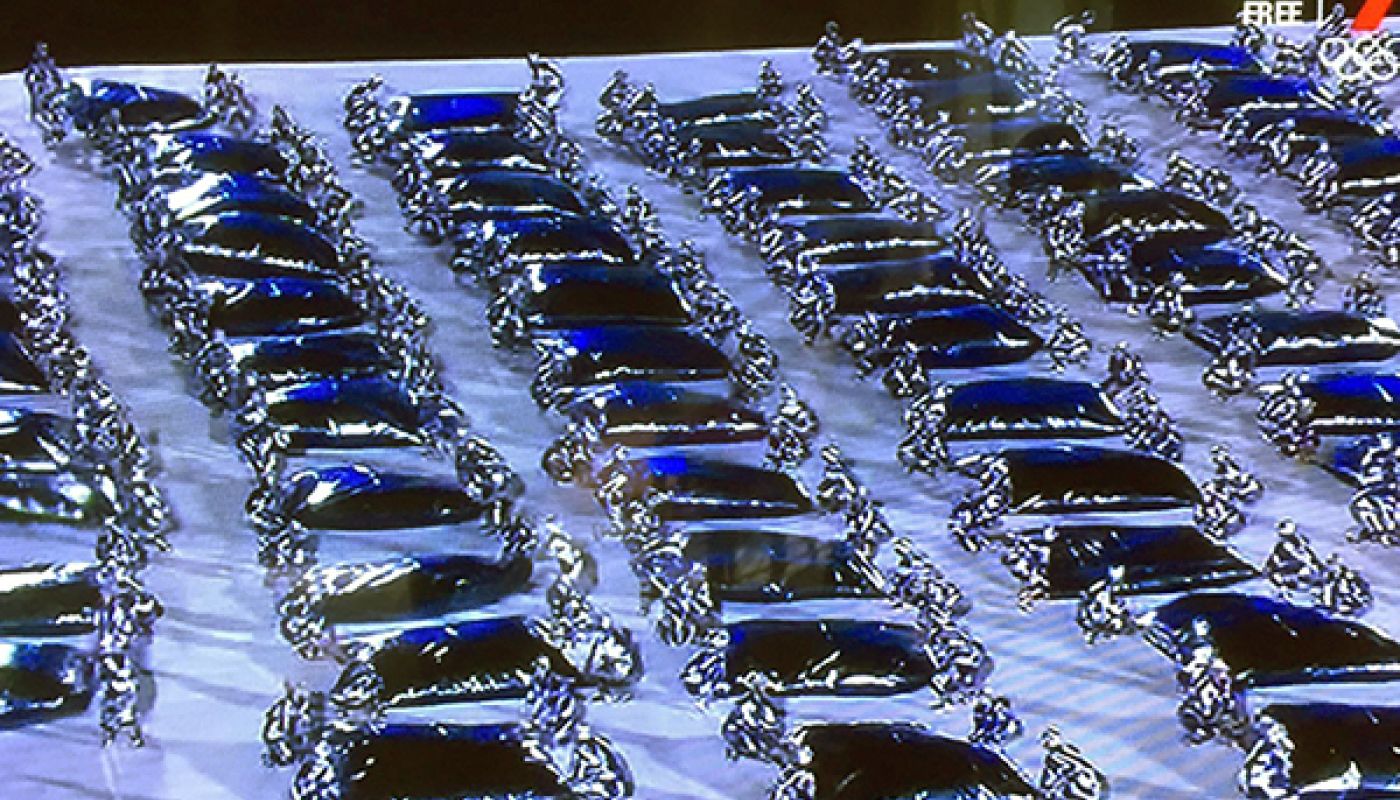
The goon bag is so ingrained in the psyche and life-experience of most Australians now that social media was set ablaze with commentary on our success at this year's Rio Olympics opening ceremony. What? Opening ceremony? Indeed – the opening ceremony featured giant metallic pillows eerily similar to our beloved goon bag parading across our TV screens (as shown above) – and Australians everywhere responded. The icon of our carefree youth was on display in front of an audience running into the hundreds of millions, and we couldn’t be prouder. I’m welling up just thinking about it. OK, maybe not. But it was a reminder of just how entrenched boxed wine is, in our collective memories.
In a world where wine is serious business, boxed wine still has a place (and not just in official Olympic proceedings). It is still regarded as a high-quality packaging system that is worthy of holding high-quality wines, despite most producer’s reluctance to embrace it and challenge the status quo. Perhaps a little marketing innovation is in order? [See Jancis's recent wine of the week featuring the innovative 'bagnum' pouch used by Australian Andrew Nielsen for his Fleurie-Poncié – JH]
And should you find yourself Down Under in the future and asked to play Goon of Fortune, I’d encourage you to give it a spin – things might have changed by then – you never know your luck.
Understanding Australia’s WET. Dive in
See updates on this controversial issue at the bottom of the article.
It was a mild Sunday afternoon in May, and I found myself in the bustling hipster-filled inner-Melbourne suburb of Fitzroy, tastebuds at the ready for the third annual Handmade wine-tasting event. More than 60 craft 'labours of love' were on display and open for tasting, the many serving rooms packed with wine enthusiasts from all walks of life. While small batch/natural/minimal intervention wine is certainly on the rise, nothing quite prepared me for the onslaught I faced.
I’ve never heard so many people use the words 'carbonic maceration', 'field blend' and 'I bottled this last week' in all my life. Unfined and unfiltered were de rigueur. The very first red wine in my mouth was made from seven co-fermented grape varieties – four of which were white grapes! Unbelievable that anyone would even attempt such a thing, more so in that it produced such a delicious wine – quite the success – and I found many wines that I later went on to purchase.
Not every wine I tried that day was a winner – despite the protestations of one winemaker, you would swear some of their wines had been fermented in a gumboot on a warm summer’s day. I’m not joking.
Innovation and experimentation with wine is something I’ve grown to love, even when the result isn’t always as expected or to everyone’s tastes. Where it once would have received quizzical looks and blank stares, craft wine as a genre is in demand; the crowd at the Handmade event a testament to that.
The rise of 'project wine' and the 'small-batch specialist' in Australia owes a lot to the low barrier to entry for the start-up entrepreneurial winemaker, made possible (in part) by the Australian government’s Wine Equalisation Tax (WET) rebate scheme.
WET is a wholesale sales tax of wine, imposed at 29% of the sales price (unlike beer and spirits, which are subject to a volumetric tax proportional to their alcohol content). Introduced in 2004, the WET rebate scheme was devised as an effort to drive growth and investment in small wine producers and associated regional grape growers by reducing the tax obligation for low-volume producers. A 29% tax is quite a large piece of the pie if you’re trying to break into the market.
The rebate allows for the first $500,000 of tax payable to be rebated – making approximately the first $1.7 million in wholesale sales, WET (tax) free. Not too shabby. Of course, any sales over that threshold amount still need the 29% WET to be paid (the assumption being that you’re now an established player).
So, owner-growers, small family wineries, and backyard wizards now get a leg up thanks to the WET rebate; there's increasing competition in the marketplace (great for consumers), driving the economy through small business and innovation, and benefiting small wine producers in rural and regional Australia. Success! Almost.
The scheme has not been without its problems – specifically, the double-dipping (and sometimes more) of the $500,000 rebate. As an example – imagine you are the owner of raw grape material, that when manufactured and sold as wine would have a WET payable amount of $1 million. A savvy person (of questionable ethics) could essentially create a new 'virtual winery' and split the manufactured wine evenly between these two wineries. Both wines being made from the same grapes, in the same facility, in the same tanks, by the same winemaker, at the exact same time, but now for supposedly different brands. Using this loophole, each entity now only has $500,000 in WET owing to the government, which is then completely written off as each entity is entitled to claim the WET once per financial year.
With that one example of how to manipulate the system (though there are numerous ways to circumvent paying WET), and the fact that claims for the WET rebate in the last 10 years have risen from $199 million to more than $300 million, it’s not hard to see why the Australian government is now proposing changes.
The most contentious issue of the draft changes is aimed squarely at removing the ability for the 'virtual winery' to rort the system. Specifically, the proposed legislation would require that for an entity to claim the WET rebate, they must own a significant interest (40%) in wine-producing assets; ie a vineyard, cellar door, or winemaking facilities (thereby negating the possibility of double-dipping with a virtual winery that doesn’t really exist).
Forcing producers to pass an asset test seems like a good idea on the surface, but what of our one-man band winemakers at events such as Handmade? The majority of these winemakers will no longer be able to claim the WET rebate since they primarily source fruit from growers and hire winemaking facilities without owning any (government-defined) assets.
The idea that low-volume wine producers are not financially invested in their product or the wider industry, due to simply lacking assets, is an odd position to take. A large number of businesses (outside of the wine industry) realise the value of divesting their assets and running asset-light through a budget of primarily operating expenditure (as opposed to capital expenditure).
Everyone’s heard of the 'Cloud', right? What a lot of people don’t realise is that the Cloud is just someone else’s IT asset that you’re renting, reducing the need to sink large amounts of money into buying or refreshing your own IT infrastructure. It's a pay as you go model for IT services, so to speak, that can be turned on and off like a tap. Leveraging the Cloud, under certain circumstances, makes perfect business sense. Renting wine manufacturing facilities is much the same; a smart business decision for start-ups looking to hit the ground running without needing millions of dollars in capital.
If a barrique of wine costs the average one-man operation $5,000 to produce (not accounting for his/her time), and they have a range of five wines in their stable, each matured for 18 months in some format, the small-time winemaker is likely to be $50,000 (and a significant amount of time) in the red even before the first drop of wine hits the beard of a taupe-chino-wearing hipster. The asset they own is their unsold product. It may not be an asset (as defined by the government) – but there’s no question they have skin in the game.
The proposed asset test is flawed. Yes, it will remove the loophole of multiple WET rebate claims, but it will squash small producers before they even have a chance to get off the ground – all while some of Australia’s largest producers still claim the full rebate. I can’t imagine the likes of Treasury Wine Estates with $2.23 billion in sales last year even noticing if they no longer received the rebate.
Scarier still is that the tax reform (in whatever final form it takes) is expected to pass into law and into practice from 2017. To their credit, the government has been seeking advice from the industry – although those with the largest voices tend to be those with the deepest pockets. The industry’s major producers genuinely have a larger investment to protect (and shareholders to appease) – but the voice of the industry is hardly representative of all segments. If the voice of the little guys is not heard, they could find themselves financially stretched to the point of simply ceasing to exist.
With fewer small-batch wines (assuming they shut up shop without access to the WET rebate), grape sales will fall and oversupply will set in, forcing grape prices down. Those left in the industry now benefit from reduced competition and lower grape costs. Sounds like a pretty sweet deal for those that least benefit from the WET rebate. If there were an Oxford guide to oxymorons, the new definition of Wine Equalization Tax would then rather conveniently fall somewhere between 'pretty ugly' and the 'wisdom of government'.
I haven’t discussed the entirety of the proposed changes. Another is the phased reduction of the maximum WET rebate from $500,000 to $290,000 by July 2018. And not all of the proposed changes are universally unwelcome. Removing the WET rebate eligibility on bulk/unlabelled wine is being championed by all producers, large and small, in an effort to reduce the glut of junk wines seen on supermarket shelves. A very good thing.
The Australian government needs to consider craft winemakers as genuine contributors to the industry and consider the impact of any proposed changes that affect not just their bottom line, but their ability to survive. Retailers, bars, and cafés are demanding craft wine as a product because it’s what the consumer wants – and if I know anything about clichés, it’s that the customer is always right.
Any new policy or tax reform needs a plan that is going to suit the needs of the immediate future, and remain sustainable in the years to come. The government needs more input and more facts before making a decision that could do damage that may never be able to be undone.
An old Gaelic proverb reads: 'Better measure short of seven, than spoil all at once.' If you’re familiar with kilts, a kilt for an adult man takes seven yards of fabric. Any shortfall in that measurement and, ironically, you’re going to get more than you bargained for. This is a cautionary tale that reminds us of the importance of measuring the length twice before committing with the shears.
I’d rather not see the result of a mis-measured kilt, nor the rushed reform of the WET rebate; the latter far more devastating than the first.
Now’s the time to slow down, measure twice, and cut once.
Update 4 December The rebate rate for wine producers will be cut from $500,000 to $350,000, but that will not happen until 1 July 2018, one year later than previously planned. A proposal to further cut the rebate to $290,000 has been scrapped. The coalition government was sharply criticised in May for proposing that only wine producers who owned vineyards or wineries be eligible to claim the WET rebate, and that definition has changed. From 1 July 2018 wine producers will be eligible for the rebate if they own 85% of the grapes being crushed for wine.