Miha sets down two square shaped bottles on the table with a gentle thud. ‘Do you like grappa?’ he asks enthusiastically, as a broad grin stretches across his face. A hazy memory of a grappa tasting I attended in Positano a few years ago swirls in my mind. My throat is already ablaze with trepidation. ‘Mmmm, it’s not my digestif of choice,’ I say with a half-smile, not wanting to be rude. Miha continues unperturbed. ‘You really have to try this,’ he says. ‘It won’t burn,’ he chuckles, as if peering into my memory. I fill my water glass to the brim in preparation.
I stare at the two bottles before me. ‘ISTRIAN TRAPA,’ they read, in bold capital letters. The vessel with the clear liquid states, ‘Trapa Classic 2014’ with an ABV of 44.2% (gulp) and the other, which is an intriguing crimson hue, says ‘Refoškov liker Reserve 2014’, only 17.2%. ‘Rodica Spirits’ is written in gold, overlapping an illustration of a sun and moon embraced.
Miha continues, ‘We love the Rodica family. They have a vineyard in the village of Truške in Marezige, just above the town of Koper. Every Saturday we go to the farmers market in Ljubljana to visit Aleš.’
Aleš, I discover, is a 25-year-old master trapoler (head distiller in Slovenian) who decided he wanted to make Trapa at the age of 15. Trapa is the Istrian word for pomace brandy. In Slovenia it is known as Tropinovec and in Italy as Grappa. As Istria is a peninsula sandwiched between Italy and Croatia, the language of the region is often a melange of Slovenian, Italian and Croatian. Trapa is thus a portmanteau of 'Tropinovec' and 'Grappa'.
Aleš inherited a 120-litre distiller from his grandfather, which had been dormant for twelve years since his passing. Aleš recounts, ‘As a 15-year old I was full of business ideas. I told my father (Marinko) that we should plant olive trees or make Trapa. But because we have the best pomace you can wish for, as the grapes are healthy, organic and beautiful, we decided to make Trapa … The day I started, I fermented four tons of Malvasia pomace. And then in the winter, because I couldn’t do it during school time, I called three wise old men from my village and I asked them to show me how they do it.’ After one demonstration from the wise old men, he began to practise on his own. Over the next ten years, his hobby intensified and he distilled pomace during each middle school and, subsequently, university vacation (he was studying economics at Ljubljana University) until he perfected his technique.
‘What made you so passionate about Trapa?’ I ask curiously. Aleš reflects, ‘I just loved it the moment I started doing it. Also, now when I think about taking the pomace into my hands and putting it into the distiller a joy comes to my face.’ The joy is equally palpable in his voice. Repurposing what may be considered waste into something new is the foundation of Aleš’ philosophy on sustainability and also that of Rodica as a whole.
After pressing the wine, the grape skins, seeds and stems would ordinarily be turned to compost. The black soil that forms later returns to the vineyard as fertilizer (if necessary, with the addition of cow and pig manure). Aleš decided to produce Trapa as the middle step (with the grape skins and seeds) as there was still juice left inside the solid remains and it seemed wasteful to throw it away. The product speaks for itself. After sampling both the classic variation and the Refošk liqueur I was utterly perplexed. It didn’t burn at all. It tasted, well, delicious.
Aleš’ determination to make his own Trapa was largely inspired by his father’s own self-learning journey with wine. Aleš recalls that at the outset his father had no clue about modern winemaking. Marinko was actually an auto mechanic well-versed in wiring car engines, not grape vines. Nevertheless, his automobile workshop was built within the family farm and he had spent a lot of time in the vineyard as a boy.
In 1998 when Aleš’ grandfather died, his grandmother continued to run their entire farming business. However, she wasn’t able to tend to her regular agricultural work (vegetable growing and raising livestock) in addition to looking after the vines. So, she entrusted her sons with the grapes. Right before harvest, Marinko was confronted with a decision to either make wine or to sell the grapes to a cooperative.
Aleš recounts, ‘Luckily for us, my father decided to make Istrian red wine and not sell the grapes. By reading books, learning from neighbours, friends, other winemakers, combined with lots of curiosity, he gained know-how and a real passion for winemaking and being in nature. Miraculously, his first Refošk was a success!’ In fact, according to friends, family and the farms’ regular patrons, the wine tasted so good that Marinko was encouraged to continue making it. Over the next eight years with Suzana (Aleš mum), the vineyard grew from 1,000 to 60,000 plants. Accordingly, there was less and less time for cars. Marinko was becoming a full-time winemaker and his automobile workshop was transforming into a fully-fledged wine cellar.
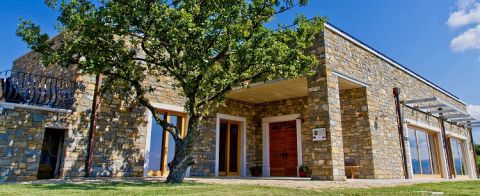
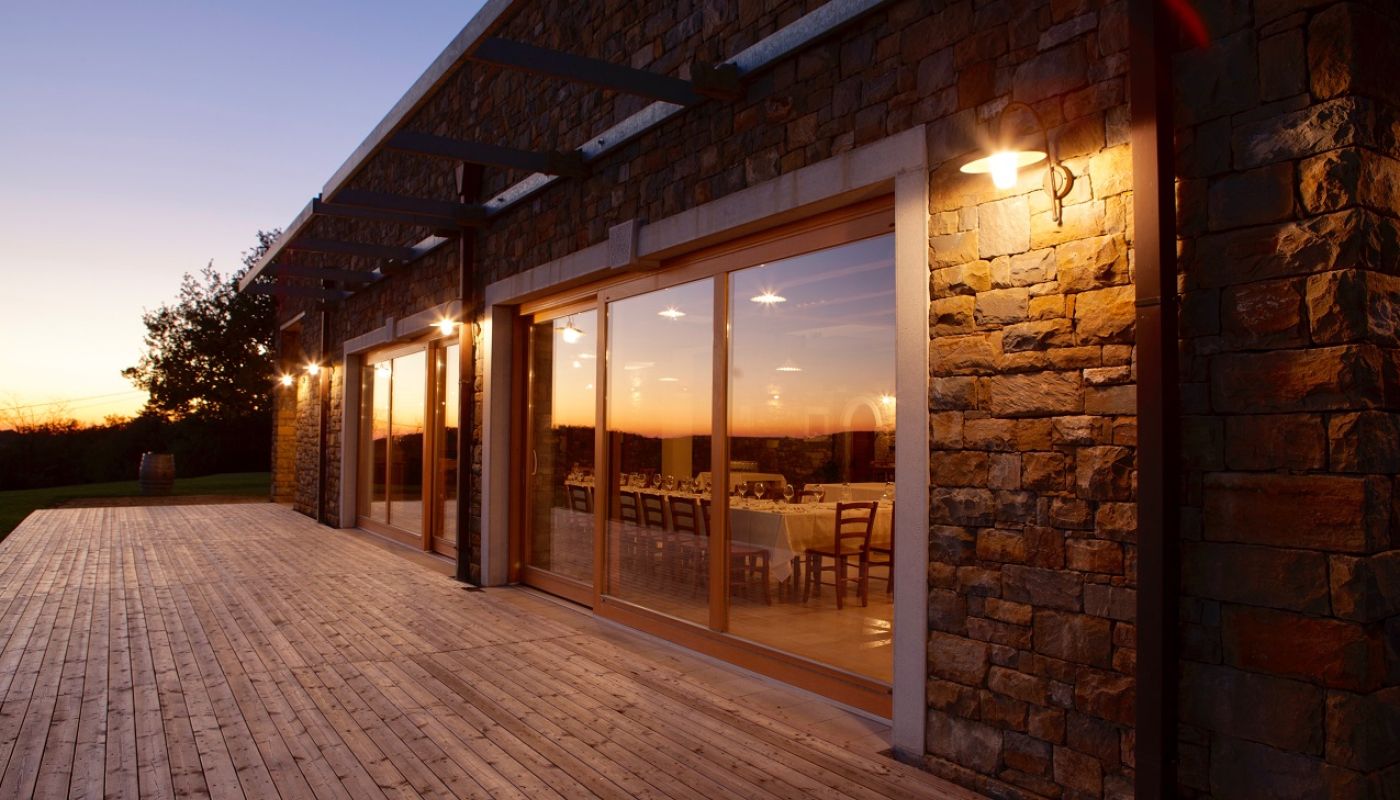
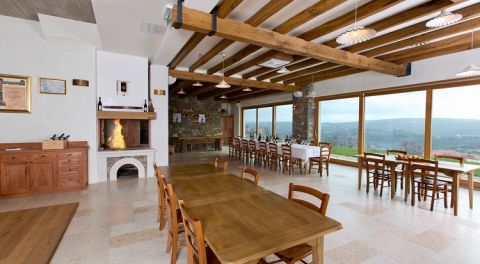
By 2012, the family’s production outgrew the original ‘wine cellar’ and they set about building a new, sustainable space 50 m up the hill that took full advantage of the Istrian surroundings. They repurposed materials directly from the vineyards, mostly peščenjak (sandstone), which makes up one of the three layers of eocene flysch surrounding the vines (Istrian lapor [marl] and brown earth are the other two). The sandstone structure was complemented with Slovenian oak and glass, which was used inside the tasting room to create floor-to-ceiling windows so visitors could enjoy the picturesque views of the Istrian peninsula, the hills, Dragonja Valley and the vineyards. It was also important that the new building met the family’s needs regarding logistics, temperature efficiency and waste water control for improved workflow in the cellar, all the while aiming to produce even better wine.
The new facilities were completed in 2013, a year after the winery was officially allowed to add their organic certification to their wine bottles. Rodica applied for this credential from the Slovenian Ministry of Agriculture in 2006. After three years of periodic testing they received their certificate in 2009. During this time the vines and soil were analysed regularly to check that no industrial chemical sprays or mineral fertilizing agents were used. This status could only be showcased externally (indicated by the official EU organic logo) in August 2012 when organic wine became fully integrated into EU legislation. In the past, wines could only be labelled as being 'made from organic grapes'. The new legislative framework, established by regulation (EC) no 834/2007, has been complemented by regulation (EU) no 203/2012. This lays down detailed rules on organic winemaking and thus opened the door for organic wine in Europe[1].
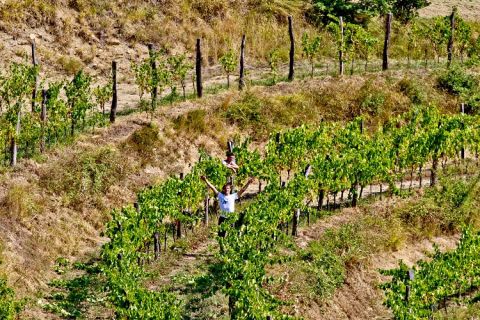
For Aleš and his family, organic farming and production was a natural and obvious choice from the outset given the prime position of their vineyards, which are set at an altitude of 250–350 meters above sea level on south facing slopes. The grapes bask in plentiful sunshine during the day and waltz in a regular breeze from the Gulf of Koper and the River Dragonja. The salty air circulates through the vines removing moisture, keeping the earth dry and helps lower the risk of disease. ‘We had all the predisposition to be organic, it didn’t make sense for my father to spray [with herbicides, pesticides and fungicides] systematically … and he felt that it’s not just about the word "organic", but that certification has a meaning. Somebody controls you and holds you accountable,’ says Aleš.
The family has also adopted some biodynamic principles in their winemaking by following the lunar cycle, as the moon guided his grandparents on their farm. Aleš recounts, ‘I remember when I was young, watching my grandmother go outside in the garden and she would say ‘today is a good day to dig the earth and tomorrow is good for planting’ but I never understood why. Later I realised that it was to do with the moon’.
Aleš explains, ‘In the vineyard when you cut the plants, you cut it on the right moon, so they don’t get infected. When you wire, you wire when the juice is going up the plant, so when you bend the plant, it doesn’t crack … In the wine cellar, the bottling and racking from one barrel to another also follows the moon. If we want the sediment to be removed, we wait for it to fall down as the moon falls, and if we want the sediments to go into the next barrel, we do the racking when the sediments are floating up and the moon is rising … When we talk amongst the family, we all agree the world of biodynamic farming has some great knowledge, which we can continue to use and experiment with in our cellar.’
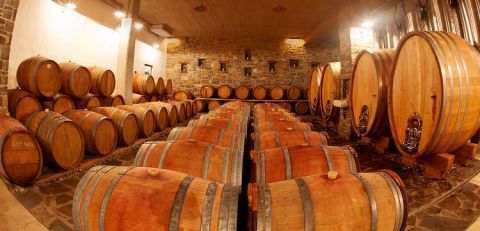
When I ask Aleš how he perceives the growing trend (or rather return) to organic and biodynamic agriculture, he says, ‘We label our wines as organic and often we are perceived as different, as the exception, not normal. But in my opinion, "organic" and similar approaches should be perceived as normal, a standard. Wine regulation states that a label must contain "it contains sulphur" but other oenological ingredients don’t need to be listed. In my opinion, this is not normal for the food and beverage industry. If this information were readily available on the label to consumers then organic, biodynamic, natural, conventional or other classifications and the debates surrounding these terms won’t be necessary. I think in the future everything is moving in the organic and biodynamic direction, with a greater emphasis on overall sustainability and I like it.’
Aleš is very active in the Slovenian winemaking community, where there are many young winemakers that informally meet on a frequent basis to exchange know-how and to organise local wine events. This year he was also selected to be part of the EU Bond Project and Youth Forum for the Future, which brings together 34 farmers, under the age of 34, from 34 different European countries to discuss and generate new ideas for sustainable agriculture. The aim of the project is that these youthful insights will translate into policy recommendations and solutions for policymakers in Europe.[2] Aleš’ enthusiasm and passion for Trapa and organic winemaking, and his knowledge of the Istrian landscape will undoubtedly help generate progressive ideas for collective action in sustainable agriculture.
I look at the Trapa bottles on the table and re-examine the labels, running my hand over the embossed ‘Rodica Spirits’ logo. The united sun and moon embody energy, harmony and cycles – the symbolism is fitting. I reach for the ‘Trapa Classic 2014’ and to Miha’s surprise pour myself another glass. Na zdravje!
Photos: all photos are from the Rodica archive.
Footnotes
















