Sedale McCall writes Sedale McCall is a writer and content creator focused on finding stories of wines, winemakers, and others that are not told enough in the industry. Sedale has been writing for three years and has published several articles highlighting diverse voices in wine. Currently, Sedale is a freelance writer, editor for Uncorked & Cultured and can be found in podcasts on occasion. He is also the voice behind the profile Untold Wine Stories on Instagram, where he works to expand the industry, through storytelling. A Virginia native, Sedale enjoys finding the places and spaces that are lesser-known and exploring what makes them interesting and often underrated. Sedale holds his WSET Level 2 certification, along with the Certified Specialist of Wine and American Wine Expert.
A Rose in the Concrete
How Ntsiki Biyela Inspires my Journey to Tell Untold Wine Stories
A rose growing out of the concrete is an interesting sight because it’s so unexpected. How did the seed get there? How does the rose get enough sun, enough water, and enough nutrients to grow? Given some thought, the answer is obvious. There is a whole, nutrient-rich world below the concrete where this rose, and others like it, thrive.
These are the stories I like to tell as a writer. Uncovering the wines, winemakers and communities who aren’t in the sunlight the way they should be. Winemakers like Ntsiki Biyela, my favorite winemaker and founder of Aslina Wines. I got to sit down with her recently and learned so many things. When I logged on, she said “it’s you!” recognizing me from the first time we met and that made my whole day better. Like the rose, I think Ntsiki’s story is less obvious than others may think.
Ntsiki Biyela was born in the Mahlabathini villages of KwaZulu-Natal in South Africa. She was primarily raised by her grandmother, while her mother worked as a maid. Even at a young age, she knew there was more to her life and she had a goal of using her studies to put her in new places.
“My upbringing was what made me realize that there was more to life than being in the village, and that’s what made me say ‘I want to study a four-year degree’” she said. “I knew that I needed to get a scholarship because I knew we couldn’t afford it. It just so happened that the scholarship that came was winemaking. Even though I had no clue what it was I said ‘I’m taking it, I’m going to study.’”
Serendipity struck. After engineering scholarships didn’t come through, her first opportunity to study came by way of a winemaking scholarship to Stellenbosch University. It sounds incredible, especially when you know this story.
Even more astounding is all of the “concrete” around this rose. South Africa was in its Apartheid era until 1994, when Ntsiki turned 16 and just four years before she started at Stellenbosch. However, her upbringing in the villages provided the nutrient-rich home environment that kept her from even realizing the oppressive forces around her.
I asked her what it was like spending her formative years during Apartheid. Like many people, I had intended to discuss how she grew up in this oppressive era for black South Africans and overcame it to become the first black woman winemaker in the country. But her response changed that.
“I grew up in the villages, we didn't experience it as much. It was happening around us. But, there were barely white people. Everyone in the villages were black.”
Biyela didn’t really have much of an idea of what was happening beyond where she was living. She learned more through the stories from her grandmother, Aslina. Stories like when Aslina was arrested visiting her husband in Durban. These stories impacted Biyela more than living through this era.
Cracks in the Concrete
Though Apartheid was more of a tragic story in another place for Ntsiki, it’s hard to ignore the impact on her home country, which would later impact how she lived in a future democratic nation.
Apartheid was a 50-year period from 1948 to the early 1990s that called for separation of different racial groups in South Africa. Literally meaning “apartness” in Afrikaans, the National Party government strictly enforced rules that kept these groups separate. The laws also created inequality between the groups, oppressing those considered “non-white.”
It was very similar to the Jim Crow era in the United States, where black and white Americans were segregated in transportation, restaurants, housing, education and even marriage. Spanning the 1870s through the 1960s, Jim Crow forcibly separated black and white people. It also separated the groups unequally, at the expense of African Americans during that time.
Like Biyela, my grandmother is the source of my understanding of those times. My grandmother grew up in Sumter, South Carolina in the 1930s and 1940s, on a farm owned by white people (her parents were sharecroppers). She told me that as a child, she wasn’t allowed to take a bus to school, and would watch the bus pass her home to pick up white children and pass her again toward the school, while she walked.
Struggle is an interesting bridge for diverse communities. Each has their own story and history, but relate to one another through those stories. Studies show us that this shared struggle is linked with the release of oxytocin, the chemical that creates social connection and stronger relationships. Our similar struggles bring us together.
Equally unifying is how these communities find their way through these circumstances. Ntsiki is a wonderful example of that, as well as my grandmother, along with so many Black winemakers, producers, artists and more.
The Rose Blooms
One similarity between Ntsiki and so many black and brown people is her ability to tune out the noise and focus on her goals. From taking a wine scholarship as her way out of the village, to working and becoming South Africa’s Woman Winemaker of the Year (all before starting Aslina Wines), she makes sure that whatever she’s going to do, it will be great.
“I fell into winemaking, but also, I’m the kind of person that says ‘whatever I’m in I must do it to the best of my abilities’” says Biyela. “So, when I got into winemaking, I thought ‘I must do this and I must be good at it.’ Even after realizing that most of the industry was white, I knew this was a tool [for me] and I had to make this work.”
Ntsiki truly made the best of her situation and turned it into a historic career.
After graduating from school in 2003, Ntsiki was hired as a junior winemaker at Stellekaya, a small, family-owned winery in Stellenbosch. Within a couple of years, she worked her way to being the head winemaker. During her time there, Stellekaya won several prestigious awards, including Ntsiki becoming the Woman Winemaker of the Year in 2009. A few years later, Ntsiki was ready to branch out on her own and start Aslina Wines, named after her grandmother.
In 2014, Ntsiki was producing around 4,500 bottles, primarily Cabernet Sauvignon. Now, she makes more than 100,000 bottles a year and includes Sauvignon Blanc, Chardonnay, Chenin Blanc, Cabernet Sauvignon, and a Bordeaux blend called “Umsasane” which is her grandmother’s nickname. My personal favorites are the Chardonnay and Umsasane. To be honest, I think the Cabernet Sauvignon is more approachable than Umsasane, but when I got to meet Ntsiki and hear the story of Umsasane, I felt it in the glass.
Umsasane is a Zulu word for the “umbrella”, or acacia tree, famously seen in many African movies. For Ntsiki and her grandmother, it’s a symbol of shelter and comfort, which Aslina provides. The wine itself is strong, structured, deep, and comforting. The complexity makes you slow down and revisit it over and over. Just like Ntsiki and her grandmother, it invites you back to listen and learn.
I’m inspired by Ntsiki’s story because it reminds me of my own family. It’s a story of using the resources around you to not only make your life better, but the lives of those around you. I have immense gratitude for how my grandparents lived, because of how it impacts my life now. In fact, I live within 20 miles of my grandmother today. I hope that I can live beyond the dreams she had for our family. But also, I hope to inspire others to find their own Umsasane and draw strength from it to pursue whatever they want to do in life. Just like Ntsiki.
Planting the Next Seed
Since starting Aslina Wines, Ntsiki has made a name for herself in the US and South Africa and now, she is starting to use her platform to help others.
“Aslina Wines has given me the platform to do certain things that bring positivity. I’m involved with Pinotage Development Academy. We’re training people through the wine industry for job placement, I do mentoring on that,” says Biyela. “Aslina Wines has helped me spread the word to the globe and South Africa to say ‘there is a career you can do, but be cautious’. Many people think there is money in the industry. Don’t think about money, think about how I can make a difference in this and make sure we all grow.”
I think there is a lot that the US can learn from black winemakers in South Africa. Changing the industry is not easy. Many of the challenges in both of our histories created the challenges we have today, and the perceptions people have of black, hispanic or other underrepresented groups.
However, what Ntsiki’s career tells us is that to a large extent, the product is still the most important aspect of the business. She was committed to doing her very best in everything she does and that includes making a great product. She still faced many challenges being a black woman in wine, but part of her ability to overcome, I think, is that you had to respect her results.
No matter where the rose blooms, its beauty makes people stop and appreciate it. Ntsiki used the fertile ground provided by her family, her village, and her own mindset to grow through the concrete and blossom. Like the rose, she had no choice in where she was planted, nor the concrete trying to keep her there. But she could decide to bloom anyway, and she did that.
I greatly appreciate Ntsiki continuing to support the dreams of those behind her, including me. I will not forget her taking a few moments to provide perspective to me on multiple occasions, and I only hope this encourages others to bloom wherever you are planted.
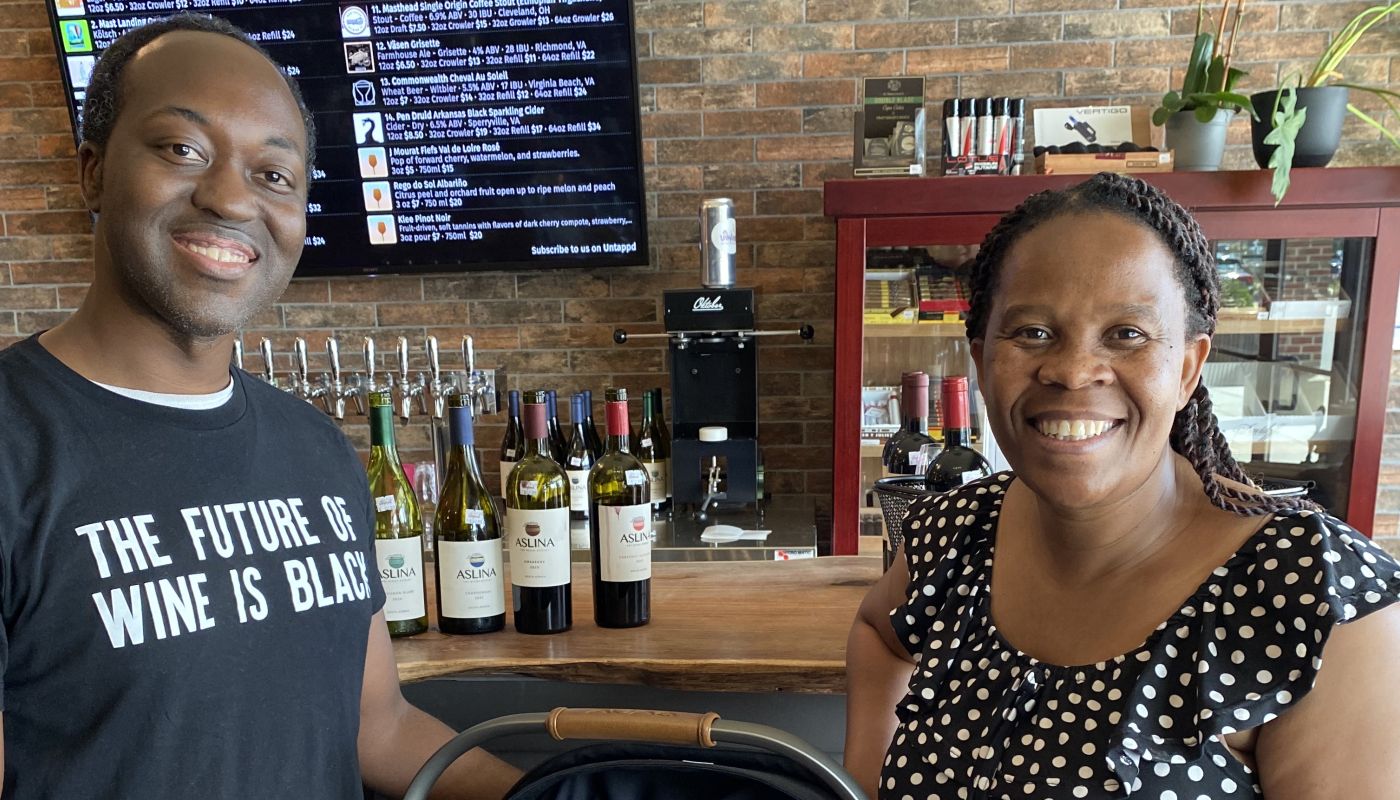
The photograph, featuring Sedale and Ntsiki, is the author's own.
















