Joanne Gibson writes South African wine writer Joanne Gibson (nee Simon) has taken a break from mainstream wine coverage in recent years to focus on researching early Cape wine history. She has recently co-authored a book about Klein Constantia and her new book about Vergenoegd Löw will launch shortly. She was formerly the Sunday Times (SA) wine columnist, a taster and writer for Platter’s South African Wine Guide, the deputy editor of Wine magazine (Winemag.co.za) and a contributor to many international publications including The World of Fine Wine and Decanter. Her wine-writing career took off in the early 2000s in London, where she acquired her WSET Level 4 Diploma while working for Harpers Wine & Spirit magazine. Named South African Wine Writer of the Year on numerous occasions, she was also a four-time finalist in the Louis Roederer International Wine Writers Awards.
EIN PROSIT
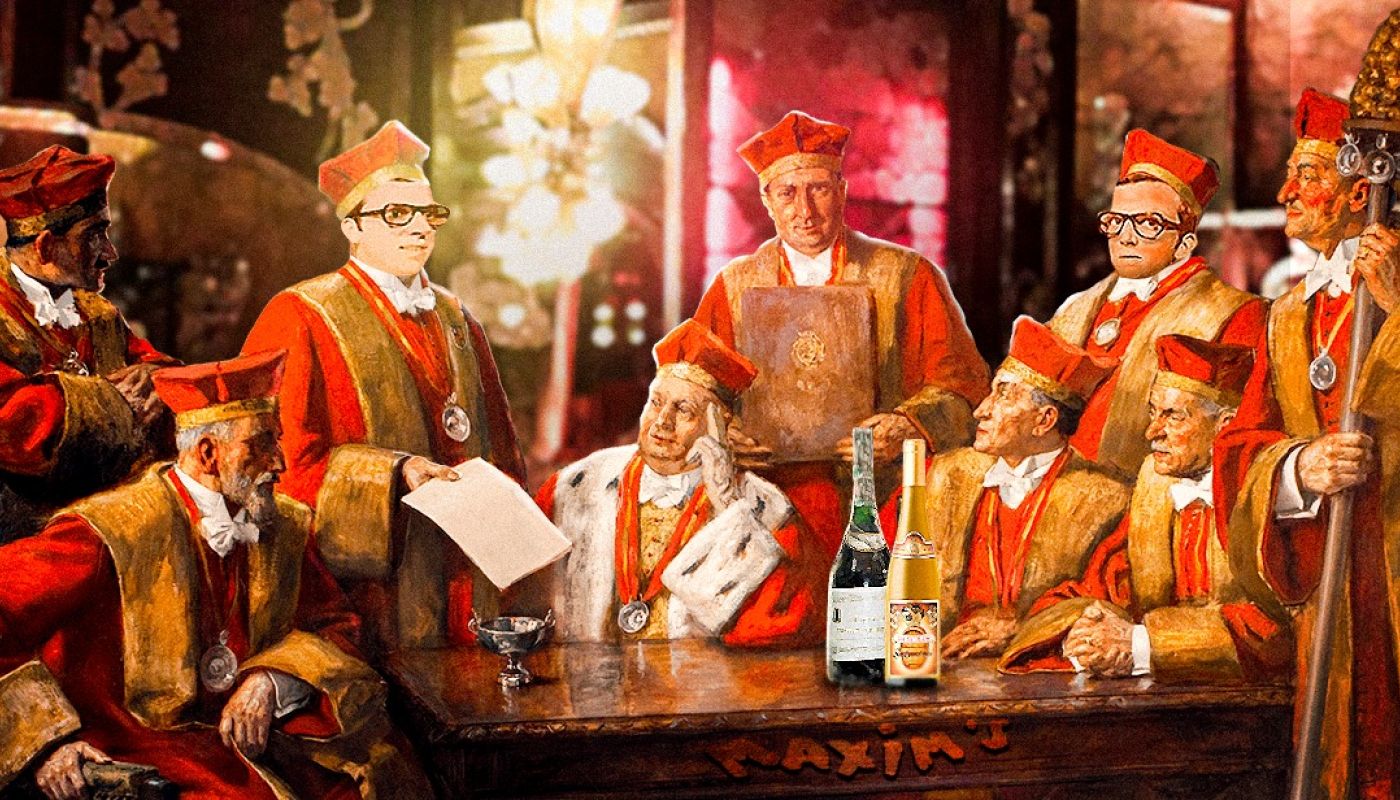
My German-South African godfather, Dieter*, used to love telling me about the time he impressed his fellow Chevaliers du Tastevin, that famous brotherhood of bacchanalia established in Burgundy in 1934, as they gathered one night in the Château du Clos de Vougeot, resplendent in their scholarly red and gold robes.
‘I told them if they wanted to drink authentic French wine, if they wanted to experience what French wine truly tasted like before phylloxera destroyed the vineyards, then they must visit South Africa and drink the wines of the Cape!’
Uttered with such conviction, and with such love for his adopted country, which he was then representing in some diplomatic capacity in Paris, Dieter’s (erroneous) claim that French grape varieties growing at the Cape had never needed to be grafted onto American rootstock and were therefore more intrinsically French was met with ‘amazement’ – or so he told us with increasing frequency over the years, especially after Alzheimer’s took hold.
I can’t imagine how those Burgundy devotees actually reacted to Dieter’s theory back then; presumably it was with the bonhomie for which they are still renowned. What I do recall with painful clarity is the blanching of Dieter’s face across the table when I finally piped up and pointed out that South Africa’s vines had not escaped phylloxera and were grafted just the same as anywhere else.
Someone quickly changed the subject, another bottle was opened, but Dieter was uncharacteristically subdued all evening. He was not himself, at a time when he was already no longer quite himself. Suffice it to say that I was indescribably relieved a year or so later when he once again gleefully recounted the time he so impressed La Confrérie des Chevaliers du Tastevin…
Born into the living hell of firebombed Hamburg, Dieter arrived in Johannesburg in the late 1960s. Despite mounting international criticism of apartheid, foreign investment in South Africa more than doubled between 1963 and 1972, and the ‘white’ population increased by almost 50% thanks to the immigration of young Europeans like Dieter, looking for a fresh start, perhaps trying to reinvent themselves (as he most certainly did, more than once). He met my parents through mutual friends and soon formed an almost brotherly bond with my dad, whose family had escaped from Berlin in 1936. My dad was Dieter’s best man when he married Joy, who in turn became (and remains) one of my mother’s closest friends. Photographs provide ample evidence of the fun they had during those carefree early years.
In due course I came along, the first of four children born to those two couples, and the only girl. As Dieter cradled me in his arms for the first time, he made a crazy promise: to take me to Maxim’s (the original one in Paris, then still at the height of its fame) when I was 18.
He kept that promise.
(It helped that he was once again living in Paris that year, the year of Nelson Mandela’s release from prison, a year I was spending in Germany as an exchange student.)
I think Dieter got a real kick out of playing my papa-gâteau that evening. And Joy, for the record, played along with equal enthusiasm, helping me find a suitable outfit (how I loved that little black dress). Three decades later, I remember more about what Dieter and I ate (including fois gras and escargots) than what we drank, seated side by side on a velvet banquette for people-watching purposes. I’m certain it was red Burgundy, though.
Did Dieter ‘teach’ me about wine? No. With the benefit of hindsight and my WSET Diploma, I don’t think he even knew all that much about it. But he certainly helped me to appreciate, even as a child, that wine was more than a drink. It was adventure and romance, stories and memories, banter and bonhomie or – in Dieter’s native German – Gemütlichkeit.
Living in Johannesburg in the 1980s, in between Dieter’s Paris stints, our families would braai together on an almost weekly basis. Those were relaxed and happy Sundays, always gemütlich, not especially memorable. But occasionally our respective family holidays to Cape Town would coincide, and then there would be Lunch on a Wine Farm.
At rustic Muratie in Stellenbosch, I remember admiring the impressive cobwebs while the grown-ups tasted the estate’s pioneering Pinot Noir with Ben Prins, the barefoot winemaker. Then we made our way next door to Delheim, where Dieter greeted German owner Michael ‘Spatz’ Sperling like an old friend (he wasn’t) and had us kids snorting over our cheese platters about the Late Harvest named Spatzendreck (literally ‘sparrow shit’), its label even depicting – to our delight – a cheeky little bird pooping into the bunghole of a barrel.
Who knew wine could be such fun? Dieter did. He also insisted that we should have a taste of that amusing nectar, then made entirely from Chenin Blanc, its honey-drizzled pear flavours a revelation (for tween me) that not all wine was dry and sour.
I have another distinct memory of visiting Twee Jonge Gezellen in Tulbagh, probably around the time Nicky Krone was building South Africa’s first underground cellar dedicated to the production of traditional-method sparkling wine (sulphite-free, no less). But who – asked Dieter – were those ‘two young bachelors’ after whom this far-flung farm was named, way back in the early 1700s? ‘Just imagine what those naughty youngsters were getting up to!’
For the record, I’m now pretty certain that they were the future bothers-in-law Barend Burger and Jan Olivier. But could that snippet of lively lunchtime conversation have sparked my passion for uncovering early South African wine stories? Quite possibly.
Dieter’s own stories got less believable over the years, and my dad found him increasingly tiresome: all show and no substance. By his own admission, Dieter was ‘no good in these situations’ when my dad was dying of cancer in 2009. In marked contrast, Joy was my mother’s ‘rock’ throughout – and her husband’s, too, without question, for better and for worse (very much worse following his Alzheimer’s diagnosis).
In June 2020, Dieter snuck out of his Johannesburg home to buy cigarettes (which he’d given up decades previously) and a bottle of wine (probably Robertson Winery’s Chapel Red, his everyday favourite because it only set him back a few rand even as his collection of old Burgundy lay gathering dust). Because tobacco and alcohol sales were banned under South Africa’s nonsensical COVID-19 restrictions at the time, he didn’t succeed in what was – at least for Joy – a seriously alarming mission. His bank statement recorded payment for a disposable mask, an entry requirement for the shops that must have puzzled him immensely but ultimately didn’t save him from contracting the virus that hastened his inevitable end.
And that was that.
So how grateful I am that the topic of this competition – my favourite wine person – has brought back memories of Dieter that are sun-dappled and rosy, redolent with braai smoke and Pinot Noir, and filled with lively conversation, laughter and the clink of glasses.
Prost!
* I’ve decided not to use his real name because his story is bittersweet (arguably more bitter than sweet).
The image, about which the Gibson wrote 'The image is a mashup of various elements from my favourite person’s wine stories. (His face as a very young man is there, too, give or take some distortion…)', was created by the author based on an original painting reproduced on the website of the Confrérie des Chevaliers du Tastevin.
















