It was the unannounced management meeting on Monday morning, and the hushed conversation that I witnessed this morning between our senior management staff and a worried-looking European harvest intern, that got me properly scared. Scared for my colleagues’ health; for the prospects of harvest and for the new wines we’re making; scared about the future of our jobs, the winery, our vineyard growers; and, of course, scared for my own family’s health, too.
The morning had been a blur between managing our harvest fruit intake with trucks rolling in, the harvest compliance documentation (never-ending) and plenty of winemaking client communication, all while walking around the winery to figure out which tanks we should fill for the fruit intake we had scheduled. So far, so normal for a mid-harvest day, except that since our morning 7 am meeting onwards, it had seemed that we were all expecting the coronavirus issue to get worse.
For New Zealand, we were at Alert Level 2, which meant – in real terms – carry on as normal but with some isolating practices in place. At a large contract winery, in the middle of harvest, with a large winemaking, laboratory, cellar and management team, and the myriad shared surfaces that we all use – fittings, hoses, equipment, pump, press and forklift controls, multiple door handles in a winery occupying a couple of square kilometres – trying to put isolation practices in place had already been difficult. Even so, there was just a creeping sense that everything was going to deteriorate.
Then an emergency health and safety meeting was called mid morning. The decision was made that we had to prepare for an emergency shut down – the New Zealand wine industry was not classed as an essential business. We made a list of what we thought we could achieve if we had to shut down, and then carried on. And then...
My winemaker colleague who shares an office with me and the winery engineer (a decidedly non-social distancing workspace affectionately known as The Goldfish Bowl) flicked onto the Stuff homepage (New Zealand’s news website). The country was now at Alert Level 3 and moving to Alert Level 4 in 48 hours – meaning that the winery, as a non-essential business, would have to close at midnight on Thursday. The plan we had discussed to shut down swung into action.

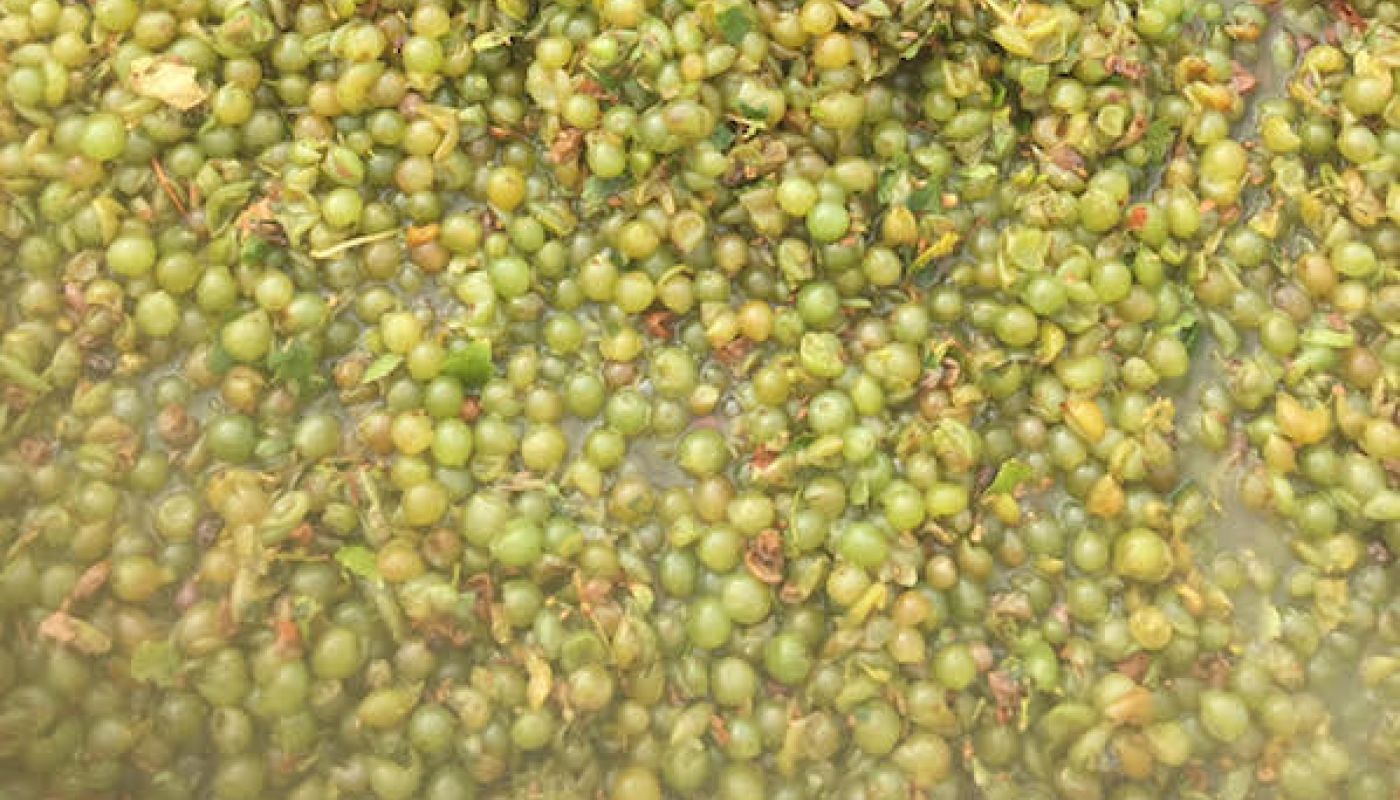
That sounds calm. It was – kind of. Trying to operate a winery of this size mid harvest is a challenge for any winemaking and cellar team. We’re a very experienced crew here – I’m the least experienced of the winemaking team – but as a team we can probably count more than a double-century of harvests between us. All that said, how can we walk away from fermentations in tanks where from ground level you can barely see their tops? How can we make sure all our staff are safe – and what happens to their employment? How do we control barrel ferments that are spitting out bungs in absentia? How do the staff of the laboratory – one of New Zealand’s busiest wine labs – walk away from monitoring 400-odd batches of fermenting juice and wine? And what exactly are we going to do with the fruit that keeps rolling in on trucks? What about the CO2 risk if we walk away from the buildings? We can hardly start a ferment if no one can look after it. Yet we can’t ignore winemaking clients’ precious cargoes of fruit either. (Sauvignon Blanc from the Tuki Tuki Valley subregion is shown at the top of this article.)
We had a list of which reds and skin-contact whites could be pressed off immediately and got to it. Plans were made for sulphuring down barrels and wines that had reached a stage where we could stabilise them. Lists of barrels that needed topping before shutdown were started on. Checks on lids, gas blanketing, tank seals were scheduled ... and the calls for harvest work kept coming.
Corny as it sounds to talk about a grapevine, everyone in the country had heard the news so, right on cue, the phone reception got worse (all of New Zealand was on the phone) as clients called for immediate requests to complete work on their wines, or immediate requests to bring in fruit before we closed down. I was caught in the middle of this, as I schedule the harvest for the winery.
On the one hand, making wine for clients is how we make money as a winemaking business; on the other hand, we can’t process fruit if we don’t have an operational winery. Most of us were of the opinion that we should concentrate on the wines and juice already here – don’t add to the problem. Others were of the opinion that we need a full winery when we inevitably re-open to help generate revenue – we charge our winemaking costs by the litre, so we need to have litres of wine in the winery. There’s no right or wrong answer, but what we needed was certainty – were we going to shut down or not?
The problem was taken out of our hands by an announcement by New Zealand Wine Growers, who were lobbying the New Zealand Ministry of Primary Industries (MPI) to reclassify the wine production industry as an essential business. They were meeting with MPI at 5.30 pm. And so we went into limbo. Should we carry on with shutdown work? Should we carry on with receiving more fruit? Who knew? We needed to know the answer from MPI.
Of course, the afternoon saw some of our most unexpected extra tonnes of fruit arrive too: one hectare of Merlot, estimated at 14 tonnes/hectare, somehow produced 25.08 tonnes. We’ve known it’s been a heavy Merlot crop in Hawke’s Bay this year, but that’s a Godzilla-size yield: 190.99 hl/ha for the European MW students out there. This fruit is going to make rosé; even with that ginormous yield it produced perfect numbers for making rosé. The sadness of the coronavirus situation is that it may negatively impact what has been looking like a very exciting harvest for Hawke’s Bay.
Needless to say we were all checking phones and websites as it moved past 5.30 pm. My wife beat us all to it and texted through a message she’d received from a winemaking friend in Marlborough who was also hanging on his phone – MPI had classified the wine industry as a primary industry. We collectively breathed a sigh of relief, tinged with trepidation at what comes next. We know that as an essential business we can stay open, but we’re waiting to hear about the regulations from MPI that we really need to adhere to in order to remain open.
All of this may sound pretty similar to the challenges that other businesses around the world are facing, and we certainly know how truly fortunate we still are to have daily jobs to go to. This added pressure during harvest, however, has lent a unique flavour to this year’s fun and games.
A demanding routine
Let me describe what a normal harvest here is like for me personally. I start at about 6.45 am in the morning. I may finish by ... who knows? This year, I beat my personal record by starting at 6.30 am and finishing at 1.30 am the following morning. I may get four hours of sleep a night; we all eat whatever we can; we all run out of laundry or wear yesterday’s clothes again; I survive off cups of tea, when or if I can make them; I can walk, climb, or run well over ten miles a day during harvest; we lift enormously heavy equipment; or carry enormous quantities of equipment; our boots are wet; our hands get cut up by stainless steel; when or if we get time off, the sleep deprivation makes you feel as if you have the severest jetlag; and it just keeps coming.
As a contract winery, we work to the behest of our clients. In reality, we have little control over the amount or quality or timing of fruit they decide to harvest. It’s our job to make the best wine we can from whatever we receive at whichever time of day or night (of course we work 24 hours a day during harvest) and there is no forgiveness if we make mistakes. That’s understandable, as clients are trusting us to provide a service, but that lends an added pressure to winemaking here. I’ve often heard contract wineries or custom-crush wineries being dismissed on quality standards by other wine industry contacts. That notion is so wrong, it’s laughable. Contract wineries are the sharp end of winemaking, plain and simple.
So, imagine that background within the new landscape of coronavirus – pressure, added on pressure, added on pressure. We are simply fearful of what the future holds, yet unable to look beyond the everyday harvest operations here. Harvest has a life of its own and it stops for nothing, not even a deadly virus. On the face of it, aside from the isolating and sterilisation regimes we have in place, we’re all carrying as normal. Forklifts are buzzing around, more trucks of fruit are rolling through the gates, presses are being filled with fruit, juice is being floated and lees are being filtered. We’re laughing and smiling and working as a team as we always do.

We desperately want the harvest this year to succeed. We’ve had a really challenging drought this year, leading to some vineyards having some pretty stressed vines and fruit, with low sugars and plummeting acids. Above is a Pinot Noir vineyard in the Maraekakaho subregion. We had hail in October that wiped out some of the early-budding varieties in the Bridge Pa subregion particularly. Yields haven’t been uniformly high across Hawke’s Bay because of the patchwork of soil types and water availability here. And we’re all doing our usual thing of checking several weather forecasts per day to see what the weather gods have stored up for us – there’s no such thing as a truly dry harvest in New Zealand, but none of us want to cope with compromised fruit riddled with rain-induced botrytis.
Luckily, we seem to be on track for a settled harvest so far, with gremlins having been confined to some spotty yields, some drought-affected fruit, and the EU pitching in with some challenging last-minute changes to permitted winemaking practices. We’re just starting to get to the red fruit arriving for serious red wines and we could be on course for having a cracker of a season. If we’re allowed to finish it.
So, we carry on. Every day has its moments now. After the rollercoaster of yesterday and not knowing if we were shutting or closing, it seems like a normal day on the surface – except that our lab is closed to visitors and one of our cellar hands has brought in many different tubs of gelato from the gelato shop that his wife runs on the Napier seafront (very sadly, they have had to shut as a non-essential business, but the gelato was already made). We’re all eating gelato for breakfast and waiting for some more trucks of Sauvignon Blanc to arrive – the new normal. For the time being.