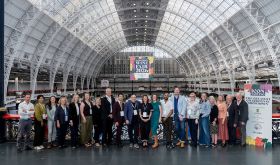
14 March 2011 Apparently Nicolas Joly, Monty Waldin and Alice Feiring are all lined up as speakers at the forthcoming Natural Wine Fair in London. But surely Monsieur Wregg would have even more to say?!
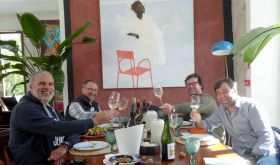
Doug Wregg of Caves de Pyrène's presentation of a selection of 16 natural wines to a group of top UK sommeliers at Vagabond Wines, shown in this short film, was a particularly interesting event since for many of these wine professionals, it was their first concentrated exposure to a wide range of these increasingly fashionable wines and the thinking behind them.
Wregg could not be more enthusiastic about the movement I described last year in Naked as nature intended? and, perhaps in an effort to make his point, did rather exaggerate the iniquity of more mainstream wine production. We were left with the impression that it just wasn't worth ever opening a bottle of bordeaux ever again. He is also a natural writer and, after the tasting, circulated both his own account of the natural wine movement and the 16 wines shown, which you can download as a PDF, and his Second Natural Wine Manifesto that I have published below my brief tasting notes.
Perhaps incorrectly, I sensed a certain scepticism among the gathered sommeliers, although they were all very polite, and keen to learn about the next big thing, although some of them expressed concern about the need to keep these low-sulphur wines at relatively low temperatures.
I took copious notes at the time but, infuriatingly, my little Samsung notebook was no big fan of natural wines and has naughtily hidden or swallowed my detailed tasting notes and my record of all the questions and observations. Instead, I'm afraid you will have to make do with the following brief notes made from memory the day after the tasting from me – but Doug's thousands of words arguably more than make up for my terse comments.
I have left the names of the wines in the format supplied because I am not going to add these notes to our tasting notes database, alas. There is also the fact that so many natural wines are made on the fringes of officialdom that relatively few of them carry conventional appellations.
WHITES
2008 Chardonnay Chalasses Marnes Vieilles Vignes, Domaine J-F Ganevat
Pretty good, if very tight. Shows just how fine Jura Chardonnay can be – really gives white burgundy a run for its money. Great value in fact.
£21.90 Les Caves de Pyrène
2009 Irouléguy Blanc Hegoxuri, Domaine Arretxea
Lovely spring flowers on the nose – real freshness, one of natural wine's great attributes shown to advantage in this wine from the French western Pyrenees.
£20.50 Les Caves de Pyrène
2007 Fiano, Don Chisciotte, Il Tufiello
'Interesting'. Not nearly as fat as most Fianos I have come across but certainly not short of personality, hem, hem. Named after Don Quixote.
£19.45 Les Caves de Pyrène
2008 Vin de Table, Gilbourg, Benoit Courault
This was a bone dry Chenin Blanc chock full of the variety's characteristic apples and honey. It had been grown in a Coteaux du Layon vineyard south of Angers in the Loire.
£18.85 Les Caves de Pyrène
2008 Matassa Cuvée Alexandria, Vin de Pays des Côtes Catalanes
From the Agly Valley outfit in which Sam Harrop MW was originally involved and which is now run by South African Tom Lubbe of The Observatory. I had tasted and been impressed by their other cuvées but had never tasted their version of the Muscat of Alexandria grape that is so widely grown for vins doux naturels in Roussillon. This was impressive and certainly the best dry Muscat of Alexandria I have ever tasted. Real vitality and a great ambassador for natural wine.
£17.10 Les Caves de Pyrène
2009 Sancerre Skeveldra, Sébastien Riffault
Wild and wacky! Smelt of an old oak chest, very intriguing and seems set to last for a very long time.
£22.25 Les Caves de Pyrène
REDS
2009 Gamay d'Auvergne, Pierres Noires, Domaine Maupertuis
Too odd and marked by unconventional winemaking for me.
£10.75 Les Caves de Pyrène
2009 Vin de Pays de la Côte Vermeille, La Luna, Bruno Duchene
Very heavy and sweet. From Collioure/Bandol country.
£15.55 Les Caves de Pyrène
2009 Brouilly, Croix des Rameaux, Jean-Claude Lapalu
This was a bit tough. I have had better 2009 beaujolais, even though in theory I'm a big fan of Lapalu. Perhaps it just needs time (and cool storage)?
£18.55 Les Caves de Pyrène
2009 Pinot Noir, Cuvée Julien Ganevat, Domaine J-F Ganevat
Really lovely and pure – another Jura wine that throws down the gauntlet at the Côte d'Or. A good buy.
£22.25 Les Caves de Pyrène
2008 Vigne Vecchie, A A Panevino
Very big, sweet blend of local Sardinian varieties, especially Cannonau (Grenache). One wonders how the natural wine gospel spread to Sardinia.
£22.20 Les Caves de Pyrène
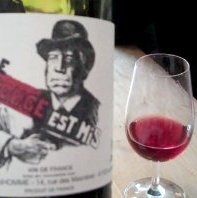
2009 Vin de Table, Le Rouge est Mis, Thierry Puzelat
Very fruity Pinot Meunier - vindication of the approach from the charismatic Loire winemaker I visited while researching Naked as nature intended? Very charming but not for the long term. The punning label is shown above.
£17.15 Les Caves de Pyrène
2008 Minervois, La Nine, Jean-Baptiste Sénat
Big and bold from the Languedoc. One of the less distinctive wines in this collection, but it doesn't seem to have much of a price premium over other, more conventional, wines made nearby.
£11.95 Les Caves de Pyrène
2009 Bourgogne Rouge, Auguste, Clos des Vignes du Maynes
This may come from a 1,000-year-old vineyard but I'm afraid its monastic austerity is a bit too much for me.
£26.55 Les Caves de Pyrène
2009 St-Joseph Rouge, Domaine Dard et Ribo
Fine, though sweeter than I would have expected.
£23.95 Les Caves de Pyrène
DOUGLAS WREGG'S SECOND NATURAL WINE MANIFESTO
Wine writers and foodies bridle when they hear the term 'natural'. How dare we appropriate a word so loaded with 'natural' goodness? How dare we foist our funky natural yeasts on them? Smooth your quills, you fretful porpentines. We won't apologise for highlighting the vivid dichotomy in winemaking methods; there is an undeniably vast difference between a liquid which is mass processed in a factory and chemically corrected at every stage and one which undergoes virtually no interventions other than the conversion of grape juice into wine. The former is a product no different to coca cola, the latter is about wine.
1. Start from the following simple premise. To adapt Gertrude Stein: The wine is the wine is the wine and the grower is the grower and the vintage is the vintage etc. It is not about this is good and that's better. There is no uncritical freemasonry of natural wine aficionados and its devotees will happily 'dis' a wine that deserves it.
2. Who is the leader of the natural wine movement and articulates its philosophy? Probably, whoever chooses to – over a drink! We are all Spartacus in our cups. Think camaraderie and comity with these guys, not po-faced table-thumping, self-indulgent tract-scribbling and meaningless sloganeering.
3. But wouldn't it be a heck of a lot easier for consumers if there was a manifesto detailing what winemakers are supposed to do and not to do? What conceivable difference would that make? Take several hundred individuals and ask them if they agree on every single point of viticulture and vinification. See what I mean? Rules is for fools. There are enough guidelines for natural winemakers to be getting on with and as long as they work within the spirit of minimal intervention they may be said to be 'natural'.
4. But that's cheating! How can you claim the moral high ground for natural wines if you won't submit to scrutiny? We're not claiming any high ground; in fact we prefer rootling in the earth around the vines getting our snouts grubby; we're simply positing an alternative way of making wines that doesn't involve chucking in loads of additives or stripping out naturally-occurring flavours. Yes, this is self-policed – there are no certificates to apply for or bureaucratic accreditation bodies to satisfy. Praise be.
5. If natural wine is not sufficiently equipped/bothered to organise itself into a movement why should anyone take it seriously? To paraphrase Groucho Marx: A natural winegrower wouldn't want to belong any club that would accept him or her as a member. The world of wine is far too clubby and cosy. In the end it is about what's in the bottle of wine on the table.
6. But we do know who they are, these growers? Some are certainly well known, some fly under the radar. Yes, some of them are best mates; they drop in on each other, share equipment (including horses!), go to the same parties, wear quirky t-shirts, attend small salons and slightly larger tastings. And quite a few don't because they have so little wine to sell (such as Metras, Dard & Ribo...). By their craggy-faced and horny hands shall ye know them. But their activity is not blatantly commercialised; there is no single voice that speaks authoritatively for the whole natural wine movement – and therein lies its beauty, so many characters simply getting on with the job without hype or recourse to corporate flimflam.
7. A certain amount of silliness and cod-referentiality is required to appreciate natural wine. Especially those goofy labels [see image]. Plus a working knowledge of French argot. And probably an intimate acquaintance with the oeuvre of Jacques Brel.
8. People who love natural wine are not preachy nor are they competitive. We are thankful when we drink a bottle that hits all the right notes and que sera sera if it doesn't. Those who love natural wines don't mark them out of 100 because that scale is too limiting (darling, I love you, I award you 97 points); and rarely, if ever, are natural wines submitted to tasting competitions.
9. We believe that wine is a living product and will change from day from day just as we ourselves change. Natural wine will change from day to day and possibly even from bottle to bottle.
10. Oak is the servant of wine not its master. Natural winemakers understand this.
11. If it is a movement (and it's not) how big could it possibly be? We must threaten our growers with violence, we get on knees and wail piteously, we bribe and cajole for our pittance of an allocation. Take out those passionate Parisian cavistes and wine bar owners with their hot line to the growers, the Japanese who won't drink anything else and a healthy rump of Americans led by Joe Dressner et al and there's barely enough to whet your appetites and wet our whistles let alone begin to satisfy the market we're priming over here. Small is beautiful and marginal is desirable, but it makes a nonsense out of continuity. We gnash our teeth, but we love it, as the knowledge that the wine is such a finite commodity makes it all the more precious (my precious) and we become ever more determined that it goes to an appreciative home.
12. The heroes of the natural wine movement are the growers. There are teachers and pupils, there are acolytes and fans, but no top dog, no blessed hierarchy, no panjandrum of cool. Some growers are blessed with magical terroir, others fight the dirt and the climate, clawing that terroir magic from the bony vines. They are both artisans and artists. What impresses us about the growers is their humility and their congeniality, a far cry from the arrogance of those who are constantly being told their wines are wonderful a hundred times over and end up dwelling in a moated grange of self-approval.
13. One new world natural wine grower wrote to me that he felt he had more in common with vignerons several thousand miles away; he understood their language, loved drinking their wines – these people were his real family.
14. 99% of people who criticise natural wine have never made a bottle of wine in their lives. 110% of statistics like that are invented.
15. Natural wines – they all taste the same, don't they? D'oh! Of course they do, there isn't a scintilla of difference between these bacterially-infected wines which are all made to an identical formula of undrinkability; they are totally without nuance, subtlety, complexity, and those who drink, enjoy and appreciate natural wines evidently had their taste buds removed at a very young age with sandpaper. This canard is one dead duck.
16. Does the process of natural winemaking mask terroir? Terroir is in the mouth of the beholder, perhaps, but the clarity, freshness and linear quality of natural wines, supported by acidity, makes them excellent vehicles for terroir expression. The less you put into the wine the less you obscure the fruit and the way the terroir is translated through the fruit.
17. Natural wines are incapable of greatness. Let us put aside for a moment the notion that good taste is subjective and transport ourselves to our favourite desert island with our dog-eared copy of the Carnet de Vigne Omnivore, the natural wine mini-bible. To mix my metaphors because the natural wine church has many mansions you will discover a constellation of stars lurking in its firmament. You are thus allowed to take with you the wines of Dominique Lafon, Ann[e-Claude] Leflaive, Aubert de Villaine, Bize-Leroy, Jean-Marc Roulot, Olivier Zind-Humbrecht, André Ostertag, Jean-Louis Chave, Thierry Allemand, Alain Graillot, Larmandier-Bernier etc. In certain regions such as Beaujolais, Jura and the Languedoc-Roussillon virtually all the great names are what we might term 'natural growers'. Again we don't seek to make anyone join the family or fit slavishly within an overarching critique. Natural wine is fluid in that vignerons who are extremists row back from their position, whilst others, who start out conventionally, feel emboldened to take greater risks by reducing the interventions.
18. Natural wines don't age well. Hit or myth? Myth! It is true that many natural wines are intended to be drunk in the first flush of fruit preferably from the fridge. So sue them for being generous and gouleyant. Ironically, many white wines with skin contact and deliberate oxidation have greater longevity and bone structure than red wines. But it is simply not true to assert that natural wines can't age. A 1997 Hermitage from Dard et Ribo was staggeringly profound (et in Parkadia ego), old magnums of Foillard's Morgon Cote de Py become like grand cru Burgundy as they morgonner, some of Pierre Breton's Bourgueils demand that you tarry 10 years before coming to grips with their grippiness. Last year we had a 10.5% Gamay d'Auvergne from Stéphane Majeune, as thin as a pin, and still as fresh as a playful slap with a nettle, whereas the conventional big-named Burgs, Bordeaux and Spanish whatnots all collapsed under the weight of expectation and new oak. If the definition of an ageworthy wine is that you can still taste the knackered lacquer 20 years after, then give me the impertinence of youth any day.
19. Natural wines are unpredictable. You said it, kiddo. And three cheers for that. Their sheer perversity is embodied in these lines by Gerard Manley Hopkins:
And all things counter, original, spare, strange;
Whatever is fickle, freckled (who knows how?)
With swift, slow; sweet, sour; adazzle, dim...
20. 19, 20, my glass is empty. As it should be – it was a glass of delicious natural wine from Maxime Magnon.
Natural wine adherents recognise that not everything can be made in a petri dish. To truly capture the spirit of the vineyard and the flavour of the grape, one has to let go. Natural wine is the freedom to get it wrong, and the freedom to get it very right indeed. Natural wine relishes and embraces the contradictions and dangers inherent in not being in control.
We want people to drink without fear or favour, not worry about right and wrong, leave critical judgement on hold, and enjoy wine in its most naked form.