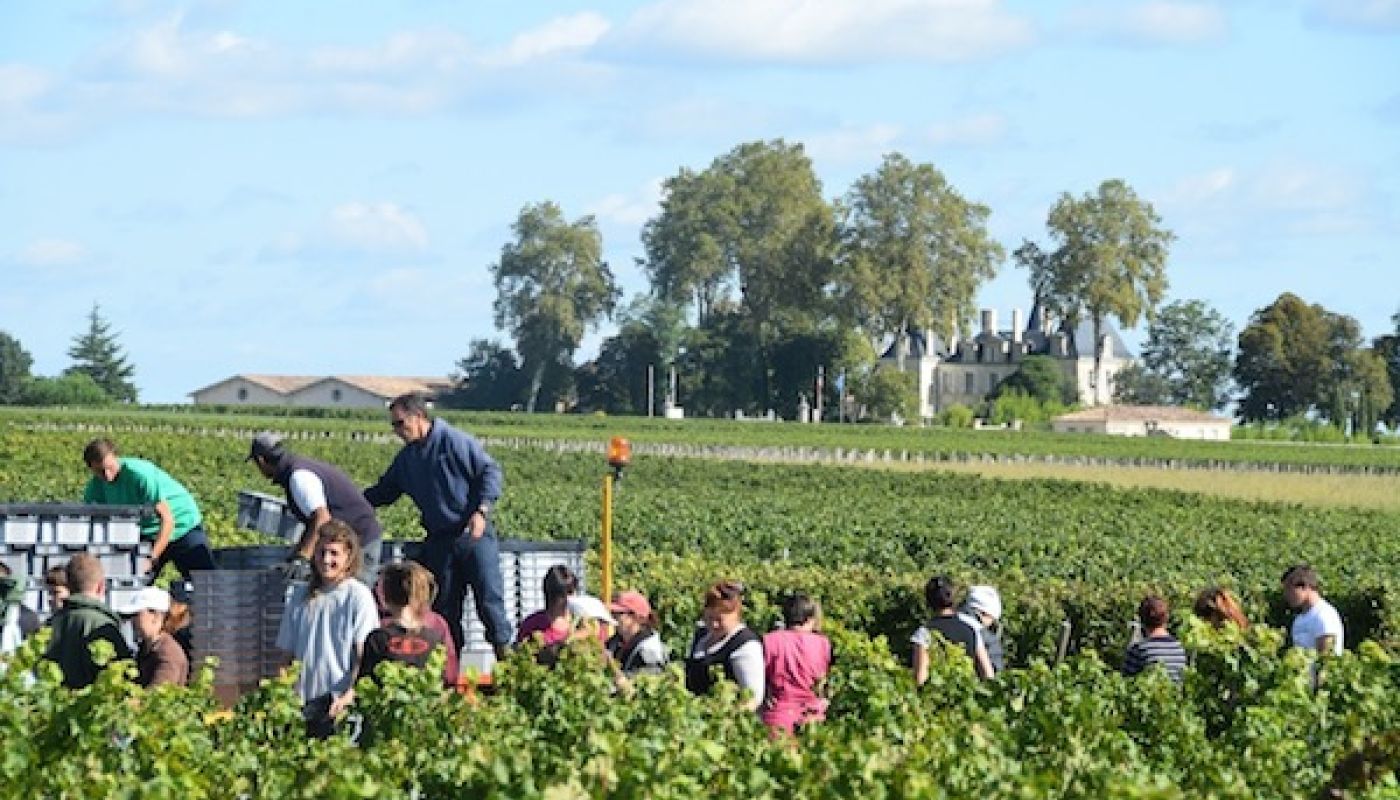
This is the story of a vintage year in two parts: a totally extraordinary, excessive first half that gradually tempered into a gentle, more typically Atlantic-influenced and erratic second half. It is the story of a year which, until high summer, was charged with universal enthusiasm but which ended very variably. For some properties there was a truly great ending, while for others just a very good one. Here is how it began.
Winter 2014/2015
The hot, rain-starved 2014 harvest period had left the vineyards in urgent need of winter rainfall if they were to withstand any of the summer drought conditions so common in recent years. The autumn of 2014 had been the driest and hottest of the last 115 years. So the 120 mm (4.7 in) of rain that fell in November 2014 couldn’t have been more welcome. But this was to be the end of any real replenishment as December was worryingly dry again (less than half the normal rainfall for the month) and January and February provided nothing exceptional. Later no one could quite understand how, given the shortage of winter rainfall, the vine tolerated the five months of severe drought that were to follow from March. Maybe part of the answer was that we had entered the season with a good stock of moisture deep down in the soil from the relatively wet previous two years.
Apart from water, the other essential winter requirement was frost, to enable the vines to achieve the full dormancy that would kill off pests. The autumn heat persisted well into November, but then at last came frosts: 16 freezing nights over December and January, with even more in the countryside – nothing excessive, never below -5 °C (23 ºF), but perfect for getting the pruning done while the sap was down and for keeping the bugs at bay.
Spring 2015 and an on-time perfect budding
These very welcome February frosts were to be the last of the season (apart from the odd, mild harmless one in March out in the country). Without them, the budding would certainly have started there and then. The warm daytime temperatures of March then became dangerously high, but the cold nights quickly put paid to the vines’ zeal and the few swellings that were noticeable in some warmer sites around the middle of the month were promptly arrested by the frigid northerlies of 22-26 March. Bordeaux had been lucky: in the world as a whole, March was the hottest since 1880 and the Arctic lost 1.2 million square km of ice cover.
The first few days of April stayed cool but the vine was getting impatient. Its wood was strong and healthy and it was raring to go. Maybe the fact that it hadn’t been tired out by the previous four relatively low-yield vintages had something to do with it, and this also could partly explain why it coped with such extreme heat during the drought that was to come. So, when the weather suddenly warmed up on 6 April, quickly crescendoing into the high 20s Celsius (80s F), there occurred the most amazingly rapid budbreak, whites and reds, Merlots and Cabernets, all in unison. This was all thanks to the strongest, longest and most widespread spring anticyclone on record, stretching from Atlanta to Ankara and from Timbuktu to Tromso. The shoots grew quickly, up to 4-5 cm (1.6-2.4 in) on some Margaux Merlots as soon as 17 April. The embryo bunches immediately looked big and there were a lot of them. With the added help of some good rainfall during the last 10 days of April, the foliage galloped ahead and it became clear we were now off to an early start after all.
Early summer and a speedy flowering
May continued very dry (April had seen a 70% rainfall deficit on average precipitation, and May would be almost 60%) and was also very hot as the foliage continued to grow solidly, often reaching the top wire by 10 May or so. The vine was now ready to flower but got slightly delayed by the cooler nights of 14-23 May. Then, with the very regular warmth of the next 10 days – 10-12 °C (50-54 ºF) every night and 21-24°C (70-75 ºF) every day – vines blossomed into the fastest, most efficient flowering possible, this being perhaps the most important stage on the way to a high-quality vintage. Then the heat suddenly escalated in the first few days of June, culminating in an amazing 35 °C (95 ºF) on 4 June (see Bordeaux 2015 – first hurdle overcome). Such a sudden burst of heat just as the flowering was concluding could have meant casualties in the form of aborted grape-set, but it came just after the main part of the job had been done, timed perfectly to accelerate the end of the process by efficiently expelling the flower ‘capa’ (calyptra) and, over the ensuing gently warm week and with some beneficial rain the week after, the bunches started to look robust and well-formed. As each year, there was talk here and there of just a little coulure, and later in some areas ‘windows’ became visible in the bunch spread, especially on the right bank – but it didn’t matter too much because the flowering had been so generous.
With the flowering over so quickly, more precise planning than usual could be made for the rest of the year’s vineyard work and for harvest dates. The little cool period just beforehand had put the programme back from early to normal, making it later than the record precocious 2011 but ahead of most recent vintages. Now there was the prospect of a September rather than October harvest, a further indicator of a top-quality vintage.
The dangerous drought of high summer
The only snag at this point was the extreme heat and drought. June was turning into the fourth successive month of 50% rainfall deficit and of scorching temperatures. April and June were both a full 3.2 °C (5.8 ºF) above the mean normal temperature and both broke records for the number of sun hours – in the case of June, just as the sun is at its most powerful. This brings us to the point about effeuillage, the practice of cutting off the leaves around the bunches, first on the east side, then on the west side, in order to obtain direct sunlight on the grapes. Many growers had got half way through this process, largely encouraged by temporarily cooler and damper conditions mid-month, then had to stop in order to avoid scorching when the heat wave quickly returned. Many had already decided against it, as it encourages extra sugar in the grapes and a certain jamminess in the wines, both characteristics widely considered to have been excessive in recent vintages. The debate continued inconclusively for the rest of the year, but certainly on the driest soils, leaf trimming did nothing to help de-stress the vines.
The hottest day of the year was 29 June, unusually early for such a record, and was followed by almost as much extreme heat over the first 22 days of July, with three days over 35 °C (95 ºF) and 11 over 30 °C (86 ºF). Until now, the vine had withstood the pressure of drought and heat remarkably well. Its foliage had been bright and vigorous; even the roadside grass had remained all green. Could we dare hope for a repeat of 1961? But this was not to be. These 22 days were just too much, the foliage was often beginning to curl in the heat of the day and the roadsides started to look like savannah. The month ended up as the fourth hottest July in Aquitaine in 100 years. The vine, which had done so well until now, started to suffer, especially on the lighter soils, but only here and there as total shut-down, more generally as a sort of closing in on itself, ceasing to give priority to its reproduction in favour of its own survival. This difficult period was not long – just three weeks – but it was enough to ensure that the grapes would remain very small and that they would prematurely thicken their skins. If these conditions were to continue, they could end up devoid of juice, many severely shrivelled, others half burnt. This was a very anxious time. Until July, the heat and drought had been thought of as a very positive, early-ripening influence; by mid July they were considered more as a negative, delaying and even possibly fatal influence.
Late summer’s rains save the day
It was precisely now, with the vines at the end of their tether and forest fires blazing in St-Jean-d’Illac threatening the south-west suburbs of Bordeaux (but a mere nothing compared with what north-west America was now experiencing) that the air started to change, the wind first going round and round in circles and then at last bringing some dampness from the ocean. All this quickly escalated into two violent coastal storms on 22 and 24 July, which then convected into strong rains as they passed over the oven-baked land, providing up to 30 mm (1.2 in) inland, especially on the right bank. The aforementioned strong anticyclone was starting to deflate, allowing depressionary tracks to come through for the first time in five months, and setting the stage for what would come to be termed ‘August 2015’s rains of salvation’. With 13 days over 30 °C (86 ºF), August remained hot – the land takes time to cool down – but it brought four wonderful episodes of rain, and eight in Sauternes (which would account for the very early first stage of botrytis this year). This August rainfall was unequally distributed: 90 mm (3.5 in) at the Mérignac meteorological station, but up to 140 mm (5.5 in) in parts of the right bank, up to 100 mm (4 in) in parts of the Médoc and Graves, and as little as 50 mm (2 in) in parts of the Entre-Deux-Mers (contributing to the low yields and high alcohols of the EDM wines this year).
It also coincided with véraison (colour change in the grapes), which quickly became the most even and earliest since 2009 and was easily concluded by the weekend of 8/9 August under the influence of these reinvigorating showers – but only reinvigorating to a point because, as a result of the preceding drought, the vine was already ceasing to foliate, taking in this nourishment for itself and leaving its grapes to concentrate on their own. This premature halt in the growth of the foliage and the nourishment of the bunches was possibly the biggest factor explaining the extreme health of the crop at the end, allowing most harvesters to wait calmly and unhurried for the optimum picking time for each parcel and variety, even when conditions were not perfect. Indeed, apart from a few Sémillons that became fragile at the end of August and a few Merlots that took on too much water in September, there was hardly an ounce of grey rot to be seen all year. Oidium [powdery mildew] and mildew [downy mildew] were a real danger early on, as they love the spring sunlight, but were usually brought well under control, even in the organically farmed vineyards, and black rot’s first appearance for several years sometimes went unnoticed. But, generally, the bunches ended up so healthy that there would be little need to rush to harvest.

Autumn’s erratic rainfall shuffles the cards
The harvest started during the week of 24 August with the earliest dry whites in Sauternes and Pessac-Léognan. Apart from light showers on 31 August, they enjoyed perfect sunny conditions and suddenly much cooler temperatures, maxima in the 20s and minima in the teens Celsius. In addition, the diurnal temperature variation was usefully high, often 15 °C (27 ºF) between night and day temperatures, providing good acid retention and nice freshness in these quite strongly constituted wines. The spritely but powerful Sauvignon Blancs were quite clearly the leaders over the softer-styled Sémillons, which had not reacted so well to the August moisture. The whites of the cooler soils of the Bordeaux appellation were harvested quickly towards the end of this period, getting caught at the end under the mid-September rains, but they were so concentrated it didn’t matter too much; also the white-wine vineyards are situated precisely in the places of lowest September rainfall.
The sunshine had now run out. On 10 September, a depression was announced for two days later, followed by two days of damp, cloudy weather culminating in torrential rain for ex-tropical-storm Henry’s visit on 16 September and damp conditions continuing for a further week beyond that. If this forecast were correct, it would be a serious setback to the vintage but, curiously, very few people rushed out to pick their Merlots. Most unusually, everyone just calmly rescheduled their picking dates to later. Normally September rain accelerates the harvest dates (1999, 2006); this time it delayed them. Growers could sense the grapes’ resistance and didn’t need to hurry. And, since the vine was no longer feeding the grapes, they didn’t swell very much.
The forecast was correct for the dates, but incorrect for the volumes of rainfall, which ended up being much greater over the initial period of 12-14 September than for the remains of Henry on 16 September. In addition, the geographical distribution of this rain was wildly erratic: at its heaviest in the northern Médoc, heavy in Blaye, only 40 mm (1.6 in) or so in Pessac-Léognan, Margaux and Sauternes, and varying from almost 0 to 40 mm on the right bank. Apart from the perennial panickers at the lower end who had ripped through their harvest from the week of 7 September, the Merlots generally started at the tail end of the showers, around 18 September, starting as usual with the young vines and those that had been weakened in areas of greater rainfall. Then, with the return of sunny days and cold nights between 20 September and 1 October, almost all the rest of the Merlots were picked, at leisure, each parcel constantly being rescheduled to take advantage of each one’s maximum ripeness, wherever possible always delaying rather than advancing the programme. The great majority of the top estates picked their Merlots over the last four days of the month, in perfect conditions. However, some had to wait further into October for full ripeness, including the dwindling group of partisans of over-ripeness.
It was now time for the Cabernets: Francs on the right bank, Sauvignons on the left. This year, these were all picked simultaneously, and, with the return of the fine weather and northerly cool winds from 8 October, they could be concluded at a leisurely pace once again. The weekend nights of 3-4 October brought heavy rain, once again especially on the Médoc, which motivated those on the left bank to accelerate more than the right bank. Nobody seemed worried by the catastrophic forecast of 30 mm (1.2 in) for 12 October and they were right … it never materialised.
By the time the rain returned on 27 October, the whole harvest was finished, the final Cabs and Sauternes in perfect cool and sunny conditions around 20-22.
Appendix 1: The year’s monthly rainfall and temperatures
| Month | Rainfall 2015 (mm) | Normal rainfall (mm) | Temp (ºC) in relation to normal | Sun hours 2015 |
| Winter | ||||
| 11/2014 | 120 | 88 | + 4.2° | |
| 12/2014 | 54 | 107 | + 0.5° | |
| 01/2015 | 93 | 101 | + 0.9° | |
| 02/2015 | 80 | 85 | - 0.6° | |
| 03/2015 | 38 | 77 | +1.5° | |
| Total | 385 | 458 | + 1.3° | |
| Spring | ||||
| 04/2015 | 6 | 70 | + 3.2° | 197 h |
| 05/2015 | 33 | 78 | + 1.8° | 201 h |
| 06/2015 | 44 | 56 | + 3.2° | 301 h |
| Total | 103 | 204 | + 2.7° | 699 h |
| Summer | ||||
| 07/10 | 35 | 46 | + 2.9° | 281 h |
| 08/10 | 90* | 58 | + 2.2° | 252 h |
| Total | 125 | 104 | + 2.6° | 513 h |
| Autumn | ||||
| 09/10 | 40* | 68 | - 0.4° | 209 h |
| 10/10 | 52* | 74 | – 0.1° | 169 h |
| Total | 87 | 142 | - 0.3° | 378 h |
| TOTAL | 630 | 928 |
* regional variations
'normal' = 30-year average
bold type indicates the most important figures
Appendix 2: Diary of the 2015 vintage’s harvest
Figures are from the met station in Mérignac.
| Date | Temp (°C) | Weather | Rainfall (mm) | Harvesting dates | |||
| August (norm 14°2-25°6) | Dry whites | Merlot | Cabs | Sauternes | |||
| 25 T | 13-26° | s | √ (P-L) | ||||
| 26 W | 17-29° | s | √ | ||||
| 27 Th | 18-32° | s/c | √ | ||||
| 28 F | 19-32° | s | √ | ||||
| 29 S | 21-34° | s | √ | ||||
| 30 Su | 21-34° | s | √ | ||||
| 31 M | 22-30° | s/sh | 2 | √ | |||
| September (norm 12°5-23°7) | |||||||
| 01 T | 18-24° | s/c | √ | ||||
| 02 W | 12-25° | s | √ | ||||
| 03 Th | 15-23° | s | √ | ||||
| 04 F | 9-22° | s | √ | ||||
| 05 S | 10-22° | s | √ | ||||
| 06 Su | 8-23° | s | √ | ||||
| 07 M | 11-23° | s | √ (EdM) | √ | |||
| 08 T | 11-25° | s | √ | √ | |||
| 09 W | 11-28° | s | √ | √ | |||
| 10 Th | 16-26° | s/c | √ | √ (early P-L) | √ | ||
| 11 F | 14-27° | s | √ | √ | √ | ||
| 12 S | 17-22° | r | 9-50* | √ | |||
| 13 Su | 15-22° | r | 9-40* | √ | |||
| 14 M | 14619° | r | 5-30* | √ | |||
| 15 T | 13-21° | sh | 4 | √ | √ | ||
| 16 W | 18-28° | c/s | √ | √ | |||
| 17 Th | 15-21° | c/sh | 2 | √ (+ early LB) | |||
| 18 F | 12-21° | s/sh | 3 | √ | |||
| 19 S | 13-20° | s/c/sh | 1 | √ | |||
| 20 Su | 8-23° | s | √ | ||||
| 21 M | 9-24° | s/sh | 1 | √ (+ early RB) | √ | ||
| 22 T | 14-19° | sh | 4 | √ | √ | ||
| 23 W | 10-19° | c/s | √ | √ | |||
| 24 Th | 7-20° | s | √ | √ | |||
| 25 F | 13-21° | s/c | √ (GV LB/RB) | √ | |||
| 26 S | 11-22° | s | √ | √ | |||
| 27 Su | 8-22° | s | √ | √ | |||
| 28 M | 11-24° | s | √ | √ | |||
| 29 T | 9-22° | s | √ | √ | |||
| 30 W | 14-24° | s | √ | √ | |||
| October (norm: 9°1-18°9) | |||||||
| 01 Th | 11-22° | s | √ | √ | √ | ||
| 02 F | 4-17° | c/sh | 1 | √ | √ | √ | |
| 03 S | 10-16° | r/c/r | 20-30* | √ | |||
| 04 Su | 9-18° | s/sh | 1-10* | √ | |||
| 05 M | 14-26° | c/sh | 1* | √ | √ | √ | |
| 06 T | 17-22° | c/sh | 1 | √ | √ | √ | |
| 07 W | 13-20° | sh/s | 3 | √ | √ | √ | |
| 08 Th | 8-20° | s | √ | √ | √ | ||
| 09 F | 7-19° | s | √ | √ | √ | ||
| 10 S | 7-21° | s | √ | √ | |||
| 11 Su | 10-21° | s/c | √ | ||||
| 12 M | 12-16° | c | √ | √ | |||
| 13 T | 10-16° | s | √ | √ | |||
| 14 W | 5-12° | s | √ | √ | |||
| 15 Th | 4-16° | s/c | √ | √ | |||
| 16 F | 2-13° | s/frosts | √ | √ | |||
| 17 S | 4-16° | s | √ | ||||
| 18 Su | 11-15° | sh/c | √ | ||||
| 19 M | 9-19° | s/c | √ | √ | |||
| 20 T | 8-17° | s | √ | √ | |||
| 21 W | 8-17° | f/s | √ | ||||
| 22 Th | 10-16° | c | √ | ||||
| 23 F | 13-18° | c/s | √ | ||||
* regional variation
bold type indicates the main days of harvesting
c = cloud, f = fog, sh = showers, s = sunshine, r = rain
LB = left bank, RB = right bank, P-L= Pessac-Léognan
GV = grands vins
See also part 2 – the wines.
















