Longstanding readers of the Weekend FT may remember that my predecessor Edmund Penning-Rowsell instituted an annual report on how all the bordeaux first growths were tasting 10 years on from the year they were born.
This was based on a leisurely dinner chez Penning-Rowsell in the Cotswolds attended by us two wine writers, Michael Broadbent of Christie’s and our spouses. The wines, acquired somehow by Edmund via a mysterious system known as “prix d’amis”, were not served blind and, at Edmund’s insistence, we finished every bottle even when the number of first growths deemed of interest had risen to eight.
Times change. Modern wine writers would surely be laughed off first growth premises if they tried asking for a “prix d’amis” now that such wines are launched, many months prior to bottling, shipping and paying taxes, at thousands of pounds a dozen – and still they sell out immediately. The modern way of evaluating wines, alas, is to look at dozens of examples at a time, blind, without food. So one bottle of each wine can be shared by 15 tasters with a generous pour, up to 24 with a more parsimonious one.
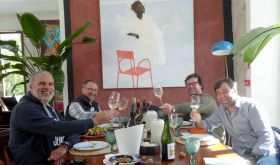
Thus it was I found myself one long morning earlier this month evaluating the 1996 red Bordeaux vintage 10 years on, attacking 70 different wines which had been assembled at the London premises of fine wine traders Farr Vintners. The 14 other tasters included fellow wine writers Steven Spurrier of Decanter and Neal Martin of www.wine-journal.com in the UK, James Suckling of Wine Spectator in the US, representatives of Bordeaux negociants Bordeaux Millésimes and Maison Descaves who, with Farr and Four Walls Wine, had kindly provided the wines, and a crew of interested wine merchants from all over the UK and one from Germany.
It was decided to focus on the left bank, Médoc and Graves, as the 1996 vintage was so much more successful there than in St-Emilion and Pomerol.
The 1996 is an apposite vintage to be examining now. It was expensive when released after an unusual growing season and has the reputation of being pretty austere and backward. Not even the greatest claret lover, perhaps especially not the greatest claret lover, has been in a hurry to open these wines. Would they prove anything like ready to drink? Or would they follow the pattern of their predecessors in the previous decade and be as unapproachable as many 1986s still are?
We started with a flight of second wines which proved a bit of a waste of time quite honestly. With the exception of two of the Pauillacs, Les Forts de Latour and Réserve de la Comtesse (second wines of Chx Latour and Pichon Lalande respectively) they seemed marked by the lack of concentration that plagued many wines in this plentiful, rain-affected vintage, Light aromas and raw tannins seemed to characterise the rest of this collection.
Underripeness was apparent in several wines in the next flight, Margaux and the southern Médoc, although there was one lovely wine, the fifth, that was seductively perfumed in the way classic Margaux is meant to be, fully evolved but with lots of quite-ripe-enough fruit in evidence and ripe tannins well in retreat. I called this “a very complete, attractive wine, although it is far from overripe. For classicists.” (I should point out that the first growths did not slum it in these communal flights; they were corralled in their own special flight at the very end, so this mystery wine was not up against Ch Margaux.)
At the end of each flight we all called out our marks and there was remarkable unanimity that wine number five was the best of this flight. [Mind you, Ch Giscours, a relic from the previous regime that the current owners were reluctant to show, was marked by excessive volatility and admired second growth Ch Rauzan Ségla was so badly affected my a mouldy cork as to be untaste-able. This was just one of at least four corked bottles we encountered, two of them containing first growths worth £400 a bottle. Another wine was oxidised. Not a good showing for the cork industry. (A bottle of Rauzan Ségla tasted blind subsequently was impressive and would almost certainly have been top wine of the flight.)
Wine number five, much to our surprise, turned out to be just about the most lowly imaginable, Ch Ferrière, a tiny third growth property resurrected from desuetude only in the 1960s, now run by Claire Villars-Lurton along with Chx La Gurgue and Haut Bages Libéral, often ignored by commentators and hence available at a very good price. France Chauvin of Maison Descaves was particularly pleased by its showing as she had recently seen its potential and virtually cornered the market in it.
While we attacked the next flight, some particularly toothsome Graves, Stephen Browett of Farr was notable by his absence. This was not too surprising since he had such a bad head cold he told us could not smell a thing. I did wonder whether he was after some more tangible reward for having spent the last 12 months organising this tasting and yes indeed, this terrier-like buyer came back in time for the Graves score gathering to report that he had been on the phone to Bordeaux rounding up every bottle of Ferrière 1996 he could get his acquisitive hands on.
I gave no Graves, other than the corked Ch Fieuzal, a score lower than 16 out of 20 and was generally very impressed (as I had been by the 1998s a year earlier). They seemed to have an attractively plump, fruity mid palate and real energetic freshness rather than rawness. Most, like the Margaux, are now ready to drink.
The St-Estèphes, tasted blind with some outlying Médocs, were, as one might expect, more austere. Many wines were still quite blue, as though they were just casting off their youth. Very little charm was in evidence though there was no shortage of tight-lipped discipline. Only Chx Cos d’Estournel, Calon Ségur and possibly Ormes de Pez struck me as worth waiting for.
The St-Juliens however I found even more obdurate. One or two lowly wines seemed to be drying out and the supposed star, Ch Léoville Las Cases, currently selling for more than £1,500 a dozen, was far from outstanding. Las Cases scores were all over the place so, unknown to us, it was decided to serve a second, backup bottle alongside the first growths – where it fared no better. (I tasted it blind a few days later and preferred Lagrange!) Some of these St-Juliens were undoubtedly impressive, but I would hang on to them for several more years before attacking them in earnest.
We were expecting the Pauillacs to please and were not disappointed – some were slightly exaggerated stylistically but most of them are ready to start drinking. The non first growth Pauillac that did best of all was Ch Pichon Longueville (Baron) which was the favourite of eight out of 14 tasters, including me, beating Pichon Lalande and Lynch Bages (which I scored unusually meanly) into equal but definitive second place. I scored it more than Ch Margaux and the same as its first growth neighbour Ch Latour and Ch Haut-Brion which almost always suffers when served alongside the first growths of the Médoc. But perhaps I was running out of points.
My conclusion? There are some excellent wines here at the very top of the tree, and a few excellent bargains, presumably where yields were held in check. But there are also many markedly light wines that will appeal only to lovers of the most classical bordeaux. Hang on to the first growths and the best St-Juliens and St-Estèphes. Enjoy the best Graves and Pauillacs from now.
See my detailed tasting notes, scores and suggested drinking dates in tasting notes.
Top left bank 1996s
My favourites
Mouton Rothschild
Lafite
Latour
Haut-Brion
Pichon Baron
Dom de Chevalier
Margaux
Léoville Poyferré
Group favourites
Lafite
Haut Brion
Margaux
Latour
Mouton Rothschild
Pichon Baron
Cos d'Estournel
Léoville Las Cases
This article also appears in the Financial Times.