23 Jul 2015 Here's what I reported to members on Monday about what I learned in Bordeaux last week.
20 July 2015 The main news from Bordeaux, where I spent most of last week with the Royal Houseold Wine Committee, is of the exceptionally hot, dry 2015 vintage. Delight at the successful flowering that promises to deliver decent quantity and so-far-promising quality was muted by concern that the vines may suffer from just too much heat and too little water. All but the youngest wine growers in Bordeaux have known an exceptionally hot vintage, most obviously 2003. And they have been through exceptionally dry vintages such as 2005, 2010 and 2011. But a combination of the two sets of extreme conditions is a long-anticipated novelty. The 2015 growing season is already as hot as 1947 on the right bank, according to Baptiste Guinaudeau of Ch Lafleur, and although winter was usefully cold this year and there was some rain at the beginning of 2015, Bordeaux really needs a bit of rain now.
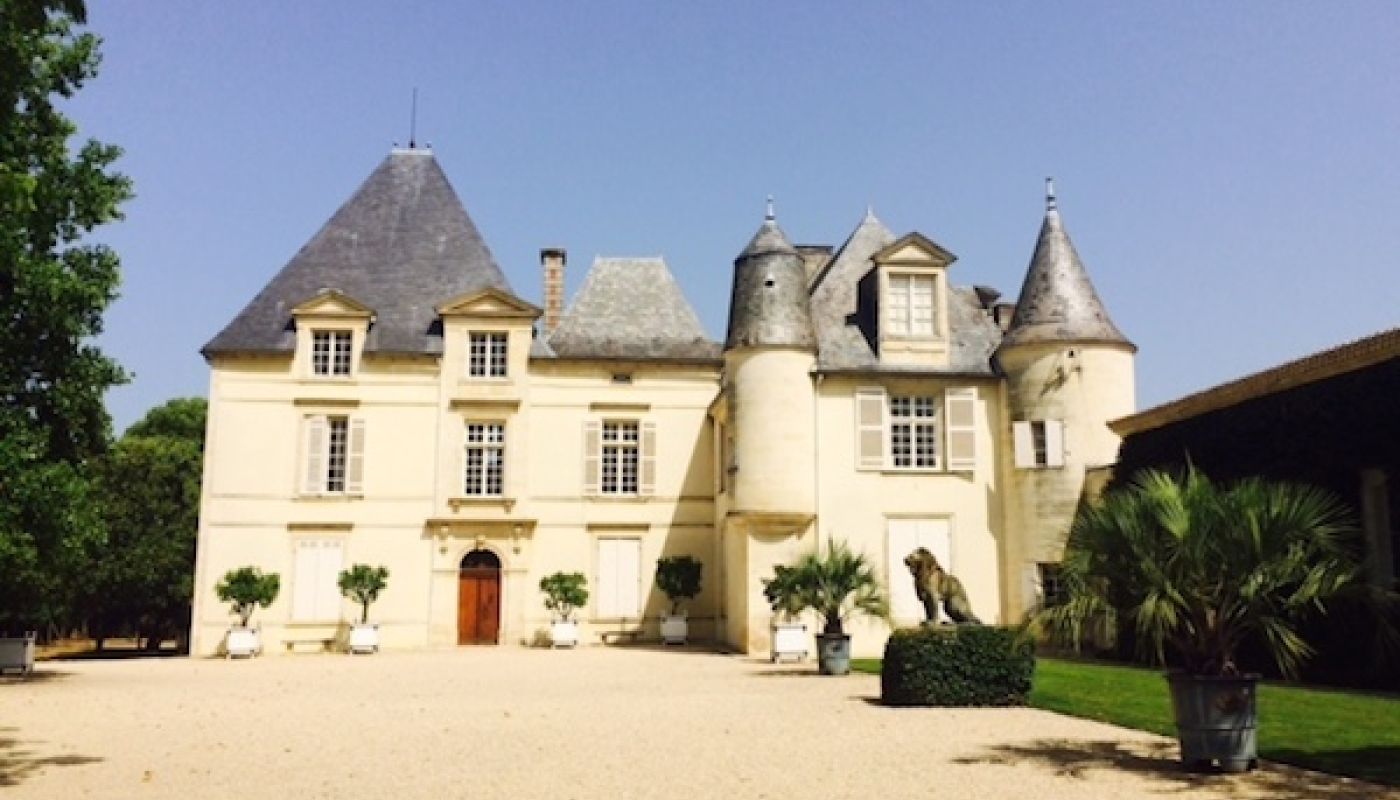
Most concern was expressed at Ch Haut-Brion (picture taken last Friday at noon) where temperatures are always higher than in the Médoc and the rest of the Graves because of the proximity of the city. Their first sign of veraison, grapes turning from hard and green to soft and purple, was as long ago as a week, 13 July. At Ch Lafleur Baptiste laughed in the middle of our tasting last Thursday in the tiny cellar because he had just been sent a picture by one of his permanent vineyard team of 15 – his wife Julie perhaps? – of the very first berry on their 4.5 ha to turn colour. This is much earlier than usual.
At Haut-Brion they expect to start harvesting their exceptional Sauvignon Blanc on or around 20 August. At least the university’s proximity means that, unlike most Bordeaux estates, they have no difficulty finding pickers. ‘We just whistle', said chef de culture Pascal Baratié, tilting his head toward the campus on the other side of the Arcachon road and railway.
(During our visit to Mouton – the royal field trip concentrated on the top end of the Bordeaux hierarchy of course – we were told that such was the pressure to bring in the 2013 harvest, a total of 695 pickers were involved. Even the tour guides were told to wield the secateurs.)
Baratié joined us late for lunch, having been out in the Haut-Brion vineyards examining his very exposed vines. He reported that not only were the young vines suffering water stress, as expected, but already some 25-year-old vines were visibly dying for lack of water. He wishes he were allowed to irrigate. Couldn’t you ask for exceptional permission in view of the weather, I asked. He explained patiently that in the past – in 2011, I think – they had officially asked. This involved petitioning the Pessac-Léognan generic body, which had to petition the INAO, who control all AOC wine, who then had to petition the French minister of agriculture. By the time all this had been achieved, it started raining.
At least the lack of rain has kept the berry size very small and the vines relatively free of disease, although Alexandre Thienpont of Vieux Château Certan has been plagued by black rot, which, he reports, has been encouraged by the morning humidity and has been blown in an arc over the plateau of Pomerol. It has not touched Le Pin next door, although water stress has, and those who have practised organic viticulture for a few years are also free of this disease which leaves berries shrivelled, black and useless (see the lower berries in the picture below). But this is the worst attack since 1983, apparently, which was a very good vintage on the right bank – better than 1982 in some cases.

Of course every visit was fascinating, and it was a treat for me to spend a little more leisurely time at these properties instead of the usual en primeur speed tasting whirligig. Another overall observation was how often these Bordeaux wine producers mentioned The Other Place, Burgundy. It was almost as though they had developed an inferiority complex. Many a winemaker stressed how they were trying to imbue their wines with a sort of burgundian quality. The quality of insatiable demand for them perhaps?
This was often true when people were discussing the white wines they are quietly developing. It is quite noticeable how many producers are trying their hand at white winemaking – typically on plots of land that have proved less-than-perfect for red-wine production. Such is the case with the Cheval Blanc team, led so eloquently by Pierre-Olivier Clouet under Pierre Lurton’s direction. Here they are apparently experimenting with a Sauvignon Blanc on a little plot of La Tour du Pin, the nearby property they took over at the end of 2006. We were told, over a bottle of Krug 2003 as an aperitif (keeping it all in the LVMH family), that they are experimenting with a sort of Sancerre-esque style. Indeed we were served a bottle of Vincent Pinard’s 2012 Harmonie with our first course before a succession of Chevals ending in 5. (Our host was in charge of the finances and had a very arithmetical brain – from which we all benefited considerably, back to 1975. Tasting notes on all the wines we were served during this visit are being added to a substantial collection of reviews of older bordeaux to be published in a week or two. I will also publish, separately, my notes on the younger vintages.)
The Lafleur Guinaudeaus are also using Sancerre as their model for Les Champs Libres, an ambitious white-wine project that uses their long experience of making Grand Village Blanc and vines from Sancerre itself. But at Lynch Bages it is white burgundy that is seen as the model for Lynch Bages Blanc, a wine that Jean-Michel’s son Jean-Charles Cazes has taken a particular interest in since he took over in 2006. Together with winemaker Nicolas Labenne, he has schemed to make it fresher and less oaky, involving earlier picking and a slightly reduced proportion of barrel fermentation. The 2014 and 2013 certainly hit the spot on a hot night in Bages.
We ate outside the Café Lavinal, conveniently placed for regular raids on Jean-Michel’s personal cellar just inside Ch Lynch Bages across the square. Jean-Michel pretended to shake his head at these forays made by Jean-Charles, just back that evening from a holiday in the Maldives, but then admitted that he had similarly raided his own father’s cellar. Quinta do Noval Nacional 1963 was the most glorious end to our first meal.
Another very distinct trend is that towards organic and even biodynamic viticulture. After years of claiming that their climate is too humid with too great a risk of the fungal diseases to which vines are so prone, more and more tip-top Bordeaux producers are experimenting with full-on ’bio’ practices. (In French of course bio means simply organic.)
As Richard reported as early as April 2014 in his Vignettes from Bordeaux, Ch Palmer is hurtling along the biodynamic path after Ch Pontet-Canet. Ch Latour have had horses in their vineyards for a few years now and from 2015 half of the famous Enclos de Château Latour will be farmed organically and half biodynamically so that they can compare the results.
At Ch Montrose they have really jumped feet first onto the track of sustainability with the owner’s wife Melissa Bouygues the biggest fan. They make their own electricity, train their staff ergonomically, cool with their own recycled water, tie (some) vines with willow specially grown by the Gironde rather than the more usual nasty old plastic. They tried out organic viticulture on their most difficult plot two years ago and are now busy converting totally to organics with a view to going biodynamic. According to the extremely competent-seeming new winemaker at Ch Montrose, Vincent Decup, ‘among the crus classés everyone wants to do it. It’s just a matter of means and logistics. We need to learn, and this is a big challenge for Bordeaux. But it’s better to anticipate than to react.’ He freely admitted that traces of pesticides are currently ubiquitous in bordeaux, but according to him many a research student at Bordeaux University is now trying to develop chemical-free vineyard preparations.
One fascinating, if slightly trivial, new development. The advantage of travelling with people such as the Keeper of the Privy Purse (yes, seriously) and the Master of the Royal Household who are not old hands at visiting châteaux is that they ask all the questions we feel unable to ask at this stage in our careers. When quizzing Decup at Montrose about the neat deep red band round the barrels, they were told that wine is no longer used to create this, but for the last few years they have effectively painted the barrels with red pigment. This is a cosmetic habit that makes chais look impressive and also ensures that any wine spilt round the bung does not look too messy. (This picture of Montrose's recently refurbished glamorously classical second-year chai was taken by Richard in April 2014 when it was full of 2012. It was eerily empty when we visited, the 2013 having just been bottled.)

From then on we quizzed our hosts mercilessly about their red band policy. Turns out Ch Latour follow the pigment path whereas Pierre-Olivier Clouet at Cheval Blanc said he deliberately avoided it in case people thought he was also using such a preparation to add colour to the wine.
Personnel changes seemed thick and fast – not least because the people we met included Ducup at Montrose, who took over from Nicolas Glumineau whom we met at Pichon Lalande. At Montrose we met Hervé Berland, who has been succeeded as commercial director at Mouton by Hervé Gouin whom we also met over lunch with the most highflown new boy of all, Philippe Sereys de Rothschild, elder son of Baroness Philippine de Rothschild. I was delighted to be told that he is now spending almost all his time immersed in his family’s various wine activities, including Opus One in the Napa Valley where he was heading this week and the Rothschild champagne made on the Côte des Blancs.
One other notable thing. During our few days we were shown wines from just about every vintage this century, and many another back to 1957 (to celebrate the birth year of the Queen’s cellarmaster Simon Berry at Jean-Michel Cazes’s suggestion, even though Jean-Charles had been planning to pluck a bottle of 1959 from the cellar). But there was one 21st-century vintage no one showed us: 2013. Perhaps it was just because it had been bottled only a few weeks before.
Most comments on individual vintages were predictable but there was considerable variation in how the 2011 is viewed. At Cheval Blanc and Vieux Château Certan it is seen as virtually the equal of 2010, whereas Olivier Berrouet at Petrus, a stone’s throw away, is pretty dismissive of the 2011 vintage, observing that it is ‘below the level of 2014, 2012 and 2010’, having tannin but not enough flesh (which is pretty much how such 2011s as I tasted seemed).
The delightfully guileless Berrouet, by the way, declared, ‘I have had my first king.’ Both Swedish and Norwegian kings have visited Petrus, apparently, and he seemed rather disappointed that the Queen was not a member of our party. ‘Twas merely a recce, Ma’am.
Below see (part of) the immaculately-tailored Adam Brett-Smith of Corney & Barrow, a UK importer of Petrus, with the all-important drains on that blessed property during the one hour of the week when the sun did not shine mercilessly.