9 March 2021 Graham Shore, once a UK government economist, has worked in the investment industry for the last 30 years. He now owns Domaine Vintur in Ventoux where organic wines are made by his fellow Plumpton alumnus James Wood. He provides an inside view of the changes wrought by Brexit.
Now that the UK has left the European Customs Union and signed a tariff- and quota-free trade agreement with the EU, is it that everything’s going to change?
What do the stories of a huge drop in cross-Channel freight volumes since December signify for the choice of fine wines to buy in the UK? Will the prices of wine in the UK go up or down?
There can be no doubt that there is more (largely pointless) form-filling, more bureaucratic oversight and more costly procedures. These are mostly a result of the knee-jerk response on the Continent to any opportunity to make simple procedures complicated. But these extra costs of moving wine will have differential effects on the various types of wine producer, from large to small and from mass-market companies to artisanal, more niche wineries.
Is the new post-Brexit process a big deal? I think its impact has been exaggerated. It’s a pain and it’s incredibly stupid on the part of, for example, the French government. Their new procedures are effectively imposing a tariff on their own exports (the reverse of the traditional French protectionism policy of disadvantaging imports!). Unfortunately, it will have an impact on small wineries exporting to the UK, but otherwise its impact will be lost in the wash.
What do the new customs procedures entail?
I own a small vineyard in the south of France, in the southern Rhône, and some years ago set up an even smaller wine-importing company in the UK to import our wine. I did this because it made it easier to ensure a continuous supply of our whole range to both my wholesale and retail customers (I sell online) and importing did not seem that hard to do. I use a bonded warehouse to receive and store the wine and they also deliver the wine throughout Britain. I had tried a courier company for home deliveries, but the number of breakages and missed deliveries was just too high.
This business/logistics aspect of the wine trade is the less glamorous side of owning and marketing a vineyard. Making very good wine is not enough, the logistical details really matter.
When I first read the details of the new trading arrangements, my immediate reaction was that they were no big deal. There would be no need to get our wine retested and certified for the British market; there just seemed to be some extra paperwork. To anyone who runs any kind of business in France, this is just a way of life, the French administration is always inventing new and mostly unnecessary paperwork. But exporting wine within the EU had always involved filling in a customs form (a DAE, or EAD in English) which was made electronic a few years ago. Alcohol is a tightly regulated product everywhere and differences in duty rates meant that there was never a proper single market in wine.
The new element is a form called an EX1. It’s a customs declaration. Why should that be hard to complete? You would think it’s just a list and possibly some classification of the information so that some statistics could be collected.
Not in France. Apparently, some people have spent an entire day trying to complete the form. The douanes (literally, customs – they also regulate wine production) ran a seminar for wine producers on how to export to the UK post-Brexit. They told us attendees not to try to complete the EX1 ourselves.
It’s clear that they would prefer that the forms are completed by customs agents. And they have made it especially cumbersome for small producers to submit the forms. Apparently, you have to post a guarantee to back up any tax you may become liable for.
When your goods arrive at the port of departure, the lorry driver now has to display a barcode demonstrating that the customs procedures have been complied with. If not, the vehicle cannot enter the port. Each consignment needs to have a customs agent who can deal with any queries or problems. Naturally, this new requirement means paying the customs agent, an additional cost per consignment.
The effect on different types of producers
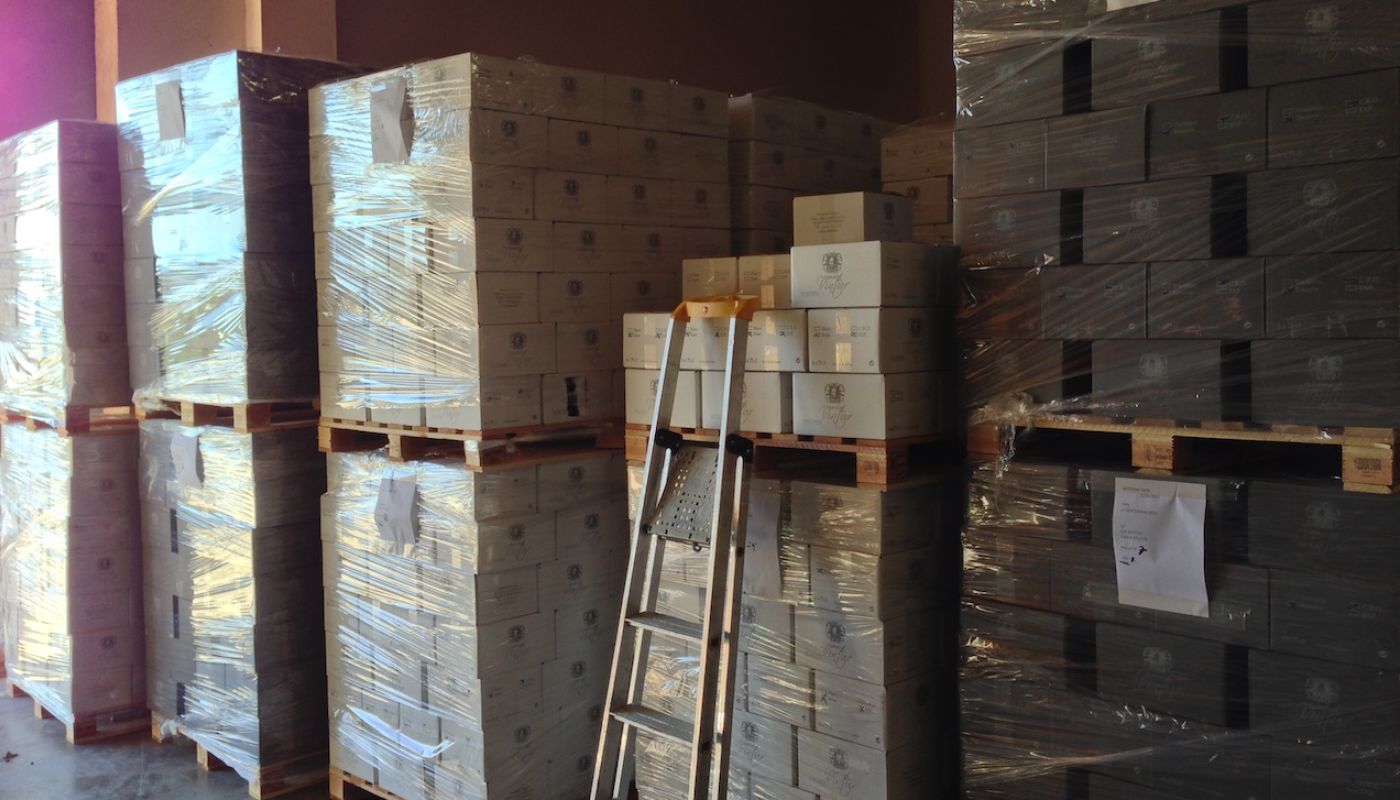
Obviously a big producer serving a large importer will typically send large consignments. They may even be able to fill a truck entirely with their own wine, making up a single consignment. But that is not the way it works for small producers. The normal procedure is to use groupage. A big truck will collect individual pallets from many different wineries for many different customers. The problem now is that each of those pallets is an individual consignment. The risk is that a problem with the EX1 form for just one pallet will hold up the entire delivery.
We normally send one, sometimes two, pallets in any shipment. A pallet is usually between 600 and 720 bottles. But some importers I know will ship much smaller amounts from individual vineyards: say, 120 bottles each from several suppliers in a winegrowing area. Often, these wineries will co-operate by delivering their share of the shipment to a single winery where the goods are all loaded together onto a single pallet. The freight company then needs to collect only this pallet from one place.
The freight haulage companies are, quite naturally and justifiably, nervous that an error in any one of the declarations in their overall load could lead to their lorry being held up at the port for an indefinite time. The more different consignments in the truck, the greater the risk. A truck with, say, 24 pallets inside from 24 different wineries is a risk. A truck with 24 pallets from 50 wineries because some have consolidated small shipments onto a single pallet is an even greater risk. The solution for the haulier is to insist upon the use of their own customs agent, for which they of course need to charge the wine producers.
What does this mean for the cost of imports?
For large importers, the post-Brexit changes are of little significance, adding fractionally to the cost of the wine, but for smaller importers the cost implications are more significant. I calculate that for my own imports from my winery, the changes since 1 January have added between 17p and 20p per bottle to the cost of bringing in a pallet.
To that I have to add the increased cost of freight. The handlers I use have increased prices, partly to reflect the risk that their trucks get held up, but because they have problems with loads going in the other direction. An empty leg adds to costs. President Macron’s unilateral decision in December to impose a temporary blockade on movements between France and the UK has had long-term repercussions on the movement of freight.
The total increase in cost per bottle if the wine is transported to the UK is probably less than 25p per bottle if the wine is on a single pallet. This extra cost is not hugely significant to a wine retailing at over £15 per bottle. For a cheaper wine from a small winery, it is material but not crippling.
Of course, the wholesale and retail chain may add their own margin on this extra cost, but even in the most extreme case, it is unlikely to be that significant. It is a stupid and unnecessary shot in their own foot by Continental exporting countries, but not a crippling shot.
Putting these extra costs in context, a small movement in the euro/sterling exchange rate is likely to be just as significant. In large part because of the faster vaccine-rollout in the UK, sterling has recently strengthened against the euro and £1 is now worth about €1.15. By my calculations, the exchange rate movement since 1 January 2021 has more than offset the increase in shipping costs for all but very low-priced bottles.
However, importers from small vineyards who put their shipments on a pallet shared with neighbours may find the cost increase for each small consignment renders this uneconomical. This would be a great shame for both Continental producers and British wine drinkers.
What about flexibility and timing?
I have just brought in my first pallet of 2021, which has now been entered into the British warehouse’s system as available for dispatch to customers. The process from ordering the freight to getting the wine delivered and released for dispatch was completed in a record time! One swallow does not make a summer, but the process has not been as slow as expected. Maybe I have just been lucky, and maybe it will be worse at a busy time such as in the run-up to Christmas.
Other stupid changes in the offing?
It seems the EU have already done their worst. It will be possible for the UK government to institute daft changes in due course, such as making UK labelling requirements differ from the EU’s. One threat is to require extra certification for organic wine. We are an organic producer and are certified as such by the French organisation Ecocert. Having just spent five months getting (and paying) Ecocert to recertify our labels for the US market, I am in no hurry to do this again!
There is also a rumour that the UK government may require all wooden pallets admitted into the country to be stamped to prove that they have been treated to prevent contaminants (for example, to avoid the spread of insect-borne diseases). This is already a requirement for our exports from France to the US. I find it more difficult to object to this as it sounds sensible.
The UK government has, initially at least, resisted the opportunity to require EU winemakers to get their wine retested and recertified for the UK market. The EU created this requirement as a protectionist measure against New World winemakers and it is embodied in the VI-1 form to which this plea to the government from the UK wine trade refers. It is an extra expense and unnecessary burden on any exporter. As our regulations are harmonised with the EU for the time being, the UK continues to require wine imports to produce this certificate. The British government has said that the exemption that a VI-1 is not required will continue until July 2021, but has refused to respond to requests for the ‘exemption’ to continue thereafter.
I don’t think the British government aims to impose unnecessary barriers on imports of wine. At least I hope not. Perhaps they don’t want to respond on VI-1 until they have gained a reciprocal exemption on British exports of alcohol to the EU. The EU has already shown that imposing stupid regulations is in their DNA, even when it hurts their own exporters. I just give thanks that I am not an English wine producer trying to sell my products on the continent.
What about shipping bottles as a private individual?
Jancis asked me to write about this too. It is not my area of expertise, but I have had bad experiences doing it in the past (goods held up in customs) and if you are going to get a winery to do it, they would use one of the major couriers. We have a discounted account with one of these courier companies and it seems that shipping 12 bottles from where we are in France to London would cost about £10 per bottle.
I once bought some wine I liked in New Zealand and had it shipped to the UK. I had no end of hassle with customs and then found out that it was selling at around the same price (delivered) at one of Britain’s leading fine-wine retailers. So stick to using your duty-free allowance this summer, if you are allowed to visit France by car!
See more in this thread on our members' forum.
















