29 January 2005 See also 700+ tasting notes with ratings and suggested drinking dates on Purple Pages.
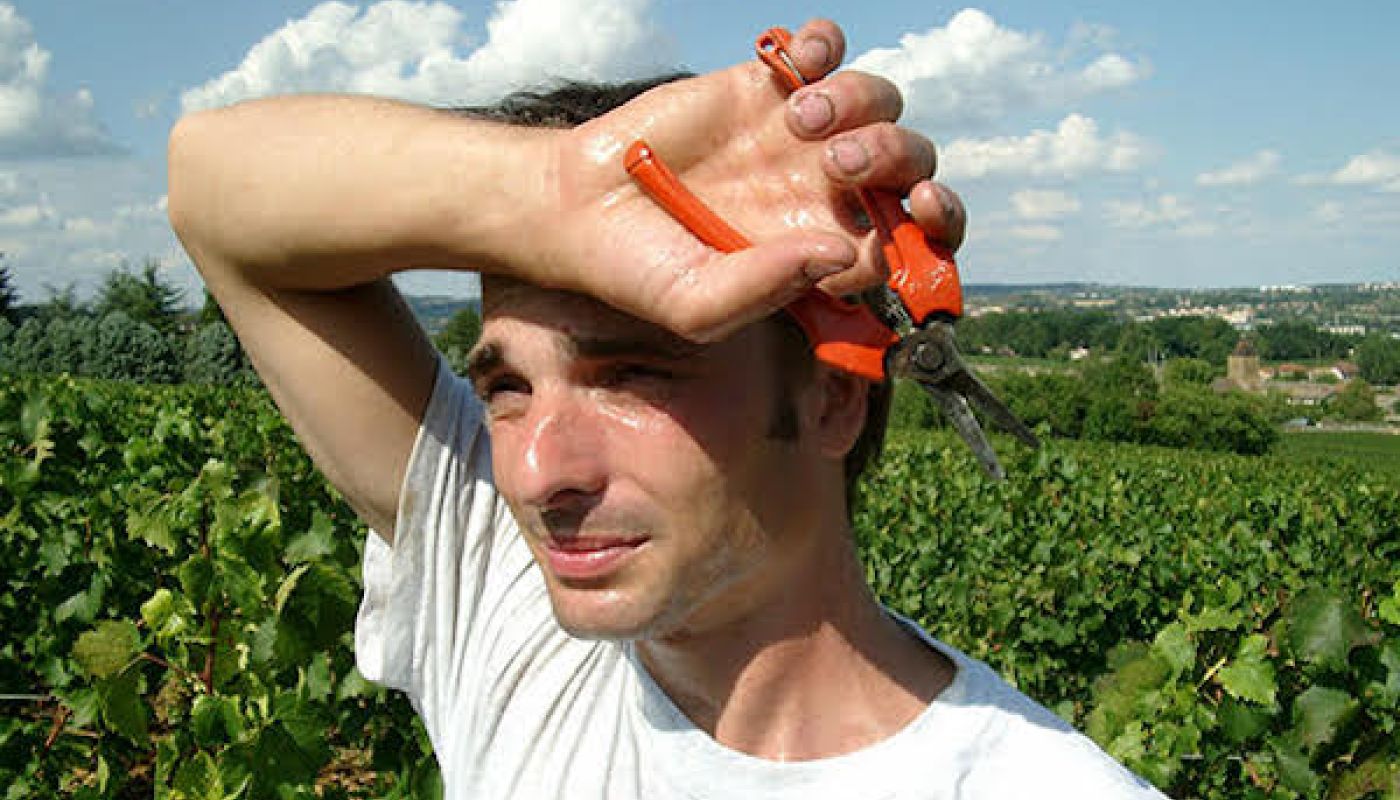
No Burgundian will forget the summer of 2003 (and I suspect no burgundy lover will forget tasting the wines). Trains melted. Streams dried up. Wine producers moved their beds into the cool of their cellars in search of sleep, or took off early in their annual search for sea breezes in the expectation of a grape harvest that might take place as early as the first week of September. (Burgundy specialist photographer Jon Wyand took this picture of a sweaty grape picker in 2003.)
Fred Mugnier of Chambolle-Musigny arrived back home on 15 August to prepare his brand-new winery for the coming vintage, only to find that some of his friends were already picking. 'Completely unthinkable!' was his reaction. The Domaine Chandon de Briailles was forced to pick its grand Corton-Charlemagne vines that day because the Chardonnay grapes were shrivelling dangerously and had already reached 14.5% alcohol (almost fino sherry strength). They had no official permission to do so for the authorities were on holiday.
Yet traditionally Burgundy’s grapes and wines, particularly reds, are the most fragile and delicate in the world. Yes, Pinot Noir ripens relatively early – much earlier than Cabernet Sauvignon for example – but it tends to need every one of its standard 100 days on the vine from flowering to harvest to develop the thrillingly nuanced cocktail of flavours that a good burgundy can offer. In 2003, many grapes were picked after only about 80 days on the vine, because after the record summer, acidities were dangerously low and many of the grapes were beginning to turn into raisins. Those growers who could afford and manage it, refrigerated their grapes as soon as they were picked – a 2003 variant on the pre-fermentation ‘cold soak’ so beloved by many Burgundian winemakers today. So what sort of wines were made from this freak year in which the harvest took place earlier than in any previous recorded year?
The first thing to say is that this truly was and is a quite exceptional vintage – not a 1976, nor a 1947. The wines obey even fewer rules and generalisations than is usual in Burgundy. They have by all accounts changed considerably in barrel since they were made, and to judge from the many wines I tasted several times recently, the majority of which are already in bottle, they take burgundy’s notorious capriciousness to new limits. I would not therefore recommend that any investor takes a major punt on 2003 burgundy. I think many of the wines, especially the whites, will develop rapidly, and even the finest reds, which certainly exist, will probably go through several unpredictable stages of development on their way to eventual greatness. All views below should be seen through that prism.
Even from the same domaine there are mammothly successful wines alongside bottlings that do a disservice to the names of their producers and appellations. And price is not always a sure guide to this disparity. More telling often are the precise geographical conditions of the vineyard, the magic of terroir. Sometimes in a very ripe vintage, in Bordeaux in 2000 for example, there is a tendency to assume that the vintage will assert itself over the character of each individual vineyard. This is not the case for Burgundy in 2003 where each vine was struggling to function and survive in these extreme conditions.
Apparently small factors could play a huge part in determining which wines work and which do not. The orientation of the rows, for example, was hugely important in 2003. Bunches on rows of vines which run north-to-south, for instance, were scorched by direct sunshine for a usefully shorter overall, and cooler, time than south-facing bunches on east-to-west rows. At the Domaine Marquis d’Angerville in Volnay pickers had to be sent into the vineyard specifically to cut off the sunburnt, ruined south-facing grapes, but the north-facing bunches produced small quantities of particularly fine, fresh juice.
This is hardly a classic Chablis vintage but vineyards on the naturally coolest, dampest soils, or in relatively high-elevation appellations which usually struggle to ripen such as Pernand-Vergelesses and the Hautes-Côtes, yielded some of their finest wines ever. It was a rare treat to taste such ample whites from St-Romain and St-Aubin, and many of them have better balancing acidity than white burgundies from grander but lower, warmer appellations such as those with Montrachet in their name – although some are betting on the fact that the grander wines will take longer to come into balance. Even some of the vineyards on the fringes of Burgundy’s heartland which are accorded only the modest Bourgogne appellation have produced some of their finest-ever wines.
As a massive generalisation, the biggest disappointments perhaps are the grandest whites. Far too many of them seem unappetisingly flabby. The Chardonnay grapes were picked with acid levels at an all-time low (typically 2.5–3.2 g/l rather than 3.5–4). The professional oenologists counselled adding acid before fermentation, as is done routinely in warmer parts of the wine world every year. Burgundians are splendidly individualistic and rooted in their sense of identity and tradition however, so most quality-conscious vignerons, which is the majority nowadays, in fact added little or no acidity. They were rewarded by seeing, as in Bordeaux on the other side of the country, overall acid levels rise during fermentation. But in the case of some of those white wine vineyards that are most favourably exposed in a more usual vintage, even this was not enough to make exciting wine out of 2003’s overblown raw ingredients.
In terms of quantity, the 2003 harvest is only about half the size of an average crop. Potential yields had already been shrunk by spring frosts which killed off some of the buds that burst so precociously after a mild February and March. The summer’s heat and relative (though not absolute) lack of precipitation further reduced potential volumes by delivering small grapes with thick skins and large pips – not much juice in other words. But the summer was so hot – every single day in the first half of August reached around 100 degrees and there was little respite at night – that the vines shut down and the ripening process was the very opposite of the slow, sure accumulation which Pinot likes best.
This means that many of the red wine grape musts made from grapes picked in August were notably low in acid, high in tannin (thanks to those thick skins and large, bitter pips) but not ridiculously high in grape sugar, and often had rather unripe phenolics, the compounds that determine flavour and tannin quality. Altogether a very rum recipe for burgundy, red and white – for many of the whites are also marked by quite noticeable astringency. Some merchants are selling this astringency as an alternative to the acidity that is so obviously missing, but I am not sure this will make for great balance in the long term. Energetic lees stirring on the other hand seems to have paid at least short-term dividends for the likes of Fichet and Javillier in Meursault.
Some growers waited to pick their Pinots until early September and benefited from some refreshing drizzle in late August. This brought a little more phenolic development, although possibly sacrificed some freshness – a quality that is all too rare in 2003s of both colours. Négociant Lucien Lemoine claims to have retained freshness in his wines by pumping in small amounts of carbon dioxide through the lees. He is also vehemently against late picking in 2003, arguing that the results in most cases were over the top and lack the refreshment factor that characterises successful burgundy. The large house of Bouchard Père et Fils is another enterprise which has nailed its colours to the mast of early picking, and early bottling. 'We called the technical team together and said, do we want to make a monster like a Chilean wine, or do we want to make great burgundy?', Bernard Hervet of BP&F told me. 'When we picked on 21 August we were one of the earliest – some outsiders were shocked. We all love 2003 even though it is not classic. We’re going to launch them very slowly because we’re convinced they’re going to age beautifully.' Certainly the Bouchard reds I tasted seemed very embryonic – although the Chablis from the associated house William Fèvre were some of the best Chablis to come my way. In general far more 2003s are already in bottle than is the case most years – though some whites, and even some reds, are still being kept in tank in an attempt to inject a note of freshness before bottling.
The wines, especially reds, are said to have become more refined in barrel, and that may be so. I tasted 2003s for the first time only last November. But some are still marked by uncomfortably dry, roasted characters – and in some wines this has been accentuated by the fact that new barrels were ordered on the assumption of a much bigger crop, so a higher-than-usual proportion of new oak has been used on musts that did not always warrant it. But then 2003 is exceptional …. At Clos des Lambrays initial fears that they had used too much new oak turned out to be unfounded. And Maison Champy, for example, used more new wood than usual but has made a range of most unusually fruity wines.
Prices from some domaines have risen, notably where the whispers have been enthusiastic such as at Domaine Sylvain Cathiard (although these wines did not shine so brilliantly in London last week). But in general the Burgundians have, as usual, been relatively modest in their pricing, despite the much-reduced quantities. This is presumably not unrelated to the depressed American market for wines made in the euro-zone.
See 700 or so tasting notes, ratings and suggested ageing potential on purple pages.
Some particularly successful producers in 2003
Comte Armand
Ghislaine Barthod
Bertagna
Jean-Marc Boillot
Michel Bouzereau
Bret Brothers
Ch de Chorey
Bruno Clair
Colin Deleger
Confuron-Cotetidot
Christophe Cordier
de Courcel
Digioia-Royer
Drouhin-Laroze
René Engel
Frédéric Esmonin
Jean-Philippe Fichet
Follin-Arbelet
Jean Grivot
Patrick Javillier
Les Héritiers du Comte Lafon
Domaine des Lambrays
Comte Liger-Belair
Martelet de Cherisey
de Montille
Louis Remy
Sérafin
Clos de Tart (Mommessin)