That bottle of wine just a few inches away from your glass is made of glass, cork (or plastic), metal and a little bit of paper. It’s just a little piece of paper, stuck on with glue, and you may have barely glanced at it as you poured or you may have studied it intently – perhaps, even, taking a photo and checking its rating on Vivino. You would have logged it out of CellarTracker as you pulled it out of your wine rack, or out of the fridge where you popped it three hours ago when you got back from the supermarket where you bought it. Or perhaps you’re sitting in a restaurant and you chose it from a wine list.
When the cashier rang your bottle through the till, he or she scanned the barcode and the price and the SKU (stock keeping unit) number would have flashed up on a screen, logging that bottle out of stock and onto your receipt. When the waiting staff brought that bottle to your table, they’d already processed it out of their inventory and on to your bill with price and description. When the importer/distributor sold a pallet-load of those bottles to the restaurant/supermarket/wine merchant, they logged your bottle out of their books and across to their customer’s.
Months previously, they’d loaded their spreadsheets or tracking software with the details of your bottle and all its siblings when the producer shipped it over. A year or more before that, the producer had carefully filled in forms, log books, spreadsheets as this wine came into being, from tracking the rainfall and sunshine hours of the year of its birth, to recording the rising alcohol and falling malic acid. The winemaker filled in multiple sets of forms to register the wine with government bodies, regional bodies, certification bodies, competition organisations, trade shows, review bodies.
There was another set of forms to fill out by hand for export. Then someone uploaded information about the wine into a pdf and onto a website. Someone else reviewed that wine and wrote about it on another website. Perhaps 37 different people tasted that wine and wrote about it on 37 websites. A critic scribbled notes in a little black book, which then got published in a big red book. Like a virus, that data grew, spread, multiplied and started to change shape. The same information was entered again and again and again and again. And again. One mistake was made. Someone copied that mistake. It was copied in two different places, then six, then 18. It became fact.
Unless you happen to work with wine data, you rarely give a thought to the spiderweb data trail that one wine creates. The number of hours invested in capturing and replicating the data for a single bottle of wine is staggering. Quite apart from the risk of data error is the black hole into which valuable data is lost or just about impossible to find, and the huge amount of storage (electronic and physical) being used across the globe to house exactly the same data, hundreds if not thousands of times over. All of this comes at a cost. It comes at a cost to businesses, from the wineries to the retailers/restaurants. It comes at a cost to the environment (the more paper we use, the more electronic energy we use for inputting and storage, the greater the carbon footprint of that wine).
It’s a problem long pondered by people in the industry. There have been several unsuccessful attempts to create a global wine identifier, a bit like the ISBN system for books, which works so incredibly well. With more success, Vivino, Delectable, Wine-Searcher and CellarTracker are all, in different ways and for different reasons, building huge databases of wine – as are we with our growing collection of 160,000 tasting notes. But none of these will solve the problem at hand. In some respects they add to the problem – spreading the data trail ever wider, and with ever more inaccuracies and holes. Open-source data, such as that curated by Vivino or Wikipedia, is notoriously ‘dirty’ and unreliable.
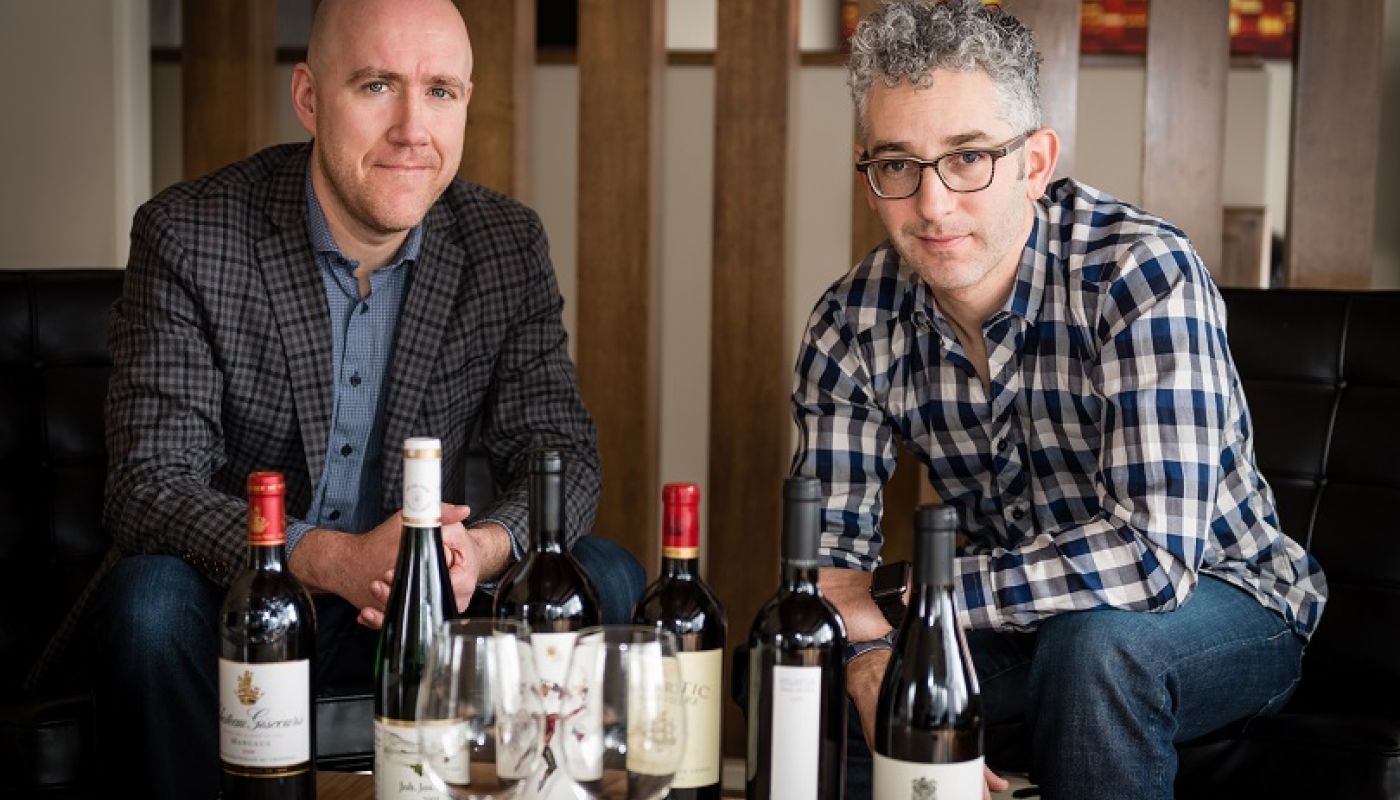
Enter David Gluzman and Matthew Protti (pictured above, right and left respectively). They’re wine lovers. And problem solvers. And entrepreneurs. Gluzman was a competitive cyclist who got the wine bug cycling around Europe. He came home to Canada and realised that many people of his generation were intimidated by wine, so together with Protti he came up with WineCollective in 2009 – an unsnobbish, accessible wine club which introduces new wines, finds great wines, promises quality, and delivers a monthly box to suit budget and palate. It has apparently become the largest wine club in Canada, growing at a rate of 50% a year.
But they ran into another problem. Protti was using spreadsheets to manage the wine club. They were becoming time-consuming, unwieldy and unmanageable. So they developed a platform for online wine sales – such a good platform that they commoditised it and BlackSquare is now an end-to-end, side-to-side e-commerce solution for wine and beer producers and the drinks industry, delivering everything from front-end website design and social media marketing to backend financial and shipping software. It’s being used by wineries as far afield as Australia (ask Henschke).
Getting restless, the next problem they decided to solve was Canada. Nobody knew how many wineries there were, how many hectares under vine, or how many labels were being produced. So they built Wine411, Canada’s first national wine directory. And they populated that database with every single winery in Canada. For the first time, reliable statistics are now available on Canadian wine.
But their vision is much bigger: to create a global database which connects producers with retailers, importers, government bodies, trade bodies and consumers. A database which anyone can access, and a database which will ensure that information is entered once, correctly, by the wine producers themselves (who will own their own information), ensuring accuracy, integrity and transparency. And so they formed Global Wine Database and began to map winery and wine data on to a database which can be accessed and used in myriad different ways by different organisations.
In practice, this has far-reaching implications. Wine producers will be able to enter as much (or as little) information about their wineries, their production and their wines as they wish, and from that point they will be able to use and send that data (or a customised subset of that data) in various formats to whoever requires it, be it Customs and Excise, an AOC approval committee, a potential importer, a shipping company, a wine competition, a merchant, or even their customers if they sell direct. Once data is entered into GWDB, their website will be automatically updated with new vintage information, new photographs, their e-commerce shop, their social media feeds. Downloadable pdfs can be automatically generated for each new wine. If you’ve integrated with third-party apps, the idea is that thy will be automatically updated with any new information and connected retailers will directly receive all the point-of-sale information they need. Export data will be available at the click of a button. Anyone using wine systems based on Blockchain technology will be able to interface with the data. Gone will be the need for dozens of people to populate dozens of databases, forms and documents, spending endless hours copying, pasting, printing, faxing, emailing, posting, and chasing queries. They sum it up thus: Upload data once. Drive the facts forward.
The first time I heard about it, my first thought was a flat: impossible. My second thought was: who’s paying for it?
I can tell you that I may already have to retract that first thought. GWDB already has 13,000 wineries (worldwide) in its database. They’ve captured data for 2,714 wineries and 10,872 wines in North America, including all of Canada, most of California, and a number in Washington and Oregon. They also have the basic information for a significant number of Australian wineries.
They’re working directly with Google My Business (locations, hours of operations and reviews), which will feed two ways; they’re talking to several wine technology platforms about ways of collaborating with them; and they’re already working with Liv-Ex. They’re also in early talks with GS1 about barcodes.
As for who’s paying, the initial investment has come from BlackSquare. But they have now introduced a three-tier membership structure for wineries and other organisations wanting to get involved. Importantly, for all wine producers, entering their data into GWDB is free, and always will be. It puts the producer in control of keeping his/her data up-to-date and available for the industry. Introductory pricing for Winery Pro is $19 (€15.50/£14) a month and offers digital asset management with API access and multiple-user access. Winery Enterprise is POA with more extensive, bespoke digital asset management. Developers, academics, media and trade are invited to put themselves forward for the waiting list of people who want to have a play.
Steven Levitt, American economist, said, 'Data, I think, is one of the most powerful mechanisms for telling stories'. As consumers, this could herald a new age of information about the wines that we drink, opening up communication channels and opportunities for knowledge in unprecedented ways. For those in the trade, it could represent a revolution in reducing costs, increasing efficiency and connecting to their customers. It all depends on who buys into the future.