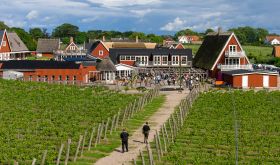
Germany is very good at Christmas. It was with great pleasure therefore that I spent a couple of nights last week at the exceptionally well-run Hotel Kronen Schlösschen in the Rheingau, most of the time bent over a wine glass. This gastronomically-minded establishment presumably always has a view of the fast-flowing Rhine on its doorstep and picture postcard views of the village of Eltville behind with its half-timbered medieval dwellings, fine feathers laboriously painted on the walls between the timbers, tiny dormer windows apparently pinched out of the steep grey slate roofs with not a rightangle in sight. But at this time of year woodsmoke curls out of the chimneys next to the satellite dishes, every public room of the hotel has its own Christmas tree, and there are candles and ribbons (but no tinny carols) everywhere.
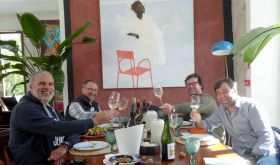
We were gathered together to look at, as the wine trade euphemism goes, 35 of Egon Müller’s fabled wines from the Scharzhofberg vineyard, Germany’s most expensive and defining wine (see detailed tasting notes), and 44 vintages back to 1916 of Domaine de Chevalier, a defining red Graves, on which I will report separately.
Although Germany is now producing a wider range of wines than ever in living memory, including serious ripostes to both red and white burgundy, there is one style of wine that nowhere else in the world can produce and that is featherlight yet ethereally refreshing and magically long-lasting fruity Riesling with well under 10 per cent alcohol, lots of acidity and extract and quite a bit of residual grape sugar, disguised by the acidity both when it is very young and very old.
It is this sort of wine in which Egon Müller specialises – having experimented with and then rejected the current vogue for dry German Rieslings – and has maintained such consistently high, uncompromising standards that the estate’s rarest, sweetest wine, Scharzhofberger Trockenbeerenauslese, or TBA, can fetch 4,000 euros a bottle in the only commercial sphere in which it is offered, the annual wine auction in Trier. Even Egon Müller’s Scharzhofberger Spätlese, made from grapes that ripened normally rather than being concentrated by the capricious and rare botrytis (noble rot) fungus, costs well over £30 or $50 a bottle – and the 2005s will be even more expensive apparently.
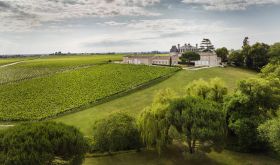
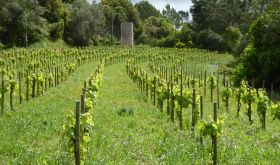
The current Egon Müller, born in famously sumptuous vintage year of 1959, is the fourth Egon Müller in charge of this estate of just over eight hectares (20 acres) of this south-facing slope in the twisting Saar tributary of the Mosel just downstream of Luxembourg. His son and his dog are also called Egon. “When my wife calls Egon, nothing whatever happens,” he reports contentedly. The name of Egon was also carefully incorporated into the names of his two younger brothers just in case the wine bug did not bite but they are now both bankers “who earn far more than me”, says Egon with another wide, slightly mysterious smile. (He later reported that he didn’t know exactly how many bottles of 1959 TBA were in his cellar, just roughly how big the stack was, so he has other compensations.)
For someone whose wines have such a high profile, he is remarkably quiet yet gives the impression of immense empirical knowledge. The French wine writer Michel Bettane asked him how he manages to have so much botrytis in Scharzhofberg. Egon smiled and added, sphinx-like, “How can we avoid it? If you do enough spraying, you won’t get any at all…. It’s very easy really.”
Inscrutable would be quite a good word for him and it came as little surprise somehow to learn that some of his early vineyard experience was gleaned in Yamanashi prefecture in Japan which even today is one of Müller’s most important destinations. Most of the rest of the wine goes to the US (Frederick Wildman) and the UK (now Top Selection). This is an insider’s wine, very much not for the mass German market.
Egon IV took over from his father, who had come back from the war in 1945 to restore the neglected vines, in 1991 and last week began by showing us a dozen of his famous Auslesen, supposedly the quintessential Saar wine, including many from this father’. You can technically make a Saar Auslese from grapes that reach a ripeness level of 88 Oechsle. Müller’s are often well over 100. Our examples were six pairs from similar vintages: 2004 and 1975 with their combination of botrytis and high acidity for a long life; the unusually potent 2003 and 1959 to demonstrate to us that the more recent drought vintage will probably also last magnificently; classic Saar vintages 1999 and 1989; the exceptionally ripe and early 1949, his father’s favourite vintage that he always wished he could have another shot at, and the 1976 which Egon IV is more and more convinced is superior to the fresher 1975 (for what it’s worth, in this case I agree); his favourite high-acid, low botrytis 1997 with 1990; and 1983 and 1971, arguably the best wines in their respective decades.
The wines were extremely varied but all showed that wines with some sweetness can also be unequivocally great and in this case enormously refreshing. Egon IV admitted that his less ripe and therefore drier Kabinett and Spätlese wines were better for drinking with food – and that even they demanded time. “Often we have problems showing our wines very young because the acidity is so much higher than on other wines shown alongside,” but he claims there is no problem drinking them with food when they are older. “Then the acidity acts as a buffer and the wine goes with foods you wouldn’t expect it to go with”. Certainly we had no trouble washing down a crab tartare and wasabi cream with his 1990 Spätlese at dinner that night, even if that rarity, a 1976 Kabinett still seemed a bit austere with a lobster salad the following evening. Don’t worry too much on my account though; the 1988 Wiltinger Braune Kupp Spätlese from La Gallais, in which the Müllers have a half share, was perfect with the lobster.
Auslesen, made from grapes somewhere between Kabinett and Spätlese ripeness on the one hand and TBA on the other, are made for places other than the dining room according to Egon IV. “My parents’ dinners would finish at 10 and then they’d start the serious drinking. It would have been considered very bad manners to stay at the table after dinner.”
But on the second and final evening we were treated to something even more exceptional. A bottle (not even a half) of the 2003 TBA had been brought along to show us just what this 4,000-euro nectar tasted like (the most extraordinarily revitalising lime syrup with headily floral notes which lasted for minute after minute in the mouth). Since hardly 15 litres of it are coaxed from each 700 kg basket of grapes, carefully selected from those that are considered worthy ‘only’ of Auslese status, the price paid for this wine by German, American, Russian and Swiss collectors is perhaps not so surprising. What was surprising was Egon’s admission of how little he pays his pickers. He admits that he will probably have to consider an increase – especially in the light of new regulations in Poland which has been the prime source of vineyard labour in Germany for years now. (He also said that in unfavourable years such as 2001, the estate actually loses money.)
For purely economic reasons of course, we carefully poured the remains of our TBA back into the bottle so that we could enjoy them after dinner that night. But by 10.30 I couldn’t help noticing that there was no sign of it, even after we had ploughed through our 1976 Scharzhofberger Eiswein (made, with decreasing frequency thanks to global warming, from frozen grapes and not as revered as TBA). How to convey this to the organiser of our tastings, Jan Paulson of Rare Wine in Waldkirchen, Bavaria? Fortunately I was seated next to Egon IV who, despite his reticence, was clearly thinking exactly the same thing as I was. So, I am glad to report, that these tastings in a fairytale setting in Germany ended with full-on seasonal bounty on the palate.
See also detailed tasting notes on 23 of these amazing Scharzhofbergers and lots of rough background notes on them and their maker.
Some superlatives among superwines
All the wines were stunning, but these were for me the absolute revelations (although only the 1949 is at its peak):
Scharzhofberger Riesling 2003 TBA
Scharzhofberger Riesling Auslese 2004
Scharzhofberger Riesling Auslese 1983
Scharzhofberger Riesling Auslese 1976
Scharzhofberger Riesling Auslese 1949